

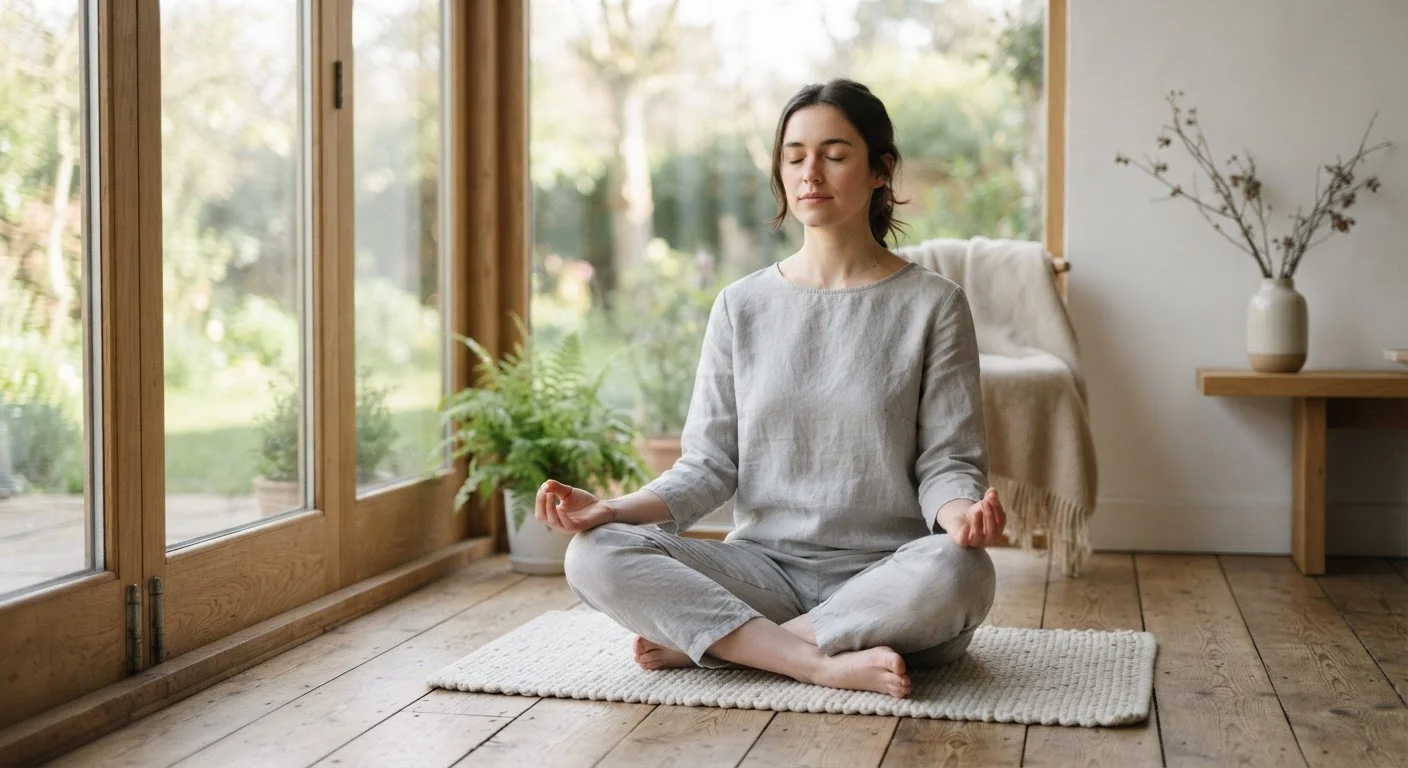
Option A
Mindfulness
An awareness you can carry into every moment of the day.
Best for: People who want a mental quality they can practice continuously during daily life, without setting aside dedicated time.
Option B
Meditation
A structured practice with dedicated time and technique.
Best for: People seeking a formal, repeatable exercise to train attention and build mental resilience over time.
What Each Term Actually Means
The words mindfulness and meditation appear together so often that many people treat them as interchangeable. They are genuinely related - but the distinction between them matters if you want to use either one effectively.
Mindfulness is a mental quality: the capacity to pay deliberate, non-judgmental attention to the present moment - to thoughts, sensations, emotions, and surroundings as they actually are, rather than on autopilot. It is not a technique you perform; it is a way of relating to experience that can, in principle, be present during any activity.
Meditation, by contrast, refers to a category of formal mental exercises - seated breath awareness, body-scan practices, loving-kindness exercises, visualization, and more. Meditation is something you do at a set time; mindfulness is something you are, or strive to be, throughout the day.
A useful analogy: mindfulness is to meditation what physical fitness is to going to the gym. Exercise at the gym builds fitness, but fitness itself shows up everywhere - carrying groceries, climbing stairs, recovering from illness. Similarly, meditation is one reliable way to build mindfulness, but mindfulness can then extend across your entire waking life. For more on how seemingly interchangeable wellness terms carry distinct meanings, see our article on flexibility, mobility, and stretching.
How They Relate - and Where They Diverge
Most formal meditation traditions explicitly aim to cultivate mindfulness, which is why the two concepts travel together so closely. Mindfulness-Based Stress Reduction (MBSR), developed by Jon Kabat-Zinn at the University of Massachusetts Medical School, is perhaps the most studied example: it uses structured meditation sessions as the vehicle for training mindful awareness.
| Criterion | Mindfulness | Meditation |
|---|---|---|
| What it is | A quality of awareness | A formal practice or exercise |
| When it occurs | Any moment of daily life | Dedicated, scheduled sessions |
| Requires set-aside time? | No | Yes |
| Requires technique or instruction? | Not necessarily | Typically yes |
| Primary goal | Present-moment, non-judgmental attention | Training attention and mental resilience |
| Relationship to the other | Can be cultivated through meditation | Often used to build mindfulness |
Yet the relationship is not one-directional. Research published in psychology and neuroscience journals suggests that regular meditation practice tends to increase trait mindfulness - a person's baseline capacity for present-moment awareness - even outside formal sessions. In other words, sitting down to meditate for twenty minutes may make you more naturally attentive during the other twenty-three hours and forty minutes of your day.
Conversely, it is entirely possible to practice mindfulness informally without ever sitting in formal meditation. Deliberately savoring a meal, fully attending to a conversation, or noticing the physical sensations of a walk are all expressions of mindfulness. This is worth knowing for anyone who finds formal meditation difficult to sustain.
Mindfulness Is Not About Clearing Your Mind
A common misconception is that mindfulness or meditation requires stopping all thoughts. In practice, both involve noticing when the mind has wandered and gently returning attention to the present - thoughts are expected. The skill lies in how you relate to them, not in eliminating them. This reframe often makes the practices feel far more achievable for beginners.
Choosing an Approach That Works for You
Neither mindfulness nor meditation is universally superior - the more useful question is which approach fits your current life, goals, and temperament.
8 weeks
Typical MBSR program length
Mindfulness-Based Stress Reduction programs studied in clinical research are typically delivered over eight weeks of structured sessions.
~14%
U.S. adults who meditate
According to the National Center for Health Statistics' 2017 National Health Interview Survey, approximately 14% of U.S. adults reported meditating in the past year.
If you are new to mental wellness practices, informal mindfulness may be the most accessible starting point. The only requirement is deliberate attention, and you can begin immediately. For a broader foundation on supporting your mental health day-to-day, our guide to mental well-being from the ground up covers core concepts alongside practical habits.
If you prefer structured routines and measurable progress, formal meditation - even five to ten minutes daily - provides a consistent training environment. Many people find that starting with guided audio sessions lowers the barrier considerably.
It is also worth recognizing that these tools, while valuable, are general wellness supports rather than treatments. If you are dealing with significant anxiety, depression, trauma, or other mental health concerns, please consult a qualified healthcare professional. You may also find it useful to explore how mindfulness and meditation compare to other mental wellness approaches in our piece on talking therapy vs. self-help strategies.
This article is for general informational and educational purposes only and is not a substitute for professional medical or mental health advice, diagnosis, or treatment. Always consult a qualified healthcare provider with any questions about your mental or physical health.
The content on this site is for informational purposes only and is not a substitute for professional advice. Always consult a qualified professional for guidance specific to your situation.