

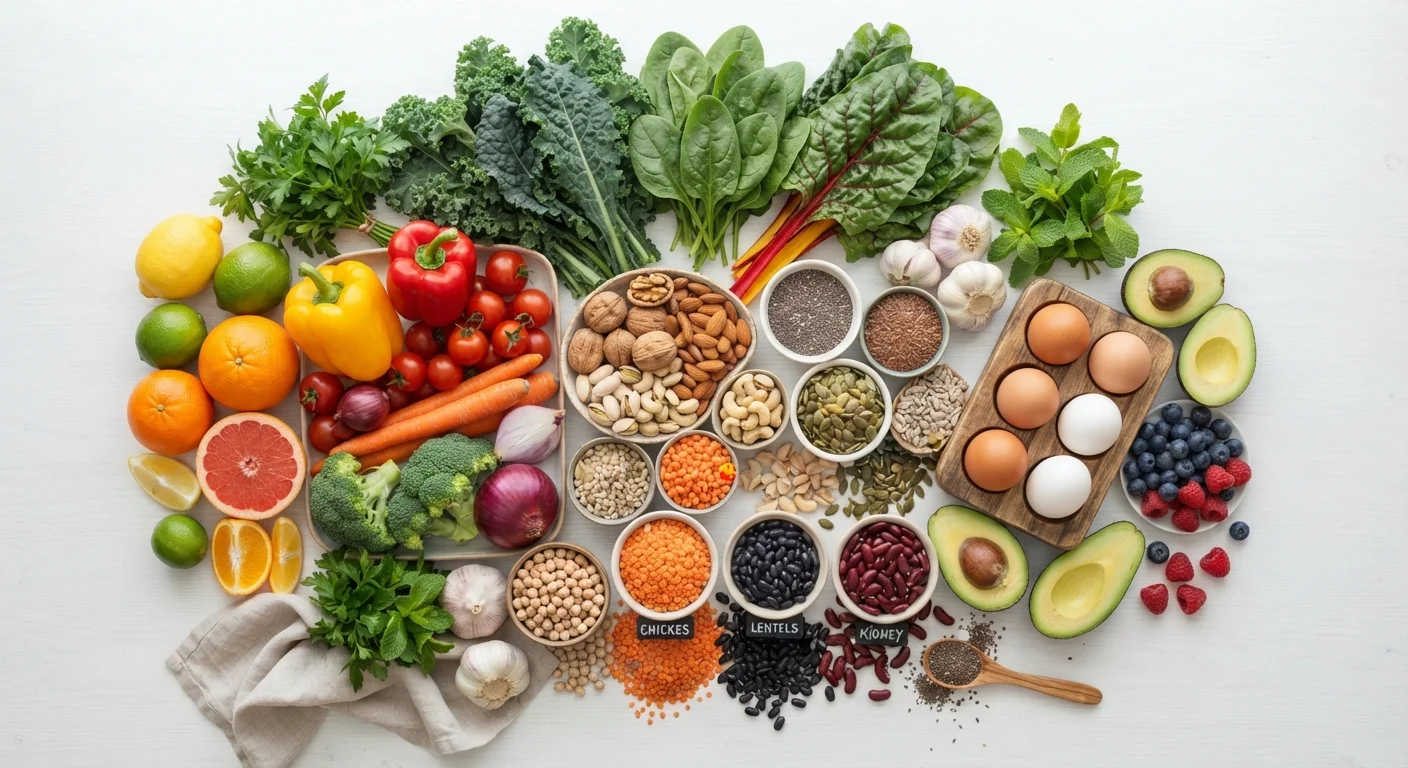
What Are Micronutrients and Why Do They Matter?
Unlike carbohydrates, proteins, and fats, which your body uses for energy and structure, micronutrients are vitamins and minerals needed in much smaller amounts-but they are no less essential. Your body cannot synthesize most of them in adequate quantities on its own, which means diet is the primary delivery system.
Micronutrients serve as co-factors in thousands of biochemical reactions: they help convert food into usable energy, regulate immune function, support bone density, enable nerve signaling, and protect cells from oxidative damage. When intake falls consistently short, these foundational processes are disrupted-often quietly and gradually before symptoms become obvious.
If you're just beginning to explore how food affects health, our beginner's guide to nutrition provides useful context for how micronutrients fit into the broader picture.
| Total essential vitamins | 13 (National Institutes of Health (NIH)) |
| Essential minerals recognized | 16+ (Dietary Reference Intakes, National Academies) |
| Fat-soluble vitamins | A, D, E, K |
| Most common global deficiency | Iron (World Health Organization) |
| Vitamin synthesized by sun exposure | Vitamin D |
| Vitamin critical in pregnancy | Folate (B9) (CDC, March of Dimes) |
Key Vitamins: Fat-Soluble vs. Water-Soluble
Vitamins are divided into two broad categories based on how the body stores and transports them. This distinction matters for both dietary planning and understanding deficiency risk.
Fat-Soluble Vitamins (A, D, E, K)
These are stored in fatty tissue and the liver, meaning the body can draw on reserves over time-but also meaning overconsumption from high-dose supplements can accumulate to potentially harmful levels. Vitamin D is notable because the body can produce it through sun exposure, but many people in northern latitudes or with limited sun access still fall short. Vitamin A supports vision, immune function, and cell growth; it's found in liver, dairy, and as provitamin A (beta-carotene) in orange and leafy vegetables.
Water-Soluble Vitamins (B-complex and C)
These are not stored in meaningful amounts and must be replenished regularly through food. The B vitamins-including B1 (thiamine), B2 (riboflavin), B3 (niacin), B6, B9 (folate), and B12-collectively support energy metabolism and neurological health. Folate is especially critical during pregnancy for fetal neural tube development, and B12 is found almost exclusively in animal-derived foods, making it a key consideration for people following plant-based diets. Vitamin C supports collagen synthesis, iron absorption, and antioxidant defense.
Micronutrients
Vitamins and minerals required by the body in small but essential amounts to support biochemical processes, growth, and overall health. Unlike macronutrients, they provide no direct energy (calories).
Fat-Soluble Vitamins
Vitamins A, D, E, and K, which are absorbed alongside dietary fat and stored in the body's fatty tissue and liver. Because they accumulate, excessive intake-typically from supplements-can reach harmful levels.
Water-Soluble Vitamins
Vitamins C and the B-complex group, which dissolve in water and are not stored in significant quantities. They must be replenished regularly through food or supplementation.
Bioavailability
The proportion of a nutrient that the body can actually absorb and use from a given food or supplement. Bioavailability varies by nutrient form, food pairing, gut health, and individual factors.
Trace Minerals
Minerals the body needs in very small amounts-such as iron, zinc, iodine, and selenium-but that are nonetheless critical for specific physiological functions including immune response and thyroid activity.
Provitamin A (Beta-Carotene)
A plant pigment found in orange and dark green vegetables that the body can convert into active vitamin A. It is a form of dietary vitamin A available to people who do not consume animal sources.
Essential Minerals: Macro and Trace
Minerals are inorganic elements sourced entirely from diet and environment. They fall into two groups: macrominerals, needed in larger amounts, and trace minerals, required in only tiny quantities-though both groups are indispensable.
Macrominerals
- Calcium: Foundational for bone and tooth structure, muscle contraction, and nerve transmission. Found in dairy, fortified plant milks, tofu, and dark leafy greens.
- Magnesium: Involved in over 300 enzymatic reactions, including muscle and nerve function, blood sugar regulation, and protein synthesis. Found in nuts, seeds, legumes, and whole grains.
- Potassium: Supports fluid balance, heart rhythm, and muscle contractions. Bananas, potatoes, beans, and avocados are reliable sources.
- Phosphorus: Works closely with calcium in bone formation and is also key in energy metabolism. Widely available in protein-rich foods.
Trace Minerals
- Iron: Essential for oxygen transport in red blood cells. Heme iron from meat is more bioavailable than non-heme iron from plants; pairing plant sources with vitamin C improves absorption.
- Zinc: Supports immune function, wound healing, and DNA synthesis. Found in oysters, beef, pumpkin seeds, and legumes.
- Iodine: Required for thyroid hormone production, which regulates metabolism. Iodized salt and seafood are primary dietary sources in the US.
- Selenium: Functions as an antioxidant and supports thyroid health. Brazil nuts are a notably concentrated source.
~42%
US adults with vitamin D insufficiency
According to analysis published in Nutrition Research using NHANES data, roughly 42% of U.S. adults have insufficient vitamin D levels.
2 billion
People affected by iron deficiency globally
The World Health Organization estimates iron deficiency is the most widespread nutritional disorder worldwide, affecting approximately 2 billion people.
~1 in 6
US adults with low vitamin B12 status
Research published in the American Journal of Clinical Nutrition suggests marginal B12 deficiency is more prevalent than commonly recognized, particularly among older adults and those avoiding animal products.
Deficiencies, Absorption, and Practical Takeaways
Micronutrient deficiencies are more common than most people expect-and often subclinical, meaning they affect how you feel and function before a clinical test would flag them. Iron deficiency is one of the most prevalent globally, followed closely by deficiencies in vitamin D, iodine, and zinc. Certain populations carry greater risk: older adults (B12, D, calcium), people who are pregnant or breastfeeding (folate, iron), people following plant-based diets (B12, iron, zinc, iodine), and those with limited sun exposure (vitamin D).
Absorption efficiency is also not uniform. Nutrients compete and cooperate: calcium can inhibit iron absorption when consumed together, while vitamin C enhances it. Fat-soluble vitamins require dietary fat for uptake. Gut health influences how well nutrients are extracted from food-chronic gastrointestinal conditions can significantly impair absorption. Hydration also plays a role, as water is involved in transporting nutrients throughout the body.
The most evidence-supported approach is a varied, whole-food diet rich in vegetables, fruits, legumes, whole grains, nuts, and-if appropriate-lean animal proteins. Supplements can address documented gaps but are not a substitute for dietary diversity, and higher doses are not always better. If you suspect a deficiency or have specific health concerns, a qualified healthcare provider can order appropriate tests and guide any supplementation decisions.
This article is for general informational and educational purposes only and is not a substitute for professional medical or nutritional advice. Always consult a qualified healthcare provider for guidance specific to your health situation.
The content on this site is for informational purposes only and is not a substitute for professional advice. Always consult a qualified professional for guidance specific to your situation.