

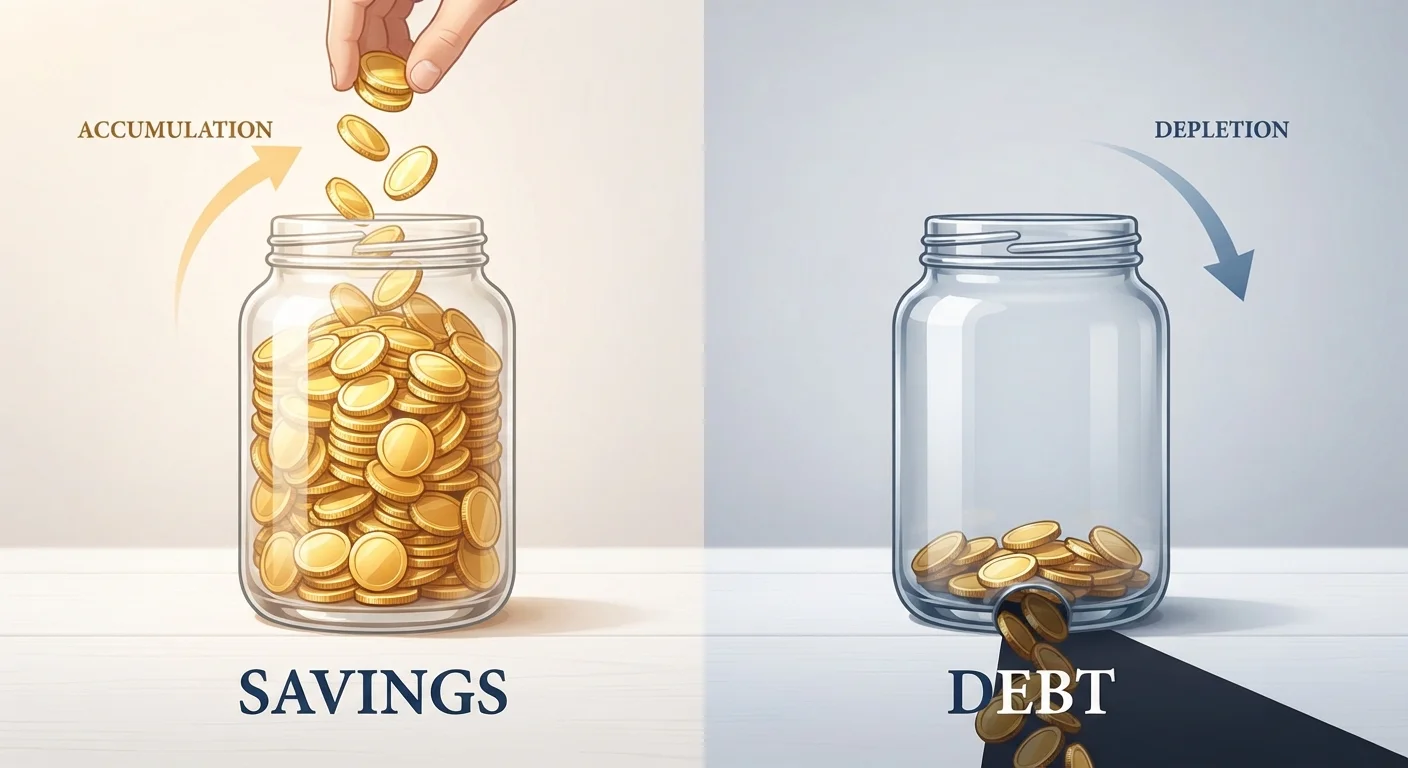
How Compound Interest Actually Works
At its core, compound interest is interest calculated on a growing base. Start with $1,000 earning 5% annually. After year one, you have $1,050. In year two, the 5% applies to $1,050 - not the original $1,000 - adding $52.50 instead of $50. That extra $2.50 seems trivial, but the same logic applied over decades produces dramatic differences.
Compare this with simple interest, which always calculates returns on the original principal only. At 5% simple interest, $1,000 earns exactly $50 every year regardless of how long it compounds. Over 30 years, simple interest produces $2,500 in gains. Compound interest at the same rate produces roughly $3,322 - more than 30% additional growth from the same initial deposit and rate.
The formula behind this is: A = P(1 + r/n)^(nt), where P is principal, r is the annual rate, n is the number of compounding periods per year, and t is time in years. You don't need to memorize this - but understanding that n and t both amplify outcomes explains why compounding frequency and time horizon matter so much.
$3,322
Value of $1,000 compounded at 5% for 30 years
Compared to $2,500 under simple interest at the same rate - illustrating how compounding generates additional growth over time.
22%+
Average credit card APR in the U.S.
Federal Reserve data has shown average credit card interest rates exceeding 20% APR in recent years, making high-rate revolving debt particularly costly under daily compounding.
10 years
Head start that can produce large wealth gaps
Starting to save a decade earlier - even with identical monthly contributions and returns - can result in dramatically larger final balances due to extended compounding time.
The Saver's Advantage: Why Time Is Everything
For savers and investors, compound interest rewards patience. The longer money stays invested or on deposit, the more the accelerating effect takes hold. This is why financial educators consistently emphasize starting early, even with modest contributions.
Consider two people: one begins saving $200 per month at age 25; another waits until 35. Assuming the same annual return, the earlier saver doesn't just end up slightly ahead - the gap can be hundreds of thousands of dollars by retirement age, purely because of the additional decade of compounding. The later saver would need to contribute significantly more each month just to close that gap.
Automate Savings to Let Compounding Run
Setting up automatic transfers to a savings account - even small ones - ensures your balance grows consistently without requiring ongoing decisions. Because compounding rewards time in the market over timing the market, regular deposits started early are more powerful than larger deposits made later. Automation removes the temptation to delay.
To make the most of compounding as a saver, look for accounts that offer competitive annual percentage yields (APY) and frequent compounding. A high-yield savings account can accelerate growth compared to a basic account, since the higher rate compounds on a larger and larger base over time.
For a deeper look at how this mechanic shapes long-term financial outcomes, see our related guide on compound interest and long-term wealth.
The Borrower's Burden: When Compounding Works Against You
The exact same mechanic that builds savings can erode financial stability when it applies to debt. Most consumer debt - credit cards in particular - compounds at high annual percentage rates, and often does so daily. This means every day you carry a balance, the interest owed is recalculated on a slightly higher number than the day before.
If you carry a $3,000 credit card balance at 22% APR and make only minimum payments, you could spend years paying primarily interest while the principal barely moves. The compounding ensures that any pause or delay in payments adds to the base that future interest is calculated on.
Mortgages, student loans, and auto loans also use compound interest, though their rates are generally lower and the debt is structured to pay off within a fixed term. The danger is most acute with high-rate, revolving debt where minimum payments don't keep pace with the compounding rate.
If you're navigating debt while also trying to build savings, understanding this dynamic is essential. The trade-offs between paying down debt and saving are worth examining carefully, especially when interest rates differ significantly across your accounts.
This article is for general informational and educational purposes only and does not constitute personalized financial, investment, or tax advice. Consult a qualified financial professional regarding your individual circumstances.
Frequently Asked Questions
Simple interest is calculated only on the original principal. Compound interest is calculated on the principal plus any interest already earned or owed. Over time, this difference becomes substantial - compounding grows (or costs) significantly more than simple interest at the same rate.
The more frequently interest compounds, the faster your balance grows. Daily compounding generates slightly more than monthly, which generates more than annual compounding at the same stated rate. For long-term savings, choosing an account with daily compounding can make a noticeable difference.
Yes. Credit card balances typically compound daily at high annual rates. If you carry a balance and make only minimum payments, the interest added each day increases the principal on which the next day's interest is calculated, causing debt to escalate quickly.
The effects of compounding become most visible over longer time horizons - typically five years or more. In the early years growth can feel slow, but the acceleration increases as the earned interest itself begins earning returns.
No. Different account types offer different interest rates and compounding schedules. A <a href="/money-finance/saving-and-debt/high-yield-savings-accounts-explained">high-yield savings account</a> typically offers a higher annual percentage yield than a standard savings account, which means more compounding benefit over time.
The content on this site is for informational purposes only and is not a substitute for professional advice. Always consult a qualified professional for guidance specific to your situation.