

Our Verdict
Automating your savings is one of the most consistently effective behavioral tools in personal finance - it sidesteps willpower and makes progress the default. However, it requires upfront planning to avoid cash flow mismatches and should not replace periodic budget reviews. Used deliberately, automation supports long-term saving goals; used carelessly, it can create friction with everyday spending.
Best for people with stable, predictable income who have already identified a realistic savings amount within their monthly budget.
What Automated Savings Actually Means
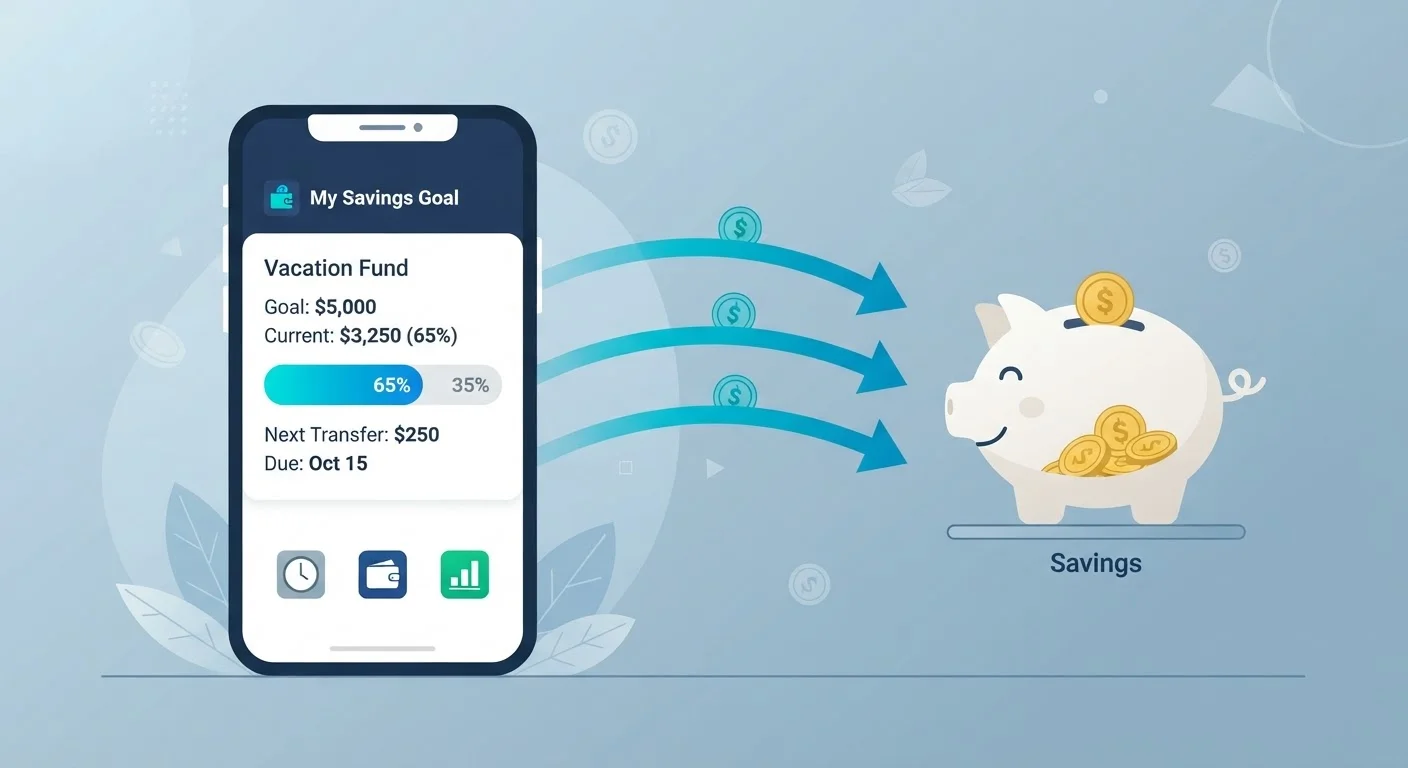
Automated savings refers to scheduling a recurring transfer from a checking account to a savings or investment account - typically set to coincide with a paycheck deposit. The transfer happens without manual action each cycle, effectively making saving a non-negotiable line item rather than an afterthought.
Most banks, credit unions, and employer payroll systems support some form of automatic transfer or direct deposit split. The mechanics vary - some people automate to a high-yield savings account, others to a workplace retirement plan, and some to both simultaneously.
Understanding what you're automating, and why, is the foundation. See budgeting methods that support long-term saving for frameworks that help you identify what amount makes sense before you set anything on autopilot.
The Case For Automation
The strongest argument for automating savings is behavioral. Research in behavioral economics consistently shows that people save more when saving requires no active decision. By removing choice from the equation, automation eliminates the friction that causes most savings attempts to stall.
Removes reliance on willpower or memory
Behavioral research consistently shows that opt-out defaults outperform opt-in choices for saving behavior. When a transfer is pre-scheduled, you don't have to decide each month - the money moves before you can redirect it elsewhere.
Builds consistent saving regardless of motivation
Automated saving occurs even in months when finances feel tight or stressful. This consistency is especially important in building an emergency fund, where reliability matters more than amount.
Enables compounding over a longer time horizon
Regular small contributions over many years can outperform sporadic larger ones due to compound growth. Automation makes early, sustained contributions far more likely.
Reduces decision fatigue around saving
Every financial decision requires mental energy. Eliminating monthly saving decisions frees that attention for choices that do require active thought, such as discretionary spending or investment allocation.
Easy to scale up incrementally
Automation can be set to a small amount initially and increased over time as income grows or expenses decrease, allowing savings rates to rise without requiring a dramatic lifestyle change upfront.
~55%
Americans saving less than one month of expenses
Federal Reserve surveys have consistently found that a significant share of U.S. adults have limited liquid savings, highlighting the gap that automated habits are designed to address.
3x
Higher savings rate among automatic savers
Behavioral economics studies, including research cited by the National Bureau of Economic Research, suggest that default enrollment significantly increases participation and contribution rates.
Automation also creates consistency over time. A modest, reliable monthly contribution compounds more effectively than irregular larger deposits made when funds happen to be available. This is especially relevant for goals with long time horizons, such as retirement or an emergency fund.
For people who struggle to get started, building a savings habit from scratch outlines how automation can serve as the backbone of an early savings routine, even at small amounts.
The Risks and Limitations to Plan Around
Automation is not foolproof. Its most common failure point is a mismatch between transfer timing and account balance. If a transfer is scheduled before a paycheck clears, or in a month with unusually high expenses, the result can be an overdraft fee - effectively undoing some of the savings benefit.
Overdraft risk if timing is misaligned
If a scheduled transfer hits before a paycheck deposits, or during a month with elevated bills, the account may not have enough funds - potentially triggering overdraft fees that offset savings gains.
Can reduce active engagement with finances
When money moves automatically, some people stop reviewing their accounts closely. This disengagement can allow fee creep, unnoticed subscriptions, or gradual budget drift to accumulate unaddressed.
Not well-suited to irregular or variable income
People with fluctuating earnings - freelancers, gig workers, or commission-based employees - may find that a fixed automated transfer is difficult to sustain reliably in lower-income months.
May feel inflexible during financial emergencies
When unexpected expenses arise, an automated transfer that still executes on schedule can feel like an added constraint. While transfers can be paused, this requires proactive action that not everyone takes in time.
Initial setup requires accurate budget data
Setting an amount that's too high for your real cash flow can create monthly shortfalls; too low and the automation provides minimal benefit. The setup only works well if based on an honest budget review.
Variable Income Requires a Different Approach
If your monthly income fluctuates, a fixed automated transfer may not be appropriate as a primary savings mechanism. Instead, consider a percentage-based rule - setting aside a fixed proportion of each deposit when it arrives. This approach maintains saving discipline while adapting to income variability. Some financial institutions support rules-based automatic transfers tied to deposit amounts rather than fixed calendar dates.
A subtler risk is reduced financial awareness. When savings happen automatically, some people disengage from monitoring their overall cash flow. Over time, this can mean missing budget drift, overlooking fees, or failing to increase the savings rate as income grows.
This is where pairing automation with periodic manual review adds genuine value. Manual expense tracking offers an alternative lens that keeps spending visible - many financially organized people use both approaches together.
Setting Up Automation to Minimize the Downsides
The most common mistake is automating an amount that hasn't been vetted against a real budget. Start by identifying your actual monthly surplus - income minus fixed and variable expenses - and set the automated amount conservatively below that figure to maintain a cash buffer.
Align transfer timing with your pay deposit date. Most banks allow same-day or next-day transfer scheduling after a deposit, reducing the risk of a balance shortfall. If your income is irregular, a fixed calendar date may not be the right trigger - some people instead automate transfers manually each time a payment arrives, which is less hands-off but more reliable for variable earners.
Review and adjust your automated amount at least twice a year. Income changes, expenses shift, and a savings rate that made sense at one point may be too conservative or too aggressive later. The structural reasons savings plans break down often include failing to revisit initial assumptions as circumstances evolve.
If you're also managing debt repayment alongside saving, managing debt and saving simultaneously examines how to allocate limited cash flow between the two priorities without defaulting to one entirely.
This article is for general informational and educational purposes only and does not constitute personalized financial advice. Consult a qualified financial professional regarding decisions specific to your circumstances.
The content on this site is for informational purposes only and is not a substitute for professional advice. Always consult a qualified professional for guidance specific to your situation.