

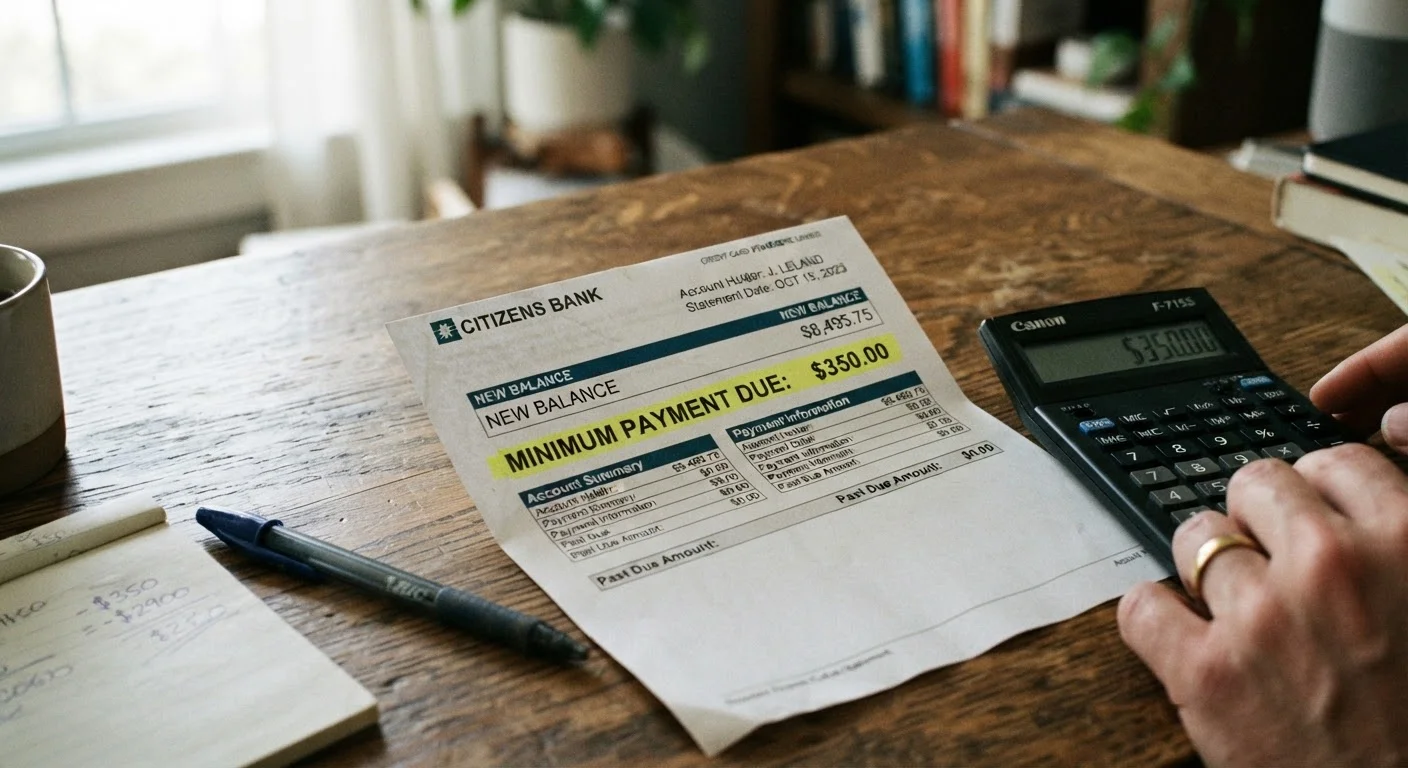
How Minimum Payments Are Calculated - and Why They Barely Dent Your Balance
Credit card issuers typically set minimum payments as either a flat dollar amount (often $25-$35) or a small percentage of your outstanding balance - usually 1% to 3% - whichever is greater. Some issuers calculate it as a percentage of the balance plus the full interest charge for that month. Either way, the result is a number designed to keep your account in good standing, not to help you get out of debt quickly.
Here's the problem: at a 20% annual percentage rate (APR), a large portion of every minimum payment goes straight to interest. On a $3,000 balance, for example, roughly $50 of a $60 minimum payment might cover interest alone - leaving only $10 applied to the actual debt. As the balance slowly shrinks, the minimum payment drops too, creating a cycle that stretches repayment across many years.
This is not a design flaw - it reflects how compound interest works. Interest is calculated on the remaining balance each billing cycle. When you pay little, the balance stays high, and interest continues to accumulate on that larger base. Issuers are required by the CARD Act of 2009 to disclose on your statement how long it would take to pay off your balance making only minimum payments - and that figure is often sobering.
Mistakes That Keep Cardholders Trapped in Minimum-Payment Cycles
Several common missteps cause people to stay stuck paying only the minimum, often without realizing the long-term cost. Understanding these patterns is the first step to breaking them.
Treating the minimum payment as the "correct" or recommended amount to pay each month.
Why it happens: Statements display the minimum payment prominently, and paying it keeps the account in good standing - so it can feel like the intended behavior.
Ignoring the payoff timeline and total interest disclosed on your statement.
Why it happens: Many cardholders skim their statements and focus only on the minimum due and the due date, overlooking the mandated payoff projection.
Continuing to make new purchases on a card you are actively trying to pay down.
Why it happens: People often treat a credit card as a spending tool and a debt account simultaneously, not realizing that new charges reset or undermine repayment progress.
Believing that carrying a balance improves your credit score.
Why it happens: A persistent myth suggests that issuers reward customers who carry balances by reporting better scores - perhaps because it generates revenue for them.
Applying extra funds randomly across multiple cards without a clear payoff strategy.
Why it happens: Without a framework, people spread extra money across all cards equally or pay whichever bill arrives first, reducing the efficiency of every dollar spent on debt.
20%+
Average credit card APR in recent years
Federal Reserve data has shown average credit card interest rates exceeding 20% annually, making high balances extremely costly to carry.
10+ years
Estimated payoff time on minimum payments alone
On a $3,000 balance at around 20% APR, paying only the minimum can extend repayment beyond a decade, according to standard amortization calculations.
For a deeper look at how widespread misconceptions can compound these mistakes, see common myths about debt that keep people stuck.
Practical Strategies to Pay Down Credit Card Debt Faster
Escaping the minimum-payment trap doesn't require a dramatic overhaul of your finances. A few deliberate adjustments can meaningfully reduce how much interest you pay and how long it takes to become debt-free.
Balance Transfers Require Careful Consideration
Transferring a high-interest balance to a card with a promotional 0% APR can reduce interest costs - but transfer fees, the length of the promotional period, and what rate applies afterward all matter significantly. If the balance isn't paid off before the promotional period ends, interest charges can resume at a high rate. Review all terms carefully and consult a financial professional if you are unsure whether a balance transfer is appropriate for your situation.
- Pay more than the minimum every month. Even adding $20-$50 above the minimum accelerates principal paydown and reduces total interest significantly. Use your card statement's amortization disclosure to see the difference in real numbers.
- Use the avalanche method. List all your cards by interest rate and direct extra payments to the highest-rate balance first, while paying minimums on the rest. This minimizes total interest paid over time.
- Use the snowball method. If motivation is the challenge, pay off the smallest balance first regardless of rate. Early wins can build momentum - though you may pay slightly more interest overall.
- Make biweekly payments. Paying half your monthly amount every two weeks results in one extra full payment per year, reducing your balance faster.
- Avoid adding new charges while paying down. Continuing to spend on a card you're trying to pay off works directly against your progress.
If you're juggling debt paydown alongside other financial goals, managing debt and saving at the same time offers frameworks for handling both in parallel. It's also worth revisiting what you believe about credit - some assumptions can quietly cost you money, as explored in credit myths that cost Americans money.
This article is for general informational and educational purposes only and does not constitute personalized financial, tax, or legal advice. Consult a qualified financial professional for guidance specific to your situation.
The content on this site is for informational purposes only and is not a substitute for professional advice. Always consult a qualified professional for guidance specific to your situation.