

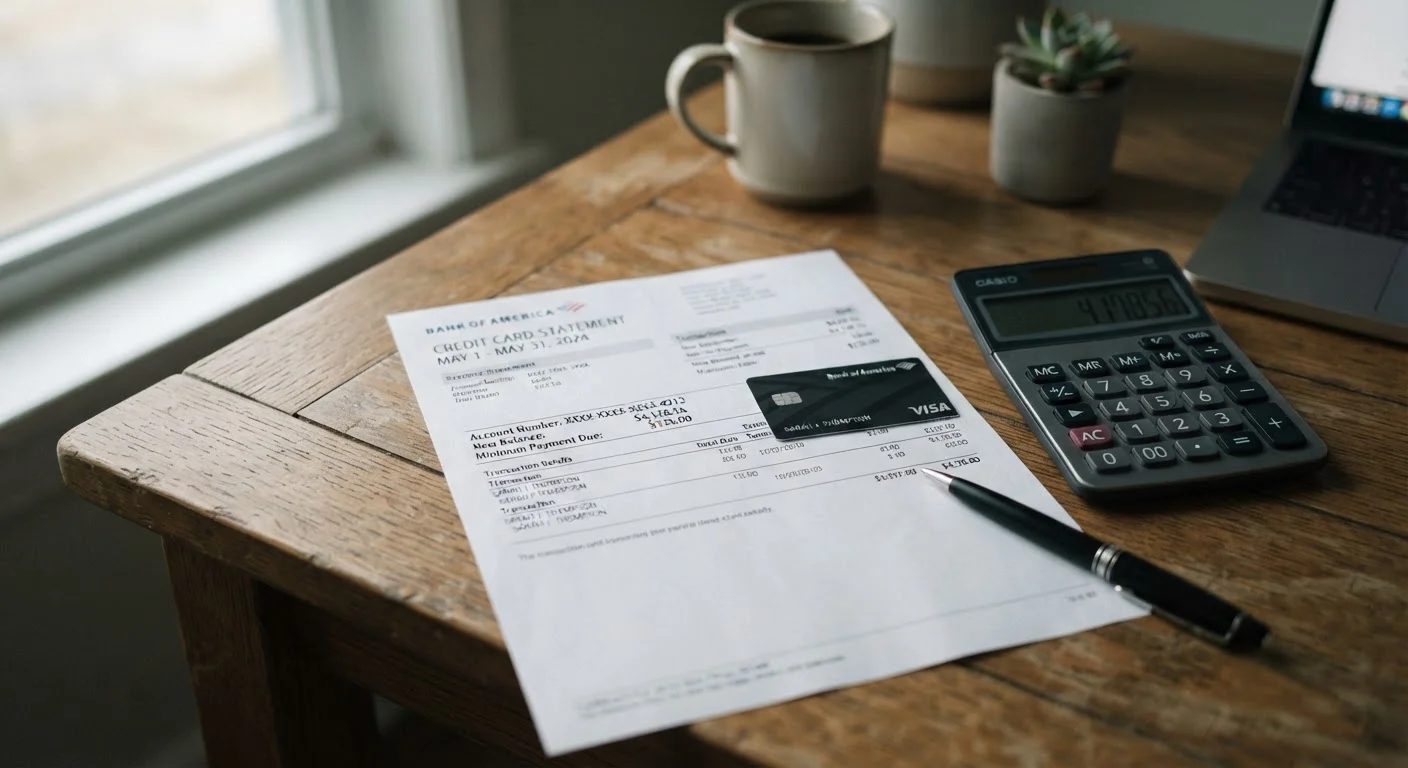
What Happens When You Pay the Minimum
When you make a credit card payment, your issuer applies it first to any fees, then to interest charges, and finally to your principal balance - the actual amount you borrowed. Because the minimum payment is designed to be just large enough to cover accrued interest plus a small slice of principal, the bulk of your balance sits untouched from month to month.
Here is a straightforward illustration: suppose you carry a $3,000 balance at a 20% annual percentage rate (APR). Your first minimum payment might be around $60. Of that, roughly $50 goes toward interest, and only $10 reduces what you actually owe. Next month, you owe $2,990 - and the cycle repeats, with interest recalculated on the new (barely lower) balance.
This is how minimum payments keep borrowers in debt for years while the issuer collects consistent interest income. It is a mathematically predictable outcome, not an accident of circumstances. As noted in habits that quietly undermine financial stability, minimum-payment reliance is one of the most common yet least visible drains on a household budget.
20%+
Average credit card APR in the U.S.
The Federal Reserve has reported average credit card interest rates consistently above 20% in recent years, making high-rate debt among the most expensive forms of consumer borrowing.
10+ years
Time to repay $3,000 on minimums alone
At a typical 20% APR, paying only the minimum on a $3,000 balance can extend repayment well beyond a decade, with total interest paid approaching or exceeding the original balance.
~1-3%
Typical minimum payment as % of balance
Most major credit card issuers set the minimum payment at roughly 1-3% of the outstanding balance or a flat dollar floor, whichever is greater, per standard cardholder agreements.
How Interest Compounds Against You
Credit card interest is typically calculated using a daily periodic rate - your APR divided by 365. Each day, that rate is applied to your current balance. By the end of the billing cycle, those daily charges are added together into your interest charge for the month. Because the principal barely decreases on minimum payments, each new billing cycle starts from a balance that is nearly as high as the last.
This is the compounding effect working against you. Unlike compound interest in a savings account - where you earn returns on your returns - compounding debt means you owe interest on what you owe. The longer the balance stays high, the more interest accumulates, and the slower your payoff progress becomes.
“The minimum payment is the most expensive way to borrow. It is structured to keep you paying interest for as long as possible, not to help you get out of debt.”
— Consumer Financial Protection Bureau, U.S. federal agency responsible for consumer financial protection and education
Federal law, through the Credit CARD Act of 2009, requires issuers to print a minimum payment warning on every statement. This warning tells you exactly how long it will take to pay off your current balance making only minimum payments, and what it will cost in total interest. If you have a statement handy, look for that box - the numbers are often striking.
Practical Strategies to Break the Cycle
Understanding the problem is step one; acting on it is step two. You do not need to double your payment overnight to see meaningful results. Consider these approaches:
- Pay a fixed dollar amount above the minimum. Even $25-$50 extra per month targets the principal more directly, shortening your repayment timeline and cutting total interest paid.
- Use the avalanche method. Direct any extra funds to the card with the highest APR first while paying minimums on others. Once that balance is cleared, roll those funds to the next-highest-rate card.
- Use the snowball method. Pay off the smallest balance first for a psychological win, then build momentum toward larger balances.
- Request a lower rate. Cardholders with a solid payment history can sometimes negotiate a lower APR directly with the issuer, reducing the share of each payment consumed by interest.
These strategies do not require a specific product or service - they require consistency and a clear picture of what you owe. For a deeper look at misconceptions that can slow your progress, see common myths about debt that keep people stuck.
Check Your Statement's Minimum Payment Warning
Every credit card statement is required by federal law to include a disclosure showing how long payoff will take - and how much it will cost - if you make only minimum payments. Use that figure as a baseline, then calculate the impact of adding even a small fixed amount. Many card issuers also offer online payoff calculators for this purpose.
This article is for general informational purposes only and does not constitute personalized financial, tax, or legal advice. Consult a qualified financial professional for guidance tailored to your specific situation.
Frequently Asked Questions
Paying at least the minimum on time keeps your account in good standing and avoids negative marks. However, carrying a high balance relative to your credit limit raises your credit utilization ratio, which can lower your score over time. Paying more than the minimum reduces that ratio.
Most issuers use either a flat dollar floor (such as $25) or a percentage of your balance (often 1-3%), whichever is higher. Some issuers add any fees or interest charges from that cycle to the base calculation. Check your cardholder agreement for the exact formula.
Even an additional $25-$50 per month above the minimum can cut years off your repayment timeline and save hundreds in interest. The more you pay above the minimum, the faster your principal balance falls, which in turn reduces future interest charges.
Under federal law, your credit card statement must include a minimum payment warning box that shows how long it will take to pay off the balance if you make only minimum payments, plus an alternative payoff timeline if you pay a fixed higher amount. Look for this box near the payment information section.
Paying only the minimum can be a short-term strategy during a genuine financial hardship to avoid late fees and default. It should not become a long-term habit, as the compounding interest cost grows substantially over time. Returning to higher payments as soon as possible limits the damage.
The content on this site is for informational purposes only and is not a substitute for professional advice. Always consult a qualified professional for guidance specific to your situation.