

Why Closing Costs Feel So Overwhelming
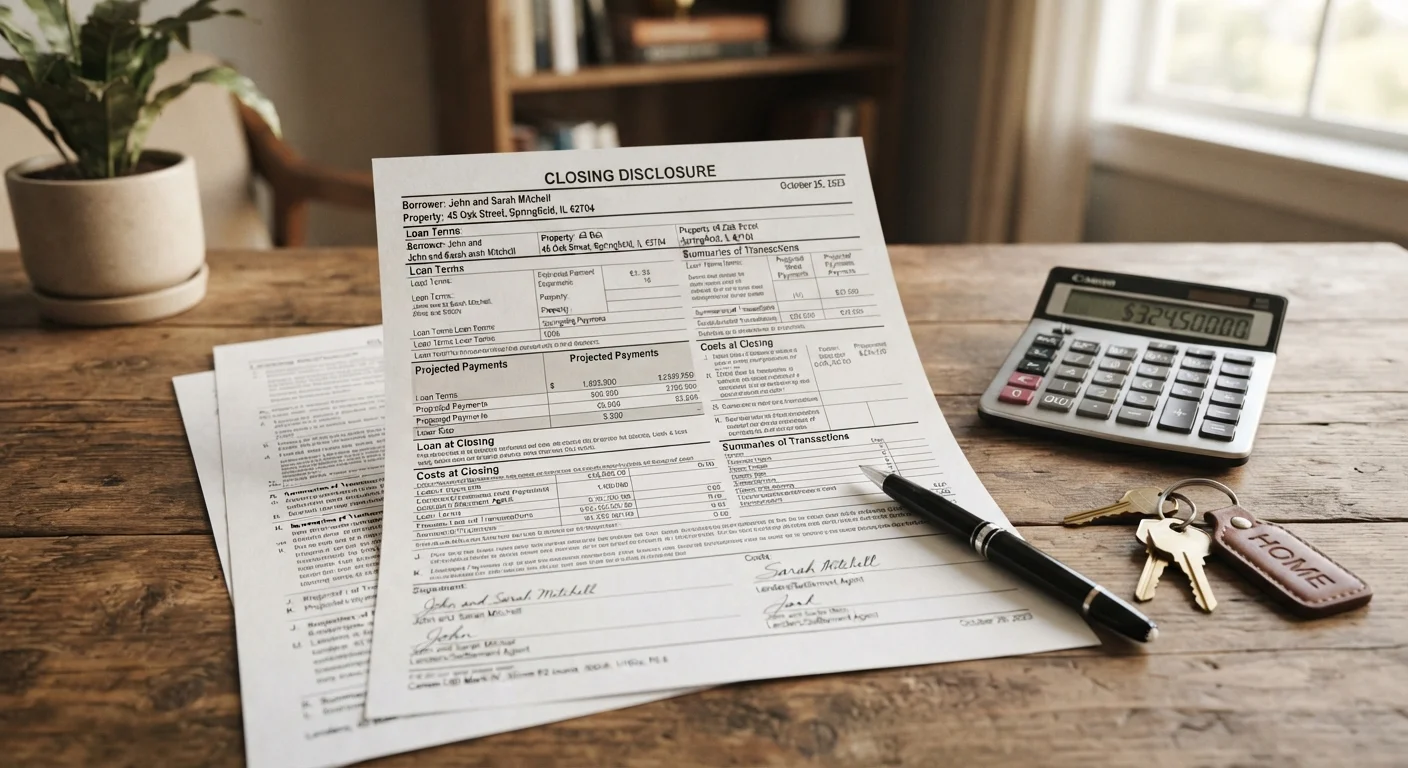
When you reach the closing table, you're handed a document - the Closing Disclosure - packed with line items, acronyms, and dollar amounts that can feel like a foreign language. For most buyers, closing costs total between 2% and 5% of the loan amount, according to the Consumer Financial Protection Bureau (CFPB). On a $350,000 home, that's anywhere from $7,000 to $17,500 in fees beyond your down payment.
The good news: none of these charges are random. Each line item exists for a specific reason, and once you understand what you're paying for, you're better positioned to ask questions, spot errors, and even negotiate certain fees. Use this reference as a line-by-line decoder for your Closing Disclosure.
For a broader vocabulary refresher, see our plain-language glossary of closing terms before diving in.
| Typical closing cost range | 2%-5% of the loan amount (Consumer Financial Protection Bureau (CFPB)) |
| Document to review | Closing Disclosure (provided at least 3 business days before closing) (CFPB TRID rules) |
| Fees that may be negotiable | Origination fee, lender application fee, some title fees |
| Fees that are generally fixed | Recording fees, transfer taxes, government-set charges |
| Who pays transfer taxes | Varies by state and local custom; often negotiable between buyer and seller |
Loan-Related Fees: What the Lender Charges
The largest cluster of closing costs typically comes from your mortgage lender. Here's what each charge covers:
- Origination fee: The lender's charge for processing and underwriting your loan. It may appear as a flat fee or a percentage of the loan amount (commonly 0.5%-1%). This is often negotiable.
- Discount points: Optional prepaid interest that lowers your mortgage rate. One point equals 1% of the loan amount. Paying points makes sense if you plan to stay in the home long enough to recoup the upfront cost through lower monthly payments.
- Application fee: Some lenders charge a fee just for applying. Not all do - compare lenders before committing.
- Underwriting fee: Covers the lender's cost to evaluate your financial profile and approve the loan. This is largely non-negotiable but should be consistent with what appeared on your Loan Estimate.
- Rate lock fee: If your lender charges to lock your interest rate for a set period, it appears here.
Closing Disclosure
A standardized five-page document your lender must provide at least three business days before closing. It itemizes every cost, credit, and loan term so you can review them before signing.
Origination fee
A charge from your lender for processing and underwriting your mortgage. It may be expressed as a flat dollar amount or a percentage of the loan, and is sometimes negotiable.
Discount points
Optional upfront payments to your lender that buy down your interest rate. One point equals 1% of the loan amount and reduces the rate by a lender-defined amount.
Escrow account
An account your lender holds to collect and pay recurring expenses like property taxes and homeowners insurance on your behalf. Initial deposits are funded at closing.
Title insurance
A one-time premium that protects against ownership disputes or defects in the property's title history. A lender's policy is typically required; an owner's policy is usually optional.
Recording fee
A government charge to officially enter the new deed and mortgage into public records. The amount varies by county.
Third-Party and Government Fees
Many closing costs flow to parties other than your lender - service providers and government entities each take a slice. These include:
- Appraisal fee: Pays a licensed appraiser to confirm the home's market value. Required by virtually all lenders. Typically $300-$600, though it varies by location and property type.
- Title search fee: Covers a review of public records to confirm the seller holds clear ownership and there are no liens on the property.
- Title insurance (lender's policy): Protects the lender if a title defect surfaces after closing. Almost always required. A separate owner's title insurance policy - which protects you - is optional but generally recommended.
- Survey fee: Some transactions require a land survey to confirm property boundaries. Whether this applies depends on location and loan type.
- Recording fees: Paid to your local government to officially record the deed and mortgage in public records. Amounts vary by county.
- Transfer taxes: Some states and municipalities charge a tax when a property changes hands. Who pays - buyer or seller - is often negotiable and may be customary in your area.
- Attorney fees: Several states require a real estate attorney at closing. Even where optional, having one review documents is worth considering.
2%-5%
Typical closing costs as share of loan amount
According to the Consumer Financial Protection Bureau, buyers generally pay between 2% and 5% of the loan in closing costs.
3 days
Advance notice required for Closing Disclosure
Federal TRID rules require lenders to deliver the Closing Disclosure at least three business days before settlement, giving buyers time to review.
$300-$600
Typical appraisal fee range
Home appraisal costs vary by region and property type but commonly fall in this range for a standard single-family home.
Prepaid Items and Escrow Deposits
A portion of your closing costs aren't fees in the traditional sense - they're prepaid expenses and initial deposits into an escrow account that your lender manages.
- Prepaid homeowners insurance: Lenders require at least one year of homeowners insurance paid upfront at closing.
- Prepaid mortgage interest: Interest accrues from your closing date through the end of the month. Closing earlier in the month means a larger prepaid interest charge.
- Property tax deposits: Your lender may collect several months of estimated property taxes to seed your escrow account, ensuring funds are available when tax bills come due.
- Mortgage insurance premium (MIP or PMI): If your down payment is below 20%, you may be required to prepay a portion of private mortgage insurance or an FHA mortgage insurance premium.
These items aren't profit for your lender - they're funds held on your behalf or paid directly to insure the property and tax obligations are met.
This article is for general informational and educational purposes only and does not constitute financial, legal, or tax advice. Consult a qualified professional for guidance specific to your situation.
The content on this site is for informational purposes only and is not a substitute for professional advice. Always consult a qualified professional for guidance specific to your situation.