

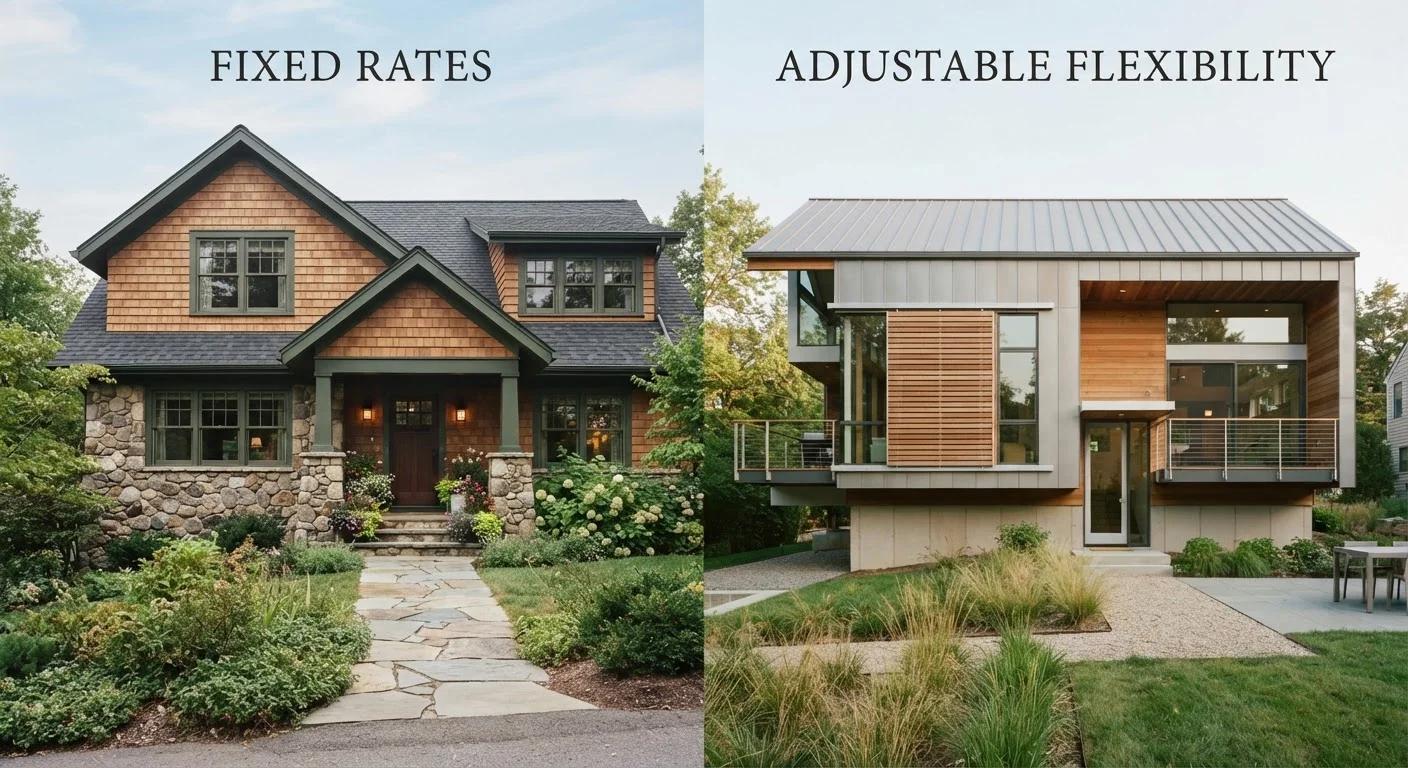
Option A
Fixed-Rate Mortgage
The stable, predictable long-term choice.
Best for: Homebuyers who want consistent monthly payments and plan to stay in their home for many years.
Option B
Adjustable-Rate Mortgage (ARM)
The flexible, lower-entry-cost alternative.
Best for: Buyers who expect to sell or refinance within a few years and want to take advantage of a lower initial interest rate.
How Each Mortgage Type Works
A fixed-rate mortgage sets your interest rate at closing, and that rate stays exactly the same for the life of the loan - commonly 15 or 30 years. Each monthly payment covers a blend of interest and principal reduction, and while that mix shifts over time, the total amount you pay never changes. This is the most common mortgage structure in the United States.
An adjustable-rate mortgage (ARM) starts with a fixed introductory rate for a set period - typically 3, 5, 7, or 10 years - then adjusts periodically based on a market index (such as the Secured Overnight Financing Rate, or SOFR) plus a lender-set margin. You'll see ARMs labeled in shorthand like 5/1 ARM, meaning the rate is fixed for five years, then adjusts annually. Caps on how much the rate can move each adjustment period, and over the life of the loan, provide some protection against extreme increases.
| Criterion | Fixed-Rate Mortgage | Adjustable-Rate Mortgage (ARM) |
|---|---|---|
| Interest rate | Locked in at closing | Fixed initially, then adjusts periodically |
| Monthly payment stability | Completely predictable | Can increase or decrease after intro period |
| Initial rate level | Typically higher than ARM intro rate | Usually lower than fixed at the start |
| Common loan terms | 15 or 30 years | 30 years (with 3, 5, 7, or 10-year fixed period) |
| Rate risk | None - lender absorbs it | Borrower absorbs post-adjustment risk |
| Best time horizon | Long-term ownership (10+ years) | Shorter ownership or refinance plan (under 7 years) |
| Rate caps | Not applicable | Periodic and lifetime caps limit increases |
For context on how mortgage type interacts with loan programs, see our comparison of conventional, FHA, and VA loans.
Weighing the Trade-Offs
The core trade-off is predictability versus initial cost. Fixed-rate mortgages carry slightly higher starting rates than ARMs in most interest rate environments, because the lender is absorbing the risk that rates might rise. You pay a premium for certainty.
ARMs transfer some of that rate risk to you in exchange for a lower opening payment. If you sell or refinance before the adjustment period kicks in, you may never experience a rate change - and you'll have saved money during the introductory phase. If you stay and rates climb, your payment can increase significantly.
~90%
Share of US mortgages that are fixed-rate
According to Freddie Mac data, fixed-rate mortgages have consistently represented the large majority of new originations in the US market.
5/1
Most common ARM structure
The 5/1 ARM - fixed for five years, then adjusting annually - has historically been the most widely used adjustable-rate product among US borrowers.
How long you plan to own the home is the central variable. The local housing market also matters - in fast-appreciating areas, some buyers plan to sell within a few years, making the ARM's lower initial rate genuinely useful. In stable or slow-moving markets, long-term ownership is more common, which tilts the math toward a fixed rate.
Managing your broader finances - including existing debt - can affect which mortgage payment you can sustain. The saving and debt hub offers grounded guidance on that front before you take on a mortgage obligation.
ARM Rate Caps: A Key Protection
Most ARMs include three types of rate caps: an initial cap (how much the rate can change at the first adjustment), a periodic cap (the maximum change per subsequent adjustment), and a lifetime cap (the maximum increase over the entire loan). For example, a 2/2/5 cap structure means the rate can rise at most 2% at the first adjustment, 2% each period after, and no more than 5% total over the life of the loan. Always ask your lender to show you worst-case payment scenarios using the lifetime cap before committing.
The content on this site is for informational purposes only and is not a substitute for professional advice. Always consult a qualified professional for guidance specific to your situation.