

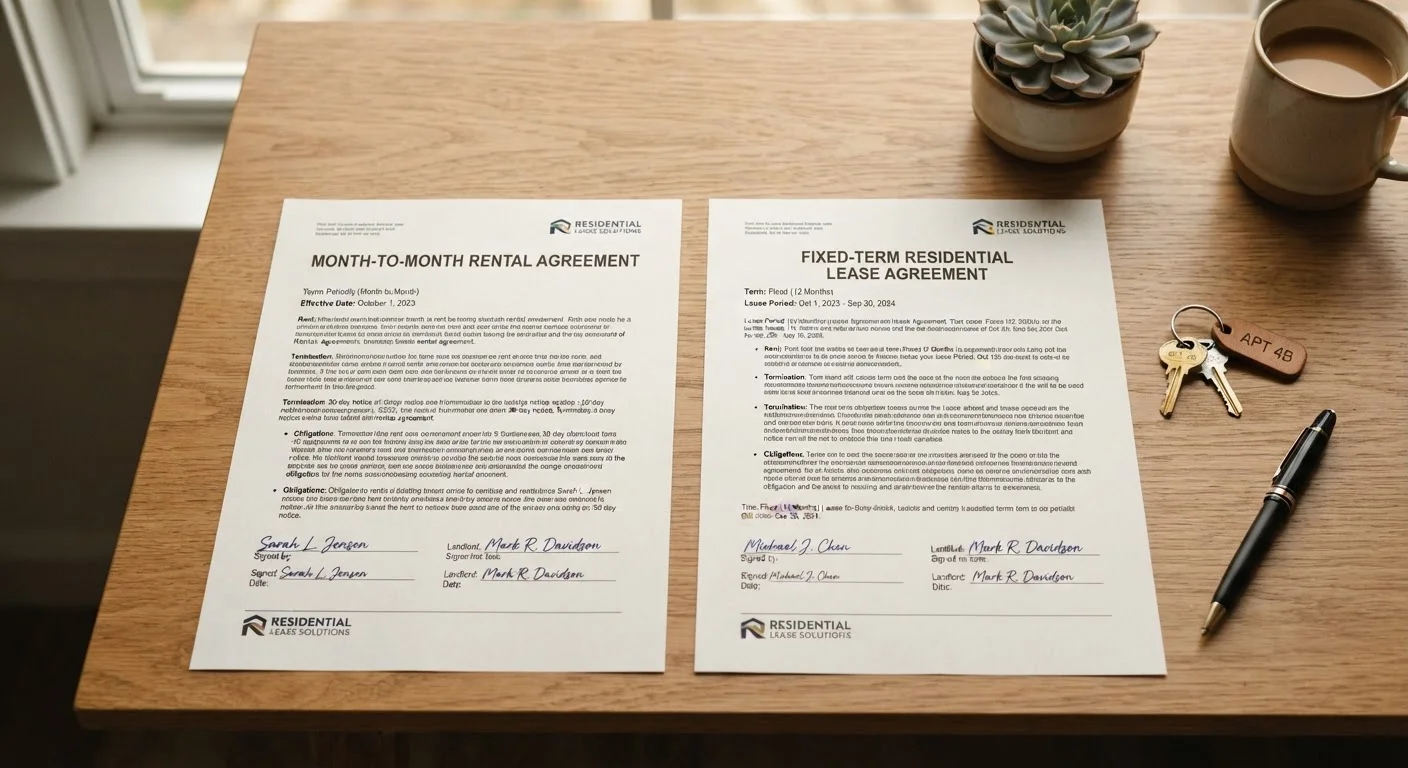
Option A
Month-to-Month Tenancy
The flexible, rolling rental arrangement.
Best for: Renters who need geographic mobility, are between life stages, or anticipate a major change in their housing needs in the near term.
Option B
Fixed-Term Lease
The stable, commitment-based rental agreement.
Best for: Renters who want predictable costs, security against sudden moves, and the ability to settle into a home for an extended period.
What Each Agreement Actually Means
A month-to-month tenancy (also called a periodic tenancy) is a rental arrangement with no fixed end date. It renews automatically each month as long as both parties continue the relationship. Either the landlord or tenant can end it by giving advance written notice - commonly 30 days, though this varies by state law.
A fixed-term lease sets a defined rental period - most commonly six months, one year, or two years. Both parties agree up front to the duration, and neither can unilaterally end the arrangement before that date without consequences. The rent amount is also locked in for the term, which is a significant financial protection for renters.
Both agreement types are legally binding contracts governed by state and local landlord-tenant law. The protections each provides - and the obligations each imposes - differ in meaningful ways that every renter should understand before signing. For a deeper look at how these agreements interact with local housing supply, see our overview of housing market dynamics.
| Criterion | Month-to-Month Tenancy | Fixed-Term Lease |
|---|---|---|
| Lease duration | Rolls over monthly; no set end date | Set period (e.g., 6 or 12 months) |
| Rent stability | Can increase with proper notice | Locked in for the full term |
| Typical monthly cost | Often higher than fixed-term rate | Generally lower; reflects commitment |
| Exit flexibility | End with 30-day notice (varies by state) | Early exit may incur penalties |
| Landlord termination rights | Can end with proper notice | Cannot end before term without cause |
| Negotiation leverage | Limited; short commitment appeals less | More room to negotiate at signing |
| Best market for renters | Declining or uncertain rental markets | Rising or tight rental markets |
The Real Trade-Offs: Flexibility vs. Stability
The core tension between these two agreements is not simply about convenience - it involves real financial and legal consequences.
Month-to-Month: Freedom with a Cost
Month-to-month tenancies give renters the ability to move with minimal commitment. That matters enormously during job transitions, family changes, or when exploring a new city. However, landlords typically price that flexibility into the rent - monthly rates on rolling agreements are often higher than comparable fixed-term units. There's also a less-discussed risk: the landlord can also terminate the tenancy with proper notice, meaning you could face an unexpected move.
Fixed-Term: Stability with Obligations
A fixed-term lease guarantees your right to occupy the unit for the full period - the landlord generally cannot remove you or raise your rent mid-term without cause. But that security comes with commitment. If your circumstances change and you need to leave early, you may owe rent for the remaining months, a re-letting fee, or other penalties. Review the early-termination clause carefully before signing. Our article on breaking a lease early outlines what that typically involves.
State Law Governs the Fine Print
Notice periods, allowable rent increases, and tenant protections vary significantly by state and sometimes by city. What's standard in one state may be prohibited in another. Before signing either type of lease, look up your state's landlord-tenant statutes or consult a local tenant rights organization to understand your specific rights and obligations.
Understanding which lease type fits your situation is one piece of a larger puzzle. You may also want to understand what obligations come with any lease - our breakdown of landlord and tenant responsibilities covers both sides clearly.
Cost, Negotiation, and Market Context
Price matters in any housing decision. Month-to-month rents can run 10-25% higher than fixed-term equivalents for similar units, depending on local market conditions - though this varies widely. In high-demand urban markets, the premium may be even larger.
~15-25%
Typical month-to-month rent premium
Industry estimates suggest month-to-month rents commonly run 15-25% above comparable fixed-term rates, though this varies considerably by local market.
30 days
Common minimum notice period to vacate
Most US states require at least 30 days' written notice to end a month-to-month tenancy, though some jurisdictions require 60 days or more.
12 months
Most common fixed-term lease length
The one-year lease remains the standard fixed-term arrangement for residential rentals across most US markets.
Fixed-term leases also provide more room for negotiation at signing. Landlords who want to fill a vacancy quickly may be open to adjusting move-in costs, minor lease clauses, or even a small rent concession in exchange for a longer commitment. Our article on negotiating lease terms explains what landlords commonly adjust and how to ask.
If you're evaluating renting more broadly - including whether it makes more sense than buying given current market conditions - the rent-vs-own market lens article provides useful context on price-to-rent ratios and local supply dynamics.
This article is for general informational and educational purposes only and does not constitute legal or financial advice. Rental laws vary significantly by state and locality. Consult a qualified attorney or housing counselor for guidance specific to your situation.
The content on this site is for informational purposes only and is not a substitute for professional advice. Always consult a qualified professional for guidance specific to your situation.