

Why Your Research Sources Shape Your Entire Trip
Planning a trip to somewhere unfamiliar is exciting - and quietly stressful. The information you gather before departure determines what you pack, how safe you feel, and whether the destination you arrive at matches the one you imagined. The problem is that travel information comes wrapped in invisible agendas: a tourism board wants you to come, a blogger wants clicks, a hotel review platform wants engagement. None of that makes these sources useless - it just means every source needs to be read with some awareness of its incentives.
Smart travelers don't find one perfect source. They triangulate across several, looking for convergence and flagging contradictions. This guide walks through the most common source types, what each does well, and what each quietly omits.
Sources Worth Trusting - With the Right Context
Government travel advisories are among the most reliable tools for understanding safety conditions. The U.S. Department of State publishes tiered advisories for every country, updated as conditions change. They're not designed to discourage travel - they're designed to inform it. That said, understanding what the ratings actually mean is important; a Level 2 advisory covers a wide range of situations, from routine petty crime to localized civil unrest, and treating them all identically can distort your sense of risk.
National and local news outlets from the destination itself - consumed with some basic media-literacy awareness - offer ground-level context that advisory systems often lack. Reading local English-language newspapers or following reputable regional outlets can reveal seasonal challenges, infrastructure issues, or upcoming events that shape what travel is actually like.
Guidebook publishers with established research teams (as opposed to crowd-sourced apps) tend to be methodical about accuracy, though their information lags behind real-world change. Treat them as a structural framework, not a live feed.
Entry Requirements Change - Verify Officially
Visa rules, vaccination requirements, and border procedures can change with little notice. Even well-maintained third-party sites can lag behind official updates by days or weeks. Always verify entry requirements directly through the relevant embassy or consulate website and your own government's travel portal before finalizing any booking. This is especially true for destinations with evolving health or diplomatic situations.
Sources to Read Critically
Tourism board websites are professionally produced and often factually accurate - but they present a curated version of a destination, not a complete one. Infrastructure problems, off-season realities, overcrowding at headline attractions, and neighborhood-level safety variation rarely feature. Use them for orientation and logistics, not for forming a full picture.
Travel blogs and influencer content vary enormously in quality. Some bloggers are meticulous researchers with years of destination experience; others publish itineraries based on a single visit or content partnership. Look for disclosures about sponsored stays, check whether the writer acknowledges limitations in their own experience, and see whether their observations are specific and dated rather than vague and evergreen.
Review platforms aggregate genuine traveler voices, which is genuinely valuable. But review samples skew toward people with strong reactions - either delighted or frustrated - and frequently over-represent certain demographics of traveler. A guesthouse beloved by solo backpackers may not suit families, and vice versa. Read reviews looking for patterns across many comments, not individual outliers. This critical lens applies equally when reading up on common safety assumptions travelers carry, which review culture can inadvertently reinforce.
Always check your government's official travel advisory before researching anything else.
Advisory systems give you a baseline safety and entry context that frames everything else you read. Starting here prevents you from building plans on an unstable foundation.
For any source, identify who published it and what their incentive is.
Every source has a perspective. Knowing whether you're reading a tourism promotion, an independent journalist, or a blogger on a press trip helps you weight the information appropriately.
Cross-reference at least three source types before forming a strong opinion about a destination.
Single-source research creates blind spots. Contradictions between sources are often where the most useful information lives - they signal complexity worth investigating further.
Filter review platforms by recency and traveler profile before drawing conclusions.
A hotel or attraction that was excellent two years ago may have changed significantly. Reviews from travelers with similar priorities to yours are more predictive than aggregate scores.
Seek out local or regional voices, not just international ones.
International travel media tends to cover destinations through the lens of a particular type of visitor. Local journalism, community forums, and expat groups often surface realities that outsider coverage misses.
Building a Research Stack That Actually Works
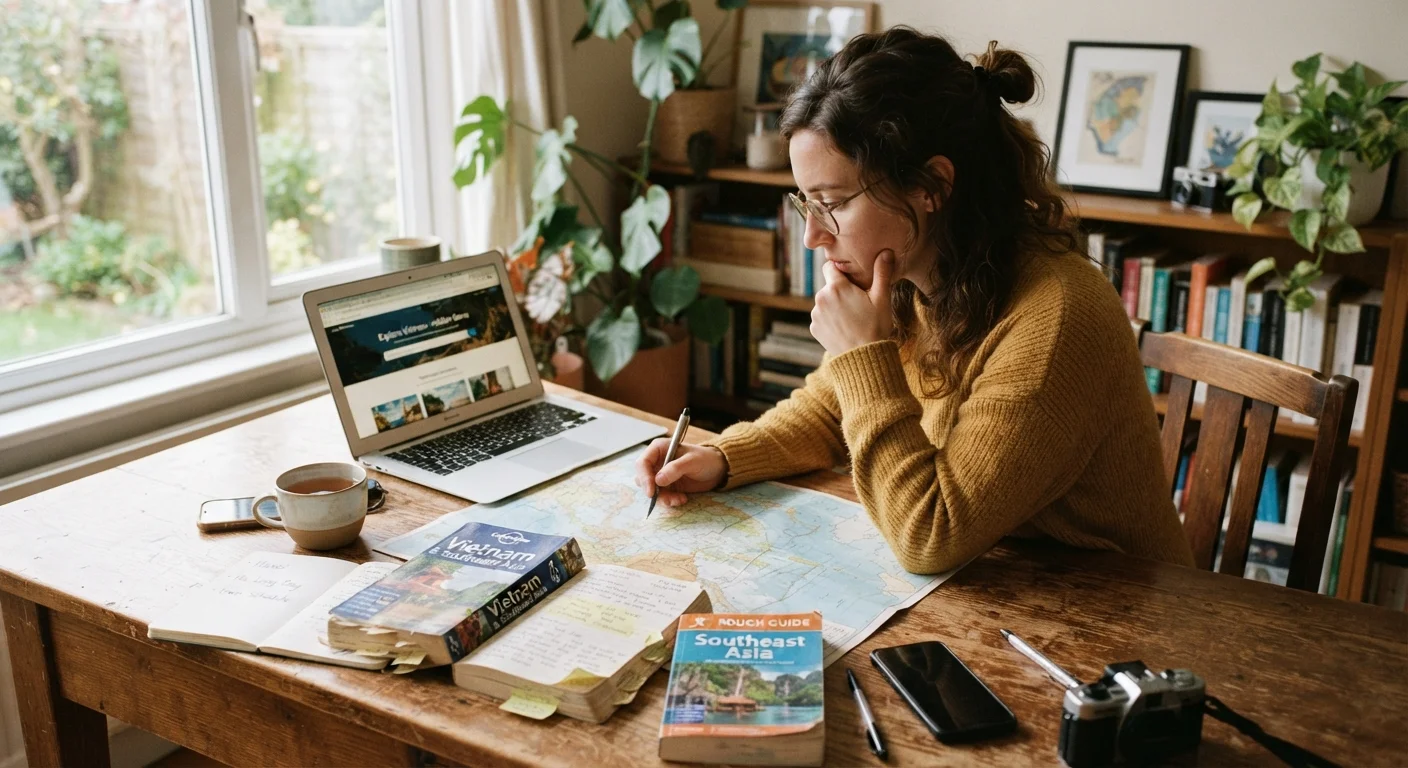
The goal is layering sources so each one's blind spots are covered by another. A practical research stack might include: a government advisory for safety framing, a current news search for recent events, a guidebook chapter for structural context, two or three independent travel writers for on-the-ground texture, and review platforms filtered by recency and traveler type.
For entry requirements - visas, vaccinations, customs rules - always go directly to the relevant embassy or consulate website and your own government's official travel portal. Official entry guidance can be dense, but it's the only source that's authoritative. Third-party summaries are convenient but can lag behind policy changes.
Once you've done the research groundwork, the next step is translating it into genuine preparedness - not just highlights, but local transport, cultural norms, and practical realities. Our guide on destination research that actually prepares you for what's there covers exactly that transition.
The content on this site is for informational purposes only and is not a substitute for professional advice. Always consult a qualified professional for guidance specific to your situation.