

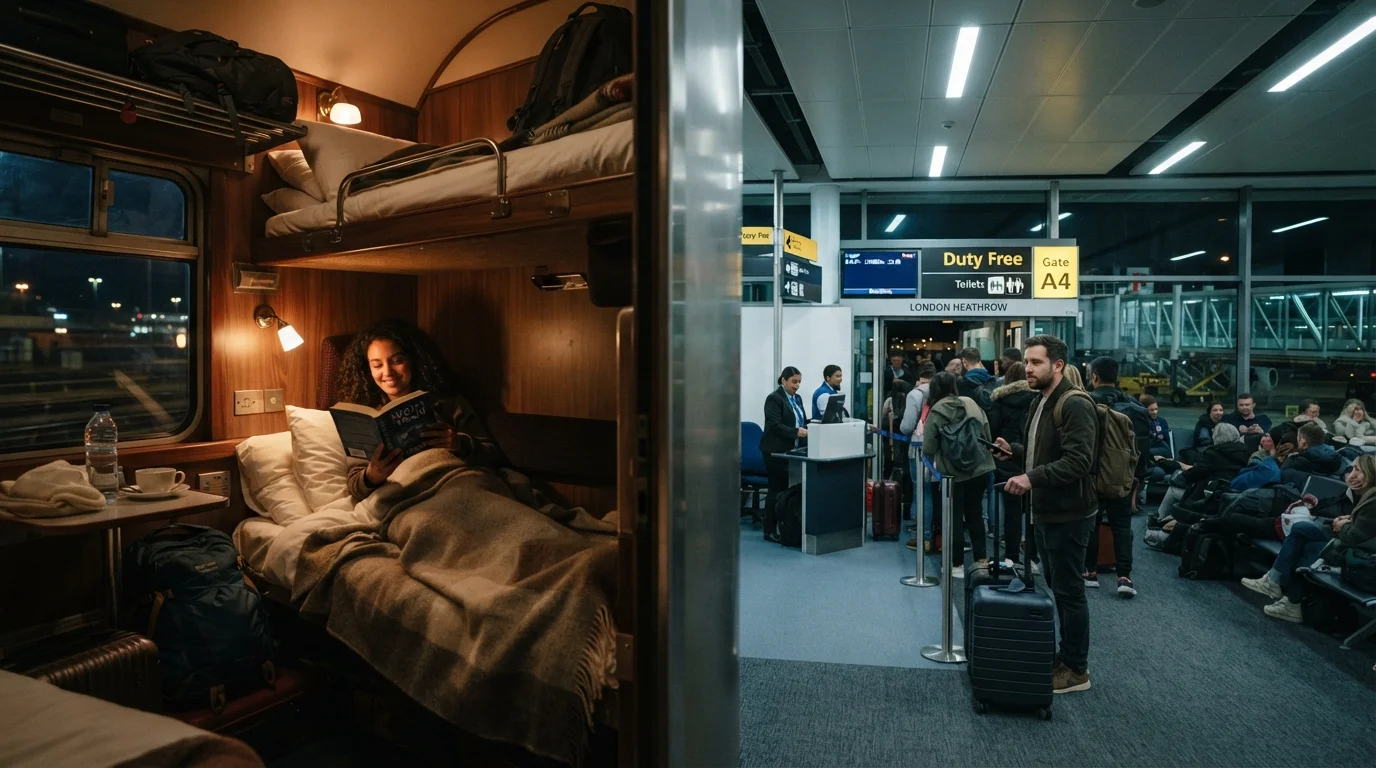
Our Verdict
Neither night trains nor budget flights win outright - the right choice depends heavily on your route, travel style, and how you weigh time against comfort. Night trains tend to reward slower, city-center-focused travelers, while budget flights suit those prioritizing speed over the journey itself. The hidden costs on both sides make surface-level price comparisons unreliable.
| Best for | Recommended |
|---|---|
| Travelers who want to save on accommodation while covering distance | Night Train |
| Those covering long distances where train routes don't exist | Budget Flight |
| Travelers with luggage, families, or mobility considerations | Night Train |
| Those prioritizing raw speed on routes served by major airports | Budget Flight |
The Real Cost Comparison
At first glance, a budget airline fare can look dramatically cheaper than a night train ticket. But that initial number rarely tells the full story. Budget carriers frequently charge separately for checked baggage, carry-on bags above a certain size, seat selection, and even printing a boarding pass at the airport. Add a taxi or shuttle to and from a secondary airport - which budget airlines commonly use - and the total cost climbs fast.
Night trains, by contrast, bundle your travel and overnight accommodation into a single ticket. A couchette (a basic fold-down bunk in a shared compartment) or a private sleeper cabin means you're not paying for a hotel that night. For routes where a hotel would otherwise cost $80-$150, the math can shift significantly in the train's favor. For a deeper breakdown of how transport and accommodation costs interact across a trip, see where your money actually goes in a travel budget.
~2x
True cost multiplier for budget flights
Consumer advocacy research consistently finds that add-on fees can roughly double the advertised base fare on many low-cost carriers.
6-8 hrs
Typical overnight train journey duration
Many popular European night train routes are timed specifically to allow passengers to sleep through the journey and arrive in the morning.
Comfort and Sleep Quality
Sleep on a budget flight is largely aspirational. Economy seats on low-cost carriers are designed for short hops, not overnight journeys. Seat pitch - the space between your seat and the one ahead - is often tight, and the cabin environment (noise, lighting, temperature) is difficult to control. Neck pillows and eye masks help, but they can't replace a horizontal surface.
Night trains offer a genuine spectrum of sleeping options. A second-class couchette gives you a bunk in a six-person compartment - functional but social. First-class couchettes or private sleeper cabins offer more privacy, bedding, and often breakfast service. The train's gentle rhythmic motion is something many travelers find conducive to sleep in a way that turbulence simply isn't.
Maximize Sleep on Night Trains
Booking a private sleeper cabin - rather than an open couchette - makes a significant difference in sleep quality, especially for solo travelers who value quiet. Many railways allow upgrades at booking or sometimes at the station if space is available. Bringing earplugs, a light layer, and your own snacks can make the experience noticeably more comfortable regardless of ticket class.
Safety: Understanding the Real Differences
Both commercial aviation and passenger rail are statistically very safe modes of transport, and it's important not to let fear distort practical decision-making. That said, the nature of risks differs. Commercial aviation, including budget carriers, is subject to rigorous international safety standards. Low-cost airlines operate the same certified aircraft types as full-service carriers and face identical regulatory oversight in most markets.
Night train safety is similarly well-regulated in most of Europe, Japan, and other regions with mature rail networks. Passengers sometimes raise concerns about security within sleeper cars - specifically around theft from compartments overnight. Most modern sleeper trains have lockable doors, luggage storage, and attendants on board. As with any travel, keeping valuables close and being aware of your surroundings are sensible precautions, not causes for alarm.
Verify Current Route and Safety Conditions
Night train networks are expanding in some regions and contracting in others. Always verify that a route still operates before building it into your itinerary. For any international journey, check your government's current travel advisories and confirm entry requirements through official sources - conditions can change independently of transport availability.
Time, Logistics, and Hidden Trade-Offs
A two-hour flight can easily become a five-hour ordeal when you account for getting to a peripheral airport, security queues, boarding delays, and the journey into the city at the other end. Night trains typically depart from and arrive at central city stations, cutting transfer time dramatically. You board in the evening and wake up in the destination - often ready to start the day without needing a hotel check-in at all.
On the other hand, night trains are limited by existing rail infrastructure. Many routes - particularly across oceans or between regions without connected networks - simply don't exist. And booking dynamics differ from flights: train availability and pricing structures vary by country, and last-minute flexibility can be limited on popular routes. Advance versus last-minute booking trade-offs apply to both modes, but in different ways. For travelers thinking about how pace shapes a trip overall, slow travel versus multi-destination itineraries is worth considering as a broader framework.
| Night Train | Budget Flight | |
|---|---|---|
| Base cost | Moderate to high upfront | Low upfront, fees add up |
| Accommodation included | Yes (sleeper/couchette) | No |
| City-center access | Usually direct | Often peripheral airport |
| Sleep quality | Good to excellent (private cabin) | Poor in economy |
| Baggage flexibility | Generally generous | Strict limits, fees common |
| Route availability | Limited to rail network | Broad, especially long-haul |
| Environmental footprint | Generally lower per km | Higher per km |
The content on this site is for informational purposes only and is not a substitute for professional advice. Always consult a qualified professional for guidance specific to your situation.