

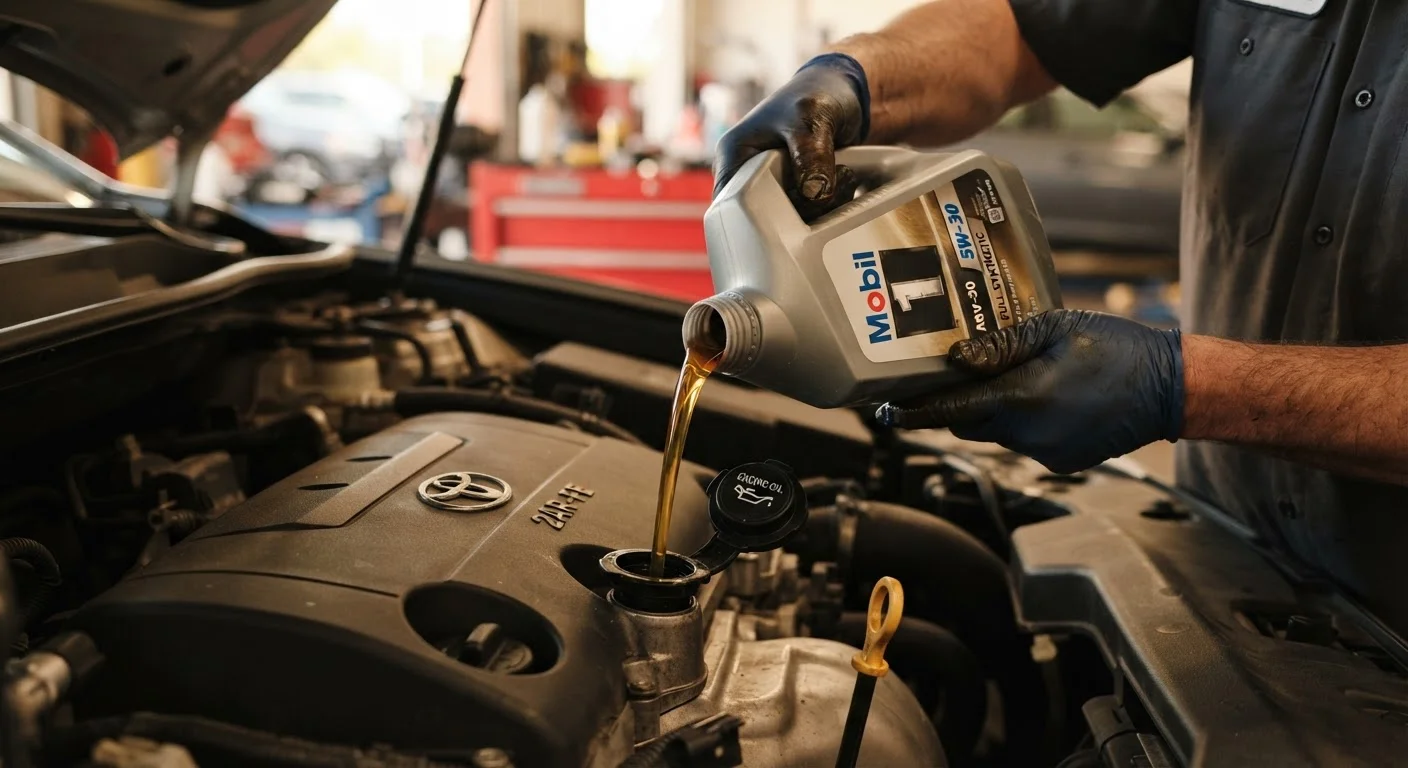
What Those Numbers on the Bottle Actually Mean
Pick up any bottle of motor oil and you'll see a code like 5W-30 or 10W-40. This is the oil's viscosity grade - a standardized measure of how the oil flows at different temperatures, set by the Society of Automotive Engineers (SAE).
The number before the W (which stands for Winter) describes the oil's flow at cold temperatures. A lower number - like 0W or 5W - means the oil stays thinner at startup, reaching engine parts faster in cold weather. The number after the W describes viscosity at normal operating temperature. Higher numbers indicate a thicker oil that maintains a protective film under heat and load.
So a 5W-30 oil flows well in cold starts and thickens appropriately once the engine warms up. Your owner's manual specifies exactly which grade your engine was engineered to use - following that recommendation matters more than any advice on the bottle label.
Synthetic, Conventional, and Blend: What the Labels Tell You
Beyond the viscosity grade, oil bottles carry one of three broad descriptions: conventional, full synthetic, or synthetic blend.
Viscosity
A measure of how easily a fluid flows. In engine oil, higher viscosity means thicker oil; lower viscosity means thinner oil that flows more freely.
SAE Grade
A standardized viscosity rating from the Society of Automotive Engineers. The two numbers in a multigrade oil (e.g., 5W-30) describe cold and hot performance respectively.
Full Synthetic Oil
Motor oil engineered from chemically modified base stocks for consistent molecular structure. It generally offers better performance at temperature extremes and longer change intervals than conventional oil.
API Service Rating
A letter code (e.g., SP for gasoline engines) from the American Petroleum Institute confirming an oil has met standardized performance and protection benchmarks.
Oil Life Monitor
An onboard vehicle system that uses engine data - not just mileage - to estimate when oil needs changing. It factors in temperature, RPM, and trip patterns.
Severe Service
A driving classification used by manufacturers to describe conditions that degrade oil faster, such as frequent short trips, towing, or extreme temperatures. Shorter change intervals typically apply.
Conventional oil is refined directly from crude oil. It works reliably for many engines but breaks down faster under extreme temperatures or heavy use. Full synthetic oil is engineered at the molecular level for more consistent performance, longer intervals between changes, and better protection at temperature extremes. A synthetic blend mixes the two, offering some of synthetic's benefits at a lower cost.
You may also see certification marks on the label - look for the API (American Petroleum Institute) donut or starburst symbol. These confirm the oil has passed standardized performance tests. The two-letter service code inside (such as SP for gasoline engines) tells you the performance category; newer letters indicate more current standards.
For a deeper comparison of how these oil types actually perform in everyday driving, see our guide to synthetic vs conventional oil.
Change Intervals: When Does Oil Actually Need Replacing?
The old 3,000-mile rule is outdated for most modern vehicles. Many current cars with full synthetic oil can go 7,500 to 10,000 miles - or more - between changes, depending on the manufacturer's specification. Some vehicles have an oil life monitoring system that calculates intervals based on actual driving conditions rather than mileage alone.
3,000 miles
Outdated change interval still cited by some shops
Most modern vehicles with synthetic oil are spec'd for 7,500-10,000+ mile intervals per manufacturer guidelines.
~50%
Of US driving classified as 'severe service'
Short trips, stop-and-go traffic, and extreme temperatures are common enough that many manufacturers consider them the norm, not the exception.
The most reliable source is your owner's manual. It will list both a mileage interval and a time interval (such as once a year), whichever comes first. This matters for low-mileage drivers - oil still degrades from moisture and combustion byproducts even if you haven't driven far.
Certain driving patterns accelerate oil degradation and may warrant shorter intervals. These include frequent short trips where the engine doesn't fully warm up, towing or hauling heavy loads, driving in dusty environments, and repeated cold-weather starts. If your driving is mostly short urban trips, your manual may classify that as severe service and recommend a tighter schedule.
Common myths about oil change timing - like judging by color alone - are worth separating from fact. Dark oil isn't always degraded; some additives darken it quickly during normal use.
For a full picture of how oil changes fit into your vehicle's broader schedule, see Your Car's Maintenance Schedule, Explained.
The content on this site is for informational purposes only and is not a substitute for professional advice. Always consult a qualified professional for guidance specific to your situation.