

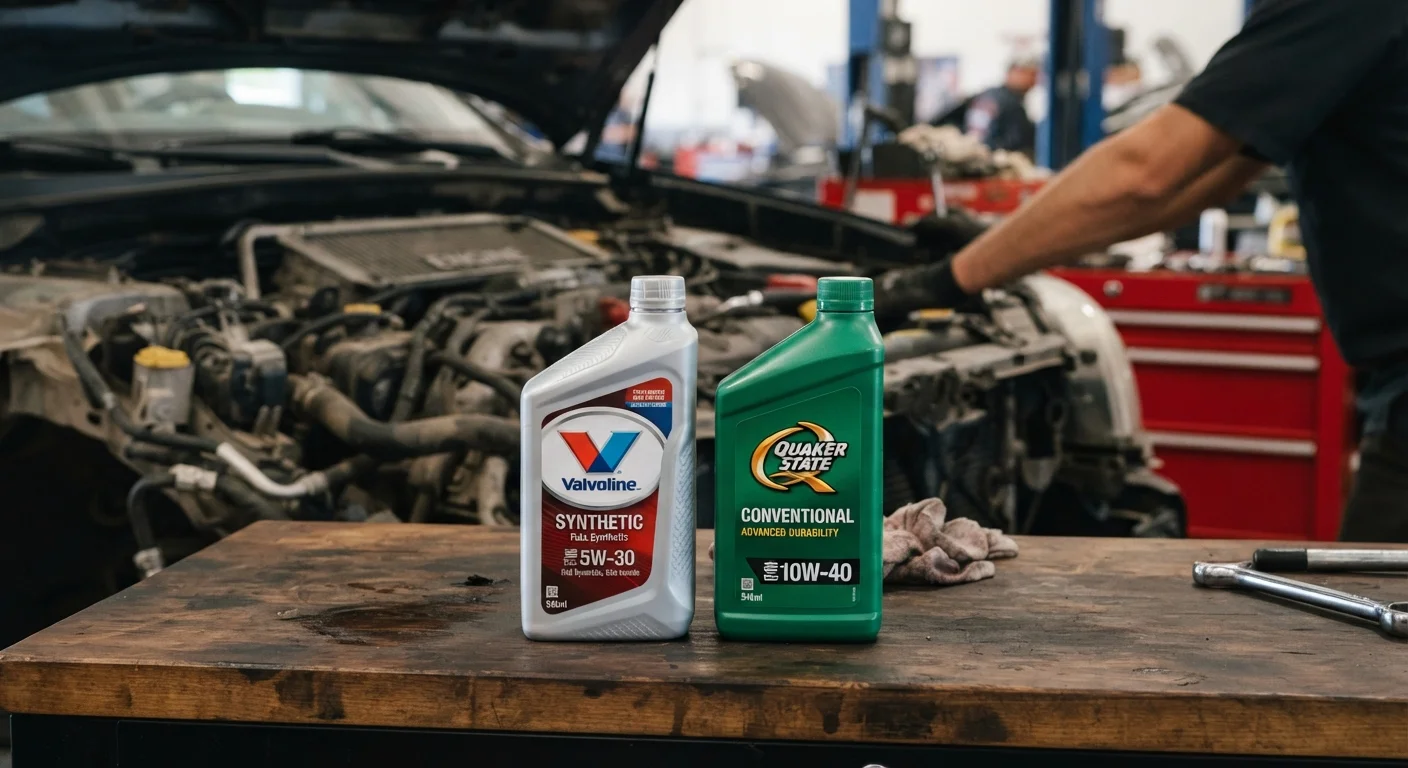
Option A
Synthetic Engine Oil
The engineered, high-performance formulation.
Best for: Drivers with newer vehicles, turbocharged engines, or those who want longer intervals between oil changes.
Option B
Conventional Engine Oil
The time-tested, widely available standard.
Best for: Owners of older vehicles with simpler engines and predictable, moderate driving routines.
What Sets These Two Oils Apart
The core difference between synthetic and conventional engine oil comes down to how each is made. Conventional oil is refined from crude petroleum. It contains a natural mix of hydrocarbon molecules in varying shapes and sizes, along with trace impurities that survive the refining process.
Synthetic oil starts with a similar base but goes further. Chemists break down and rebuild the molecules into a uniform structure, removing most impurities and tailoring the oil to perform consistently across a wide range of temperatures. Additives - detergents, anti-wear agents, viscosity modifiers - are blended into both types, but synthetic oil's cleaner base gives those additives more room to work.
There is also a middle option: synthetic-blend oil, which mixes the two. It offers some of synthetic's performance benefits at a price closer to conventional. For a deeper look at how viscosity grades and oil labels factor in, see our guide to engine oil viscosity grades and labels.
| Criterion | Synthetic Oil | Conventional Oil |
|---|---|---|
| Origin | Chemically engineered from base compounds | Refined from crude petroleum |
| Molecular consistency | Uniform, precisely structured | Variable, with natural impurities |
| Cold-weather flow | Flows readily at low temperatures | Can thicken more in the cold |
| Heat resistance | Maintains viscosity under high heat | Breaks down faster under extreme heat |
| Typical change interval | 7,500-15,000 miles (varies by vehicle) | 5,000-7,500 miles (varies by vehicle) |
| Cost per quart | Higher upfront cost | Lower upfront cost |
| Availability | Widely available | Widely available |
| Best suited for | Newer, turbocharged, or performance engines | Older engines, light-duty driving |
Performance, Longevity, and Real-World Driving
In cold weather, conventional oil can thicken more than synthetic, which means your engine briefly runs with less lubrication at startup. Synthetic oil flows more readily at low temperatures, reducing that startup wear window. At the other extreme - towing, stop-and-go city traffic, or turbocharged engines running at high heat - synthetic maintains its viscosity better and resists breaking down longer.
7,500-15,000 mi
Typical synthetic oil change interval
Exact intervals vary by vehicle make, model, and driving conditions - always check your owner's manual.
~2x
Longer service life vs conventional oil
Synthetic oil's engineered molecular structure allows it to resist thermal breakdown significantly longer than conventional oil under comparable conditions.
5,000-7,500 mi
Typical conventional oil change interval
Modern conventional oils last longer than the outdated 3,000-mile guideline, though specifics depend on the engine and use case.
Change intervals are where the practical difference shows up in your schedule and budget. Many conventional oil recommendations sit around 5,000 to 7,500 miles, though this varies by vehicle. Synthetic oil is commonly rated for 7,500 to 15,000 miles, though your owner's manual sets the real ceiling - not the oil bottle. The engine oil myths article covers why the old 3,000-mile rule no longer applies to most modern vehicles.
One concern some drivers raise: does switching to synthetic cause leaks in older engines? The evidence for this is thin. Modern synthetics are formulated to be compatible with engine seals. That said, if your engine already has minor seal wear, a mechanic's input before switching is a reasonable precaution.
How to Choose - and What to Watch For
The clearest starting point is your vehicle's owner's manual. Some engines - particularly newer turbocharged ones - require synthetic oil outright. Using conventional oil in those engines could void warranty coverage or accelerate wear. If your manual says either type is acceptable, your driving habits and budget become the deciding factors.
Always Check Your Owner's Manual First
Vehicle manufacturers specify the oil type and viscosity grade required for your engine. This is not just a suggestion - using the wrong oil in some engines can affect warranty coverage. If you've lost your manual, most automakers make digital versions available through their official websites or customer service lines.
Cost is a real consideration. Synthetic oil typically costs more per quart, but fewer changes over the same mileage can narrow the gap. Run the numbers for your specific vehicle rather than assuming one is always cheaper in the long run. For a broader look at maintenance decisions that affect your wallet, our car maintenance myths article is a useful read.
Whatever oil you use, the filter matters too. A quality filter does its part in keeping contaminants out of the oil circuit. And regardless of oil type, if you notice your oil level dropping between changes or the oil looking unusually dark early, have a mechanic check it out - those are signs worth investigating, not ignoring.
The content on this site is for informational purposes only and is not a substitute for professional advice. Always consult a qualified professional for guidance specific to your situation.