

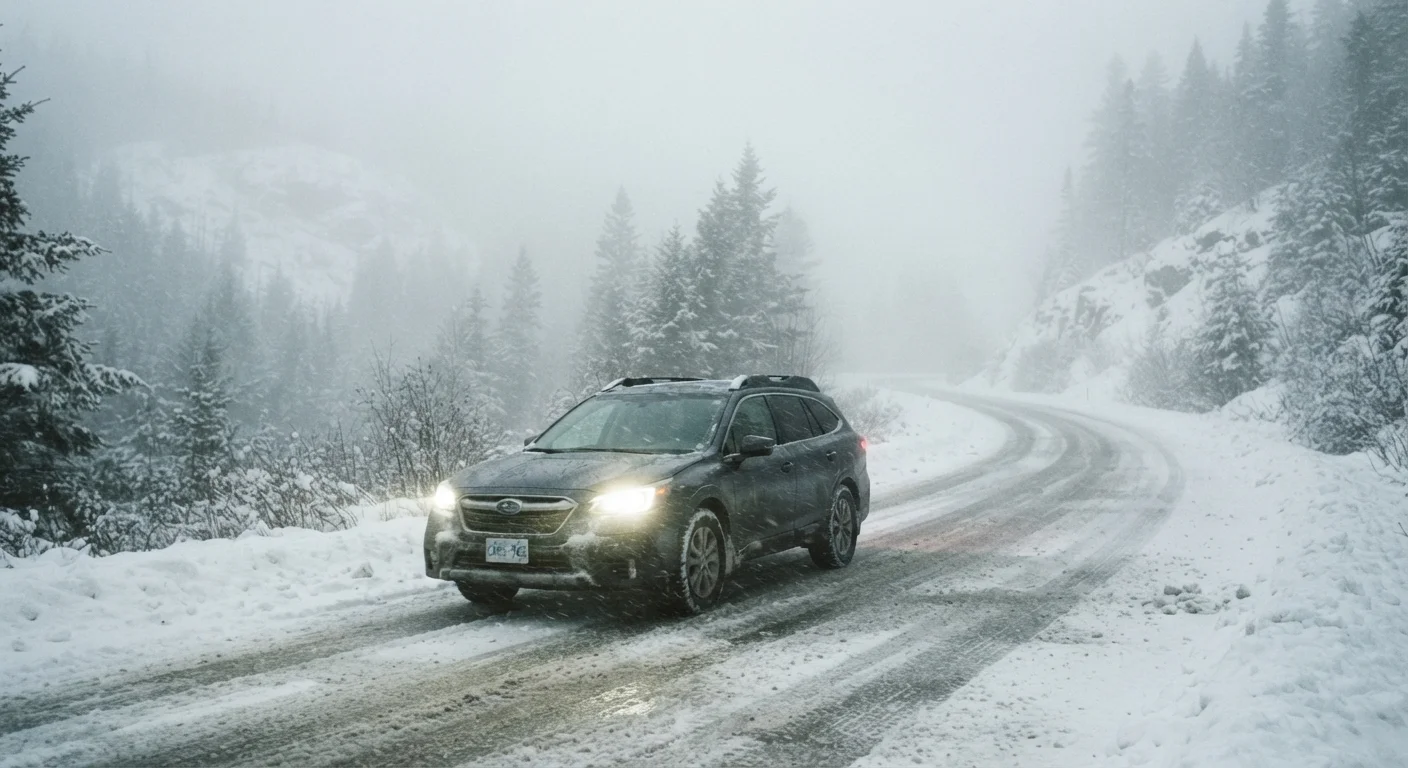
Why Each Condition Requires a Different Approach
Fog, ice, and snow are often grouped together as "bad weather," but they create fundamentally different hazards. Fog is primarily a visibility problem - the road surface may be perfectly normal. Ice is primarily a traction problem - visibility may be fine, but your ability to steer, brake, and accelerate is severely reduced. Snow typically combines both. Understanding which hazard you're dealing with shapes every decision you make.
The mistake many drivers make is applying a single catch-all response - slow down - without adjusting their technique to the specific risk. Slowing down helps in all three scenarios, but it's only the starting point. Rain demands a different mindset too, but winter conditions push the stakes even higher because the physics change more dramatically.
17%
Crash fatalities linked to weather conditions
According to the U.S. Department of Transportation Federal Highway Administration, roughly 17% of all vehicle crash fatalities occur during adverse weather conditions each year.
10x
Longer stopping distance on ice vs. dry pavement
Traffic safety research consistently shows that stopping distances on ice can be up to 10 times greater than on dry road surfaces at the same speed.
1,300+
Annual deaths on snowy or icy roads
The Federal Highway Administration estimates more than 1,300 people are killed in crashes on snowy, slushy, or icy pavement annually in the United States.
Driving in Fog: Slow Down and Use the Right Lights
In fog, your goal is to be able to stop within the distance you can see. If your headlights illuminate 100 feet ahead and you're traveling at a speed that requires 150 feet to stop, you're overdriving your visibility - a common and dangerous error.
- Use low-beam headlights, not high beams. High beams reflect off fog particles and actually reduce how far you can see.
- Use rear fog lights if your vehicle has them, but only in genuine fog - they can blind drivers behind you in clear conditions.
- Increase following distance significantly. In normal conditions, a 3-second gap is a baseline. In dense fog, 4-5 seconds or more is safer.
- Avoid the temptation to follow taillights closely. Drivers ahead may brake suddenly or have already drifted off course.
If fog becomes severe enough that you genuinely cannot see safely, pull completely off the road, turn off your running lights (so other drivers don't follow you thinking you're still on the roadway), and switch on your hazard lights.
Use the Road Edge as a Reference in Dense Fog
When visibility drops severely, the right edge line of the road - the white fog line - is a safer visual reference than the center line, because following the center line can lead you into oncoming traffic. Keep the right edge line gently in view and slow to a speed where you could stop well within what you can see.
Driving on Ice: The Gentlest Inputs Win
Ice - including so-called black ice (a thin, nearly transparent glaze on pavement) - can reduce tire grip to a fraction of what you'd have on dry asphalt. The fundamental rule on ice is that every input - braking, steering, accelerating - must be slow, smooth, and deliberate. Sudden movements break traction instantly.
Before driving on a morning when temperatures dropped overnight, test your brakes lightly on a quiet stretch to gauge how much grip you actually have - don't assume the road feels the same as it looks.
Black ice is often invisible, and your first awareness of it shouldn't be a skid at speed. A low-speed test gives you real feedback before it matters most.
In slow-moving fog traffic, resist the urge to keep pace with the vehicle ahead - maintain your own safe following distance even if a gap opens up.
Chain-reaction rear-end crashes in fog are among the most common multi-vehicle accidents. Keeping your own buffer gives you time to react even if the driver ahead brakes suddenly.
- Accelerate gently from stops. Spinning wheels on ice accomplishes nothing and can send you sideways.
- Brake earlier than you think necessary. Even with ABS (Anti-lock Braking System), stopping distances on ice can be 10 times longer than on dry pavement.
- Steer gradually. Sharp turns at any speed on ice can cause a skid.
- If you skid: ease off the accelerator, steer smoothly in the direction you want the front of the car to go, and avoid stamping the brakes.
Never Use Cruise Control on Ice or Snow
Cruise control is designed to maintain a set speed and may actually accelerate the vehicle if wheel slip causes a momentary speed drop - the opposite of what you need when traction is compromised. Disengage cruise control any time road conditions are slippery, wet, or unpredictable. Full, active control of your throttle is essential when grip is reduced.
Bridges and overpasses freeze before road surfaces because cold air circulates both above and below them. Give yourself extra room on these structures even when the surrounding road seems clear.
Driving in Heavy Snow: Momentum and Margin
Driving in snow combines reduced visibility with reduced traction, which means you're managing two problems at once. Snow-packed roads can behave somewhat like ice in terms of grip, while fresh deep snow adds rolling resistance that can stall forward progress.
- Maintain steady momentum on hills. If you stop on a snow-covered incline, restarting is very difficult. Build gentle speed before the hill begins.
- Increase following distance dramatically - the standard advice doubles or triples under snowy conditions.
- Clear all snow from your vehicle before driving: roof, hood, windows, lights, and mirrors. Snow that slides off your roof onto your windshield - or onto the car behind you - is a serious hazard.
- Know your vehicle's drive system. Four-wheel drive (4WD) and all-wheel drive (AWD) improve traction when accelerating but do not improve braking on snow compared to two-wheel drive vehicles with good winter tires.
For more on getting your car ready before the season shifts, see our seasonal car care checklist.
“The single biggest factor in winter driving safety isn't the car you drive - it's how much margin you give yourself. Speed, distance, and time: reduce all three and you're far ahead of most drivers on the road.”
— Cars & Driving Editorial Team, Vehicle Safety Research Desk
Preparing Your Vehicle Before Severe Weather Hits
Good technique matters, but it can only do so much if your vehicle isn't in shape for the conditions. Winter-readiness checks are worth doing before the first freeze - not after it.
- Tires: All-season tires handle mild winter conditions, but dedicated winter tires provide meaningfully better grip on snow and ice. Regardless of tire type, check pressure regularly - cold air causes tire pressure to drop.
- Brakes: Worn brake pads extend stopping distances on any surface. On ice, this becomes critical.
- Battery: Cold weather reduces battery capacity. A battery that barely starts your car in October may not start it in January.
- Wipers and washer fluid: Use winter-rated wiper blades and freeze-resistant washer fluid rated for the coldest temperatures in your area.
- Visibility: Check that all exterior lights work - fog, reduced snow, and early nightfall all demand reliable lighting.
Our guide on preparing for extreme heat and cold covers temperature-related checks in detail.
AWD and 4WD Don't Shorten Stopping Distances
A common misconception is that four-wheel or all-wheel drive makes a vehicle significantly safer on ice and snow overall. These systems improve your ability to get moving and maintain forward traction, but braking is governed by your tires - not your drivetrain. An AWD vehicle on worn all-season tires may stop no better than a front-wheel drive car on good winter tires. Don't let drivetrain confidence lead to overconfidence on slick roads.
When to Stay Off the Road Entirely
No driving skill fully compensates for conditions that are genuinely beyond safe limits. Even experienced drivers in well-equipped vehicles are vulnerable when a highway is glazed in black ice, a whiteout drops visibility to near zero, or roads haven't been treated or plowed.
Checking road condition reports from your state's department of transportation, local traffic advisories, and weather service alerts before leaving gives you information to make a reasoned decision - not just a gut one. Delaying a trip by a few hours, or postponing it entirely, is always a valid choice and often the safest one.
If you're caught out and conditions deteriorate rapidly, know your emergency options: pull safely off the road, signal your location with hazard lights, stay with your vehicle unless staying becomes unsafe, and call for help. A car is easier for rescuers to find than a person on foot in a snowstorm.
This article is for general informational purposes only. Always follow the guidance of local traffic authorities and emergency services during severe weather events.
The content on this site is for informational purposes only and is not a substitute for professional advice. Always consult a qualified professional for guidance specific to your situation.