

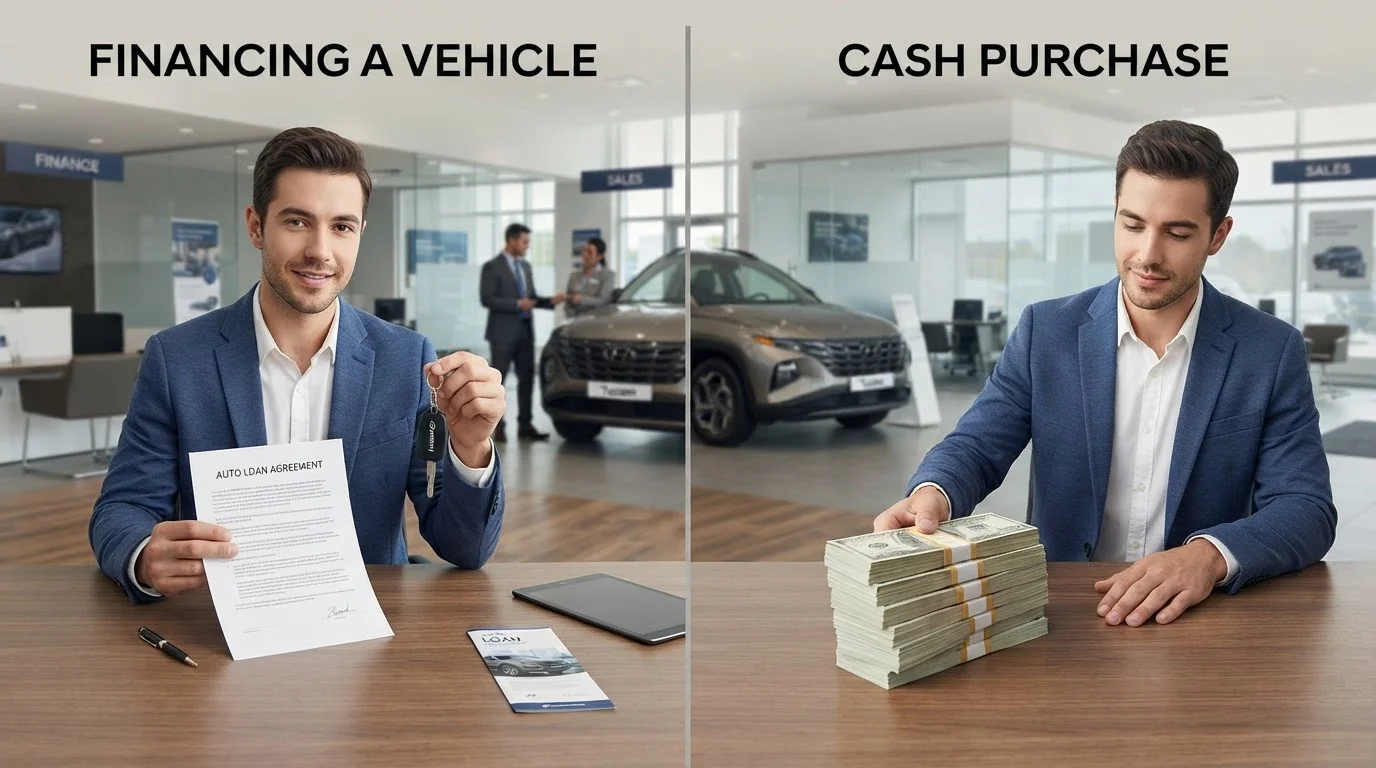
Option A
Auto Loan Financing
The structured, spread-out payment approach.
Best for: Buyers who want to preserve liquid savings or take advantage of low promotional interest rates.
Option B
Paying Cash Outright
The debt-free, ownership-from-day-one route.
Best for: Buyers with sufficient savings who prefer no monthly obligations and lower total cost over time.
What Each Path Actually Involves
When you finance a car, a lender - typically a bank, credit union, or the dealership's finance arm - pays the seller on your behalf. You then repay the lender in monthly installments over an agreed term, usually 24 to 72 months, plus interest. The lender holds a lien on the vehicle's title until the loan is fully repaid, meaning you don't own it outright during that period.
When you pay cash, you transfer the full purchase price directly to the seller. The title transfers to you immediately, with no lender involvement. There are no monthly payments, no interest charges, and no lienholder restrictions on what you can do with the vehicle.
Both paths get you the same car. The difference lies in timing, cost, and how each interacts with your broader financial situation. For a related look at how this ownership-versus-obligation dynamic plays out elsewhere, see our guide on renting vs. buying a home.
| Criterion | Auto Loan Financing | Paying Cash Outright |
|---|---|---|
| Upfront cost | Low (down payment only) | High (full purchase price) |
| Total cost over time | Higher (interest adds up) | Lower (no interest charges) |
| Monthly obligation | Yes - fixed loan payment | None |
| Ownership of title | Lender holds lien until paid off | Immediate full ownership |
| Liquidity preserved | Yes - savings stay intact | No - cash is spent upfront |
| Insurance requirements | Lender may require full coverage | Only state minimums required |
| Negative equity risk | Possible in early loan years | Not applicable |
| Credit score impact | Builds credit with on-time payments | No impact on credit history |
The Real Cost of Financing
The most concrete downside of an auto loan is interest. Over a 60-month loan at a moderate rate, you can pay several thousand dollars more than the vehicle's sticker price by the time the final payment clears. The longer the term, the more interest accumulates - even if monthly payments feel more manageable.
There's also the risk of negative equity - a situation where you owe more on the loan than the car is currently worth. Because vehicles depreciate quickly in their early years, loan balances can temporarily exceed market value. Understanding negative equity and how it arises is worth doing before committing to a long loan term.
Lenders also typically require you to carry comprehensive and collision insurance as long as the loan is active, which can increase your ongoing ownership costs compared to a paid-off vehicle.
~85%
New vehicles financed or leased at purchase
According to Experian's State of the Automotive Finance Market reports, the vast majority of new car transactions in the U.S. involve some form of financing.
68-72 months
Average new car loan term in the U.S.
Experian's automotive finance data has consistently shown average loan terms stretching close to or beyond six years in recent reporting periods.
Thousands
Dollars added by interest on a typical auto loan
Depending on loan amount, term, and rate, total interest paid over the life of an average auto loan commonly ranges from a few hundred to several thousand dollars.
The Hidden Cost of Paying Cash
Paying cash sounds straightforwardly cheaper - and often is, in total dollars spent on the car itself. But there's a subtler cost: opportunity cost. Money used to buy a car outright is money no longer working in an interest-bearing account, investment portfolio, or emergency fund.
If your savings account or conservative investments are earning a return that exceeds the interest rate you'd pay on an auto loan, financing the car and leaving that money invested could - in theory - result in a better overall financial position. This calculation is personal and depends on actual rates, your tax situation, and your risk tolerance. It's general financial education, not a recommendation for any individual, and a qualified financial adviser can help you model the numbers for your circumstances.
There's also the liquidity question. A car is not a liquid asset. Once that cash is spent, recovering it requires selling or trading the vehicle - a process that takes time and typically returns less than purchase price. Keeping a financial cushion for emergencies, medical costs, or home repairs is a consideration that shouldn't be overlooked. You can explore a broader version of this decision-making framework in our overview of what each path really means.
Cash Purchases and Dealer Negotiations
Paying cash doesn't automatically guarantee a lower negotiated price. Dealers sometimes prefer financed buyers because they can earn revenue from financing arrangements. Negotiating the vehicle price separately from the payment method is generally a sound approach regardless of how you plan to pay.
Key Factors to Weigh Before Deciding
Rather than declaring one method superior, here are the variables that most directly affect which path fits your situation:
- Interest rate offered: A low rate narrows the financial gap between financing and cash. A high rate widens it significantly.
- Your emergency fund: Financial planners commonly suggest keeping three to six months of living expenses accessible. If a cash purchase depletes that buffer, financing may be the more prudent choice.
- Credit profile: Borrowers with strong credit tend to qualify for lower rates, making financing more cost-effective. Weaker credit leads to higher rates that erode the case for a loan.
- Loan term length: Shorter terms mean higher monthly payments but less total interest. Longer terms reduce monthly burden but cost more overall.
- Your plans for the vehicle: If you intend to keep the car long-term, the financing cost is spread over many years of use. If you plan to sell or trade within a few years, carrying a loan requires careful attention to equity position.
It's also worth comparing financing with leasing as a third option - our breakdown of leasing vs. buying covers what the numbers often don't make obvious upfront.
This article is for general informational purposes only and does not constitute personalized financial or legal advice. For guidance specific to your financial situation, consult a qualified financial professional.
The content on this site is for informational purposes only and is not a substitute for professional advice. Always consult a qualified professional for guidance specific to your situation.