

Start here
Why Equipment-Free Movement Works
Build your foundation
The Four Movement Categories to Cover
Plan your week
Structuring Your Weekly Routine
Keep improving
Progressing Without Adding Gear
Stay consistent
Common Pitfalls and How to Avoid Them
Why Equipment-Free Movement Works
The assumption that effective exercise requires a gym membership or a rack of dumbbells is one of the most persistent barriers to getting started. In practice, your own bodyweight provides a highly adaptable resistance tool - one you carry everywhere and can use in a living room, backyard, or hotel room.
Bodyweight training works because the muscles respond to mechanical tension, not to the source of that tension. When you lower yourself slowly into a squat or hold a plank, your muscles are working hard enough to trigger the physiological processes that build strength and endurance. The challenge can always be scaled - either up or down - without purchasing a single piece of equipment.
For a broader perspective on how structured and unstructured movement both contribute to health, see our practical framework for everyday activity.
The Four Movement Categories to Cover
A balanced routine addresses four fundamental movement patterns. Neglecting any one of them over time can create imbalances that limit performance and increase injury risk.
- Push movements train the chest, shoulders, and triceps. Examples include push-up variations (wall, incline, standard, decline) and pike push-ups targeting the shoulders.
- Pull movements work the back and biceps. Without a bar, these can include towel rows using a door, bodyweight rows under a sturdy table, or scapular retraction exercises.
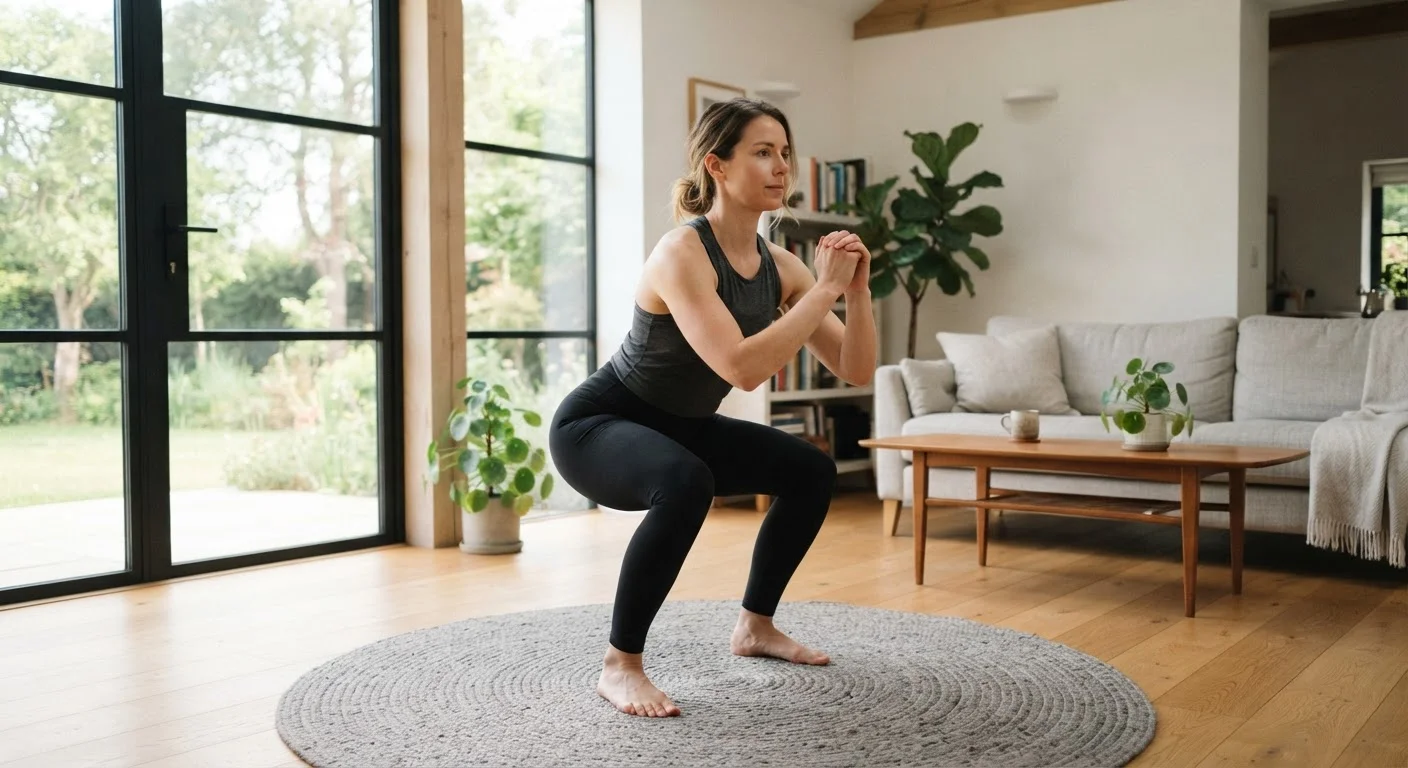
- Hinge and squat patterns develop the lower body and posterior chain - the glutes, hamstrings, and quads. Bodyweight squats, reverse lunges, glute bridges, and single-leg variations all fit here.
- Core and carries build the stabilising muscles of the trunk. Planks, dead bugs, hollow body holds, and slow mountain climbers are effective options that require no equipment at all.
Cardiovascular fitness can be layered in through movement density - shorter rest periods, circuits, or dedicated sessions of jumping jacks, marching in place, or stair climbing.
Balance Push and Pull Every Week
Many beginners naturally gravitate toward push exercises like squats and push-ups while underrepresenting pull movements. Over time, this creates muscular imbalances that can affect posture and shoulder health. Even without a pull-up bar, prioritise at least one pulling movement per session using household alternatives like table rows.
Structuring Your Weekly Routine
Structure removes the daily decision of what to do, which is one of the biggest friction points for beginners. A simple and sustainable starting framework might look like this:
- Day 1: Full-body strength - push, squat, core
- Day 2: Rest or light walking
- Day 3: Full-body strength - hinge, pull, core
- Day 4: Rest or mobility work
- Day 5: Cardio-focused - circuits or continuous movement
- Days 6-7: Rest and recovery
This is a template, not a prescription. Adjust days around your schedule - the most important variable is that rest days exist between strength sessions. For a more detailed look at weekly planning principles, building a weekly movement routine from scratch provides a thorough breakdown.
Sessions at this stage can be as short as 20-30 minutes. Duration is far less important than showing up consistently.
Shorter Sessions Still Count
Public health guidelines generally recommend accumulating 150 minutes or more of moderate-intensity activity per week, but these do not need to happen in long single blocks. Three 10-minute sessions in a day contribute meaningfully to that total. Starting with shorter, consistent efforts is more sustainable than infrequent long workouts for most beginners.
Progressing Without Adding Gear
Progressive overload - gradually increasing the demand placed on the body - is the engine of improvement. Without it, your body adapts to a given challenge and stops changing. With bodyweight training, you have several non-equipment levers to pull:
- Increase repetitions or sets
- Adding more reps or an extra set raises total volume, a well-established driver of muscular adaptation.
- Slow the tempo
- A three-second descent in a squat or push-up dramatically increases time under tension and difficulty.
- Reduce leverage
- Moving from a two-leg glute bridge to a single-leg version, or from a standard squat to a Bulgarian split squat, shifts more load onto fewer muscles.
- Reduce rest periods
- Less recovery between sets raises cardiovascular demand and metabolic stress.
- Advance movement complexity
- Working toward movements like pistol squats, archer push-ups, or single-leg deadlifts adds both strength and coordination demands.
For a deeper comparison of how bodyweight progression compares to equipment-based training, see bodyweight vs. resistance equipment training.
Common Pitfalls and How to Avoid Them
Even with no financial investment, home movement routines frequently stall for predictable reasons.
- Skipping rest days. Recovery is not passive - it is when muscle repair and strength adaptation occur. Treating rest as wasted time leads to accumulated fatigue and plateau. Our article on rest days in a fitness routine explains the physiological reasons rest is non-negotiable.
- Staying at the same difficulty indefinitely. Comfort is not progress. Revisit your routine every three to four weeks and apply at least one progression lever.
- Prioritising quantity over form. Performing twenty sloppy squats trains poor mechanics. Ten controlled repetitions with proper alignment build the movement skill that makes progression safe.
- All-or-nothing thinking. Missing a session does not erase prior progress. Returning to the routine after an interruption - at a slightly reduced intensity if needed - is always the right response.
Pain Is Not Normal Discomfort
Muscle fatigue and mild soreness after exercise are normal. Sharp, joint-specific, or persistent pain during or after a session is not. If you experience pain beyond general muscle effort, stop the exercise and consult a healthcare professional before continuing. Do not push through pain in the hope it will resolve on its own.
This article provides general health information for educational purposes only and is not a substitute for personalised advice from a qualified healthcare or fitness professional. If you have any health conditions, injuries, or concerns, consult a professional before beginning a new exercise programme.
Frequently Asked Questions
Yes. Research supports that progressive bodyweight training stimulates muscle growth and strength gains through the same fundamental mechanism as weighted exercise - progressive overload applied to muscles. The key is systematically increasing difficulty over time rather than simply repeating the same movements indefinitely.
Most beginners benefit from two to four active days per week with at least one rest or recovery day between strength-focused sessions. Starting with two to three days allows the body to adapt without excessive fatigue. Quality and consistency outweigh frequency at this stage.
Most bodyweight exercises require only enough floor space to lie down with your arms extended - roughly a yoga mat's worth of area. A small living room corner, bedroom floor, or outdoor space is generally sufficient for a complete routine.
For most healthy adults, beginner bodyweight movements are low-risk when performed with attention to form. If you have a pre-existing injury, chronic health condition, or are returning from illness, consult a qualified healthcare or fitness professional before beginning any new exercise programme.
Regression variations exist for every movement pattern. For example, incline push-ups against a wall or counter reduce load significantly, and chair-assisted squats provide support while building range of motion. Starting at a difficulty level you can control safely is always the right approach.
A reliable signal is completing your target reps with good form and minimal effort across multiple sessions. When a movement feels consistently manageable and controlled, it is generally appropriate to introduce a more challenging variation or add more volume.
The content on this site is for informational purposes only and is not a substitute for professional advice. Always consult a qualified professional for guidance specific to your situation.