

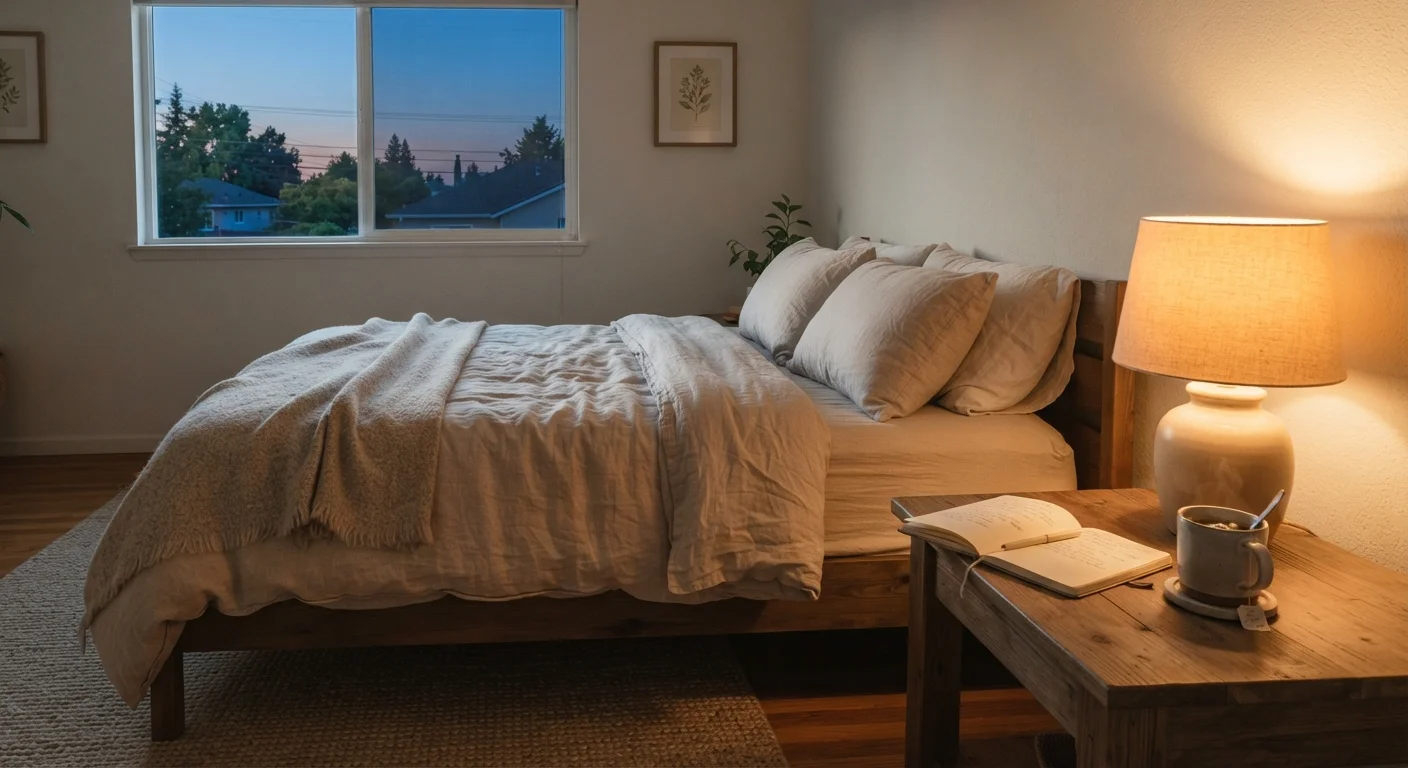
Why the Hour Before Bed Matters More Than You Think
Most sleep advice focuses on what happens during the night - but sleep quality is largely determined by what you do in the 45-60 minutes that precede it. Your autonomic nervous system doesn't switch instantly from an alert, active state into one ready for deep rest. It needs time, the right environmental cues, and a reduction in stimulation to complete that transition.
Sleep researchers describe this as sleep pressure and circadian alignment: the combination of accumulated wakefulness (adenosine buildup) and the falling phase of your core body temperature that together create the biological conditions for sleep onset. A poor wind-down routine disrupts both. Bright light delays melatonin release; psychological stress elevates cortisol; and high-stimulation activity keeps the brain's alerting systems firing when they should be standing down.
Understanding these mechanisms helps clarify why a wind-down routine isn't a wellness luxury - it's a practical tool grounded in how the nervous system actually works. If you've noticed that disrupted sleep affects your alertness while driving at night, our article on night driving habits explores how fatigue specifically changes driving performance.
Dim lamp or warm-toned bulb
Replaces bright overhead lighting in the final hour to support natural melatonin rise.
Physical notebook and pen
Used for journaling or a brief brain dump to offload mental tasks before sleep.
Blue-light blocking mode or Night Shift setting
Reduces short-wavelength light output if device use is unavoidable in the evening.
Herbal tea (caffeine-free)
A warm, non-stimulating beverage that supports the body-temperature drop associated with sleep onset.
White noise machine or earplugs
Masks disruptive ambient sound that can delay or fragment sleep.
Building Your Routine: The Evidence-Based Steps
The following steps reflect the core principles from sleep hygiene research. You don't need to implement all of them at once - start with the one or two that address your most consistent obstacles and build from there. Consistency over several weeks will produce more meaningful results than a perfect single-night effort.
The Two-Minute Brain Dump Trick
Before you begin your wind-down, spend two minutes writing tomorrow's three most important tasks on paper. Research published in the journal Experimental Brain Research found that offloading unfinished tasks to a written plan frees working memory and reduces pre-sleep cognitive arousal. Keep a small notepad on your bedside table for exactly this purpose.
Set a firm wind-down start time
Choose a time 45-60 minutes before your intended sleep time and treat it as a non-negotiable cue. Consistency of timing anchors your circadian rhythm - the internal 24-hour clock regulated largely by light and behavioral patterns. Pick a realistic time you can sustain on most weeknights, even if weekends shift slightly.
Dim the lights throughout your home
Your brain interprets bright white or blue-toned light as a signal that it's still daytime, which suppresses melatonin production. In the 45-60 minutes before bed, switch from overhead lighting to a lamp or warm-toned (amber) bulb. This single environmental shift is among the most evidence-supported steps in sleep hygiene research.
Close out open mental loops
Unfinished tasks and unresolved worries are a primary driver of the racing mind that keeps people awake. Take two to five minutes to write down any pending decisions, tomorrow's priorities, or lingering concerns in a notebook. The act of externalizing these thoughts - rather than mentally rehearsing them - reduces cognitive arousal at the time you want your brain quieting down.
Replace screens with a low-stimulation activity
Scrolling social media, watching high-intensity content, or reading emotionally charged news elevates alertness through both light exposure and psychological arousal. Swap these for activities with low cognitive demand: reading fiction in print, light stretching, listening to calm audio, or a brief mindfulness practice. The goal is to reduce nervous system activation, not simply to avoid screens for their own sake.
Lower your core body temperature
Sleep onset is closely tied to a drop in core body temperature. A warm shower or bath taken 60-90 minutes before bed is counterintuitively effective: it draws blood toward the skin's surface, releasing heat and producing a subsequent temperature drop that mimics and reinforces the body's natural cooling process. Keeping the bedroom cool (most sleep researchers point to a range around 65-68°F / 18-20°C as commonly supportive) also helps maintain this state through the night.
Use a consistent sensory cue as your final signal
A brief, repeatable sensory ritual - a specific scent, a particular piece of music, or a short breathing exercise - trains your nervous system through classical conditioning to associate that cue with sleep readiness. Over time, the cue itself becomes a reliable trigger. Keep it short (two to five minutes) and perform it in or immediately adjacent to your sleep space.
Avoid Vigorous Exercise Close to Bedtime
Moderate movement earlier in the day generally supports sleep, but intense aerobic or strength exercise within 60-90 minutes of bedtime can raise core body temperature and elevate cortisol, making it harder to fall asleep. Timing matters - shift demanding workouts to earlier in the day if sleep onset is a concern.
This article is for general informational purposes only and does not constitute medical advice. If you experience persistent sleep difficulties, consult a qualified healthcare professional.
Adapting Your Routine for Travel and Disruption
One of the most common challenges to a wind-down routine is travel, particularly across time zones. When your circadian rhythm is misaligned with local time, the behavioral cues from your routine take on even greater importance - they act as anchors that help accelerate re-synchronization. Trying to maintain the structure of your routine (dim lights, a consistent sensory cue, screen reduction) even in an unfamiliar environment can meaningfully reduce the functional impact of jet lag.
For a deeper look at what happens physiologically when you cross time zones, see our guide to the science of crossing time zones and our practical planning resource on time zone shifts and long-haul travel.
This Is General Information, Not Medical Advice
The guidance in this article reflects general sleep hygiene principles supported by research. It is not a substitute for evaluation or treatment by a qualified healthcare provider. If you experience persistent insomnia, frequent night waking, or suspect a sleep disorder such as sleep apnea, please consult a licensed medical professional.
The content on this site is for informational purposes only and is not a substitute for professional advice. Always consult a qualified professional for guidance specific to your situation.