

Our Verdict
The evidence consistently favors replacing saturated and trans fats with unsaturated alternatives where possible, rather than pursuing an ultra-low-fat diet. Artificial trans fats are the clearest target for avoidance, while unsaturated fats from whole-food sources deserve a regular place on your plate. Saturated fat sits in a nuanced middle - reasonable moderation is prudent, but the overall dietary pattern matters most.
| Best for | Recommended |
|---|---|
| Those prioritizing heart health | Unsaturated fats (monounsaturated and polyunsaturated) |
| Those seeking the clearest dietary risk to eliminate | Reducing artificial trans fats |
| Those focused on balanced, whole-diet approaches | A mixed fat profile emphasizing unsaturated sources |
Why Fat Is Not the Enemy
For decades, dietary fat was portrayed as the primary driver of obesity and heart disease, spurring a wave of low-fat products that often substituted fat with added sugars. Current nutritional science tells a more nuanced story: fat is a macronutrient the body cannot function without. It supports cell membrane integrity, helps absorb fat-soluble vitamins (A, D, E, and K), enables hormone production, and provides sustained energy.
The critical distinction is not between fat and no fat, but between different types of fat - and how each interacts with cardiovascular risk, inflammation, and metabolic health. This is an area where the evidence has become substantially clearer over the past two decades, even as headlines continue to confuse. For context on why nutrition guidance shifts, see our explainer on nutrition confusion.
The Three Major Fat Categories Compared
Dietary fats are classified by their chemical structure - specifically, the number and arrangement of double bonds between carbon atoms. This structure determines how they behave in the body.
| Saturated Fat | Monounsaturated Fat | Polyunsaturated Fat | Artificial Trans Fat | |
|---|---|---|---|---|
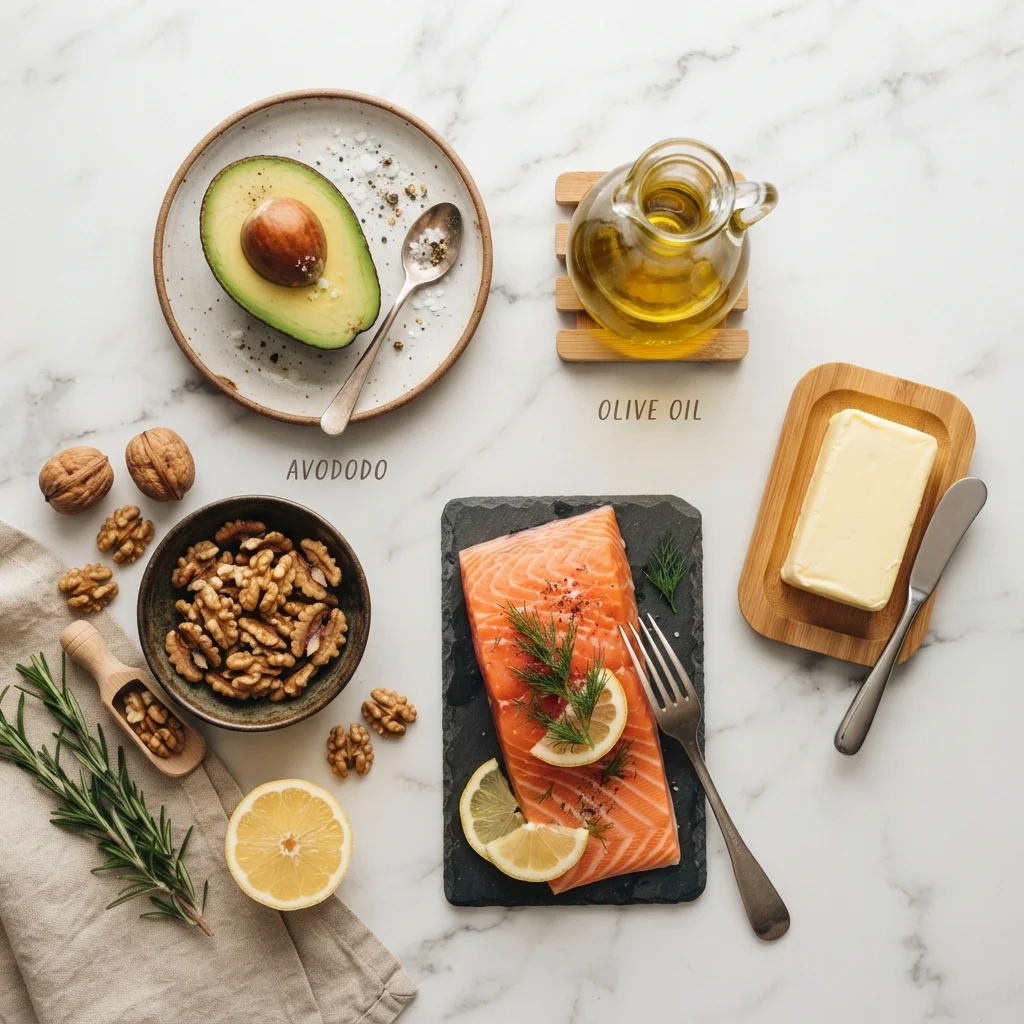
| Common sources | Red meat, butter, coconut oil | Olive oil, avocados, almonds | Fatty fish, walnuts, flaxseed | Partially hydrogenated oils (now largely banned) |
| State at room temperature | Solid | Liquid | Liquid | Solid or semi-solid |
| Effect on LDL cholesterol | Raises LDL | May lower or neutral | Generally lowers LDL | Strongly raises LDL |
| Effect on HDL cholesterol | Neutral to slight raise | May raise HDL | Variable by type | Lowers HDL |
| Cardiovascular evidence | Moderate risk; context-dependent | Generally favorable | Well-supported benefit | Clearly harmful |
| Current guidance | Limit; replace with unsaturated | Include regularly | Include regularly | Avoid entirely |
Understanding these distinctions helps explain why nutrition researchers and dietary guidelines consistently encourage shifting toward unsaturated fat sources without requiring fat elimination altogether. As the myths in nutrition science article explores, the blanket "fat is bad" narrative is one of the most persistent and least evidence-supported claims in popular health culture.
Saturated Fat: A More Complicated Picture
Saturated fats - found in red meat, full-fat dairy, coconut oil, and palm oil - are solid at room temperature. They've traditionally been linked to raised LDL (low-density lipoprotein) cholesterol, a known cardiovascular risk factor. Major health organizations including the American Heart Association still recommend limiting saturated fat intake.
However, emerging research suggests the picture isn't entirely uniform. Some studies indicate that the food source of saturated fat (for example, full-fat dairy versus processed meat) may carry different risk profiles, and that what you eat instead of saturated fat - refined carbohydrates versus unsaturated fats - significantly shapes outcomes. Replacing saturated fat with refined carbs does not appear to lower cardiovascular risk, but replacing it with polyunsaturated fats generally does, according to research published in nutritional epidemiology literature.
Think Substitution, Not Just Reduction
When adjusting fat intake, focus on what you replace saturated fat with - not just how much you cut. Swapping butter for olive oil, or switching from fatty processed meats to fish or legumes, tends to improve cardiovascular markers more effectively than simply reducing total fat. A registered dietitian can help you apply this principle to your specific eating habits.
The practical takeaway: moderate saturated fat intake within a diet rich in vegetables, legumes, and whole grains, rather than fixating on elimination.
Unsaturated Fats: The Evidence-Backed Option
Unsaturated fats divide into two groups. Monounsaturated fats (MUFAs) - found in olive oil, avocados, and most nuts - are associated with improved LDL-to-HDL cholesterol ratios. Polyunsaturated fats (PUFAs) include omega-6 fatty acids (found in vegetable oils and seeds) and omega-3 fatty acids (found in fatty fish like salmon and mackerel, walnuts, and flaxseed).
Omega-3 PUFAs in particular carry a robust body of evidence supporting their role in reducing inflammation and lowering triglycerides. Dietary patterns emphasizing these fats - such as the Mediterranean and DASH approaches - consistently show favorable cardiovascular outcomes in observational and intervention research. See eating patterns with strong research support for a deeper look at those frameworks.
~10%
Cardiovascular risk reduction from PUFA substitution
Research in PLOS Medicine found replacing 5% of saturated fat calories with polyunsaturated fat was associated with roughly a 10% lower risk of coronary heart disease events.
2-3x
CVD risk increase linked to trans fat intake
Multiple large prospective studies have estimated that diets high in artificial trans fats were associated with a two- to threefold increase in coronary heart disease risk compared to equivalent calories from unsaturated fat.
The broader dietary context matters too. Choosing unsaturated fat sources from whole foods - rather than heavily refined oils in ultra-processed snack products - amplifies the benefit. The distinction between whole and ultra-processed foods is relevant here, as processing can offset the quality of even nominally healthy fat sources.
Trans Fats: The Clearest Case for Avoidance
Artificial trans fats - created by partially hydrogenating liquid vegetable oils - are the most well-established dietary fat risk. They simultaneously raise LDL cholesterol and lower HDL (high-density lipoprotein) cholesterol, a dual effect that significantly elevates cardiovascular disease risk. The FDA effectively banned partially hydrogenated oils (PHOs) from the US food supply, and levels in processed foods have dropped considerably.
Small amounts of naturally occurring trans fats exist in some animal products (such as conjugated linoleic acid in dairy and meat), and these do not appear to carry the same risks as their artificial counterparts.
When reading food labels, look for "partially hydrogenated oil" in the ingredient list - US labeling rules permit products containing less than 0.5g of trans fat per serving to be labeled as containing 0g, so ingredients remain the more reliable check.
This article is for general informational and educational purposes only, and does not constitute medical or dietary advice. Please consult a qualified healthcare professional or registered dietitian for guidance tailored to your individual health circumstances.
The content on this site is for informational purposes only and is not a substitute for professional advice. Always consult a qualified professional for guidance specific to your situation.