

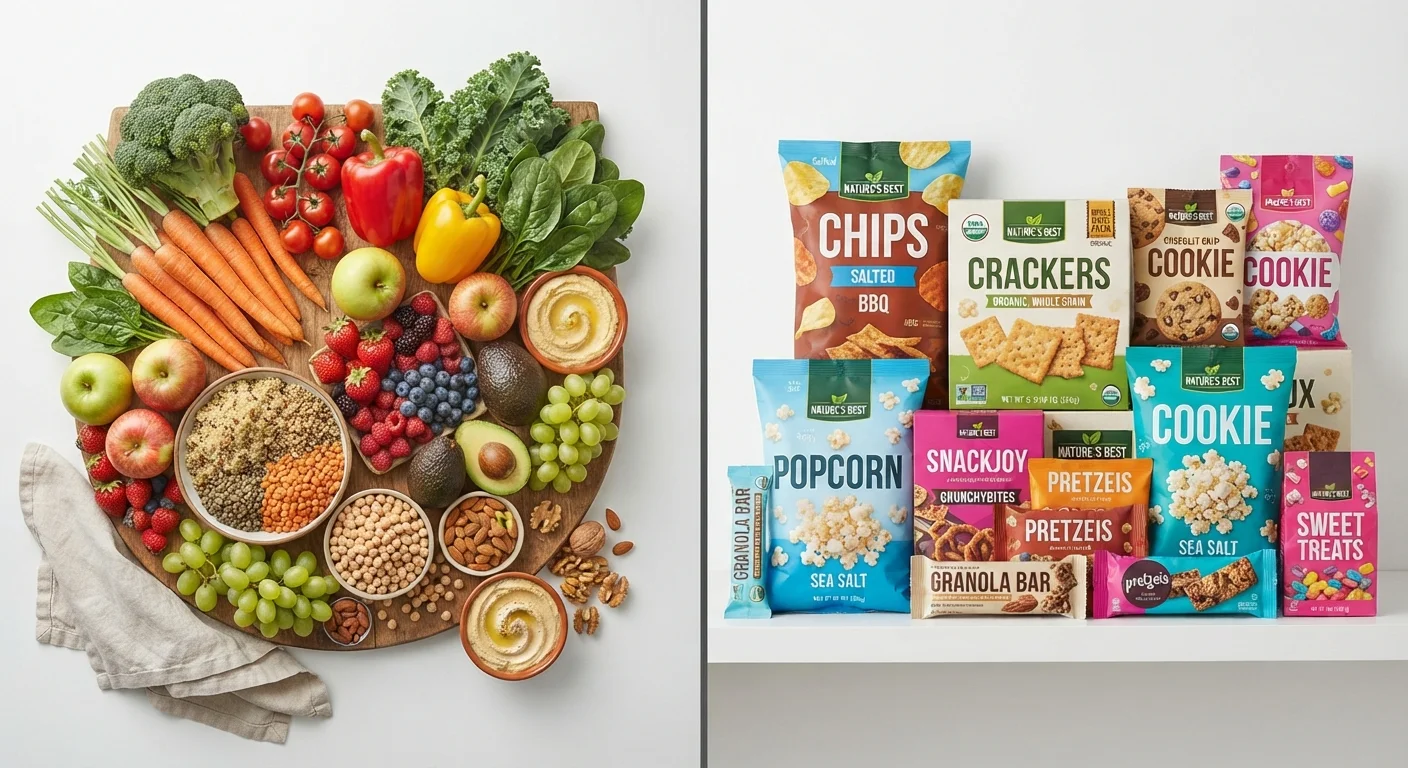
Option A
Whole Foods
Minimally altered, nutritionally dense foods as found in nature.
Best for: People seeking to maximize fiber, micronutrient, and phytochemical intake through their everyday diet.
Option B
Ultra-Processed Foods
Industrially manufactured products engineered for palatability and shelf stability.
Best for: Convenience and affordability, though nutrition research links heavy reliance on them to potential health concerns.
Defining the Terms: More Than Just 'Natural'
The word whole foods gets used loosely in everyday conversation, but in nutrition science it has a fairly consistent meaning: foods that are eaten close to their natural state with little or no industrial alteration. Think fresh fruit, vegetables, legumes, whole grains, nuts, seeds, eggs, and plain meat or fish. Minimal processing - washing, cutting, freezing, or cooking - doesn't disqualify a food from this category.
Ultra-processed foods are defined more precisely through the NOVA classification system, developed by researchers at the University of São Paulo. NOVA groups foods into four levels based on the extent and purpose of processing, not nutrient content alone. Ultra-processed products (NOVA Group 4) are industrial formulations made mostly from substances extracted or derived from foods - such as hydrogenated oils, modified starches, and protein isolates - combined with additives like emulsifiers, artificial flavors, colors, and preservatives. Examples include packaged snacks, sugary breakfast cereals, reconstituted meat products, and many flavored beverages.
Critically, the NOVA framework distinguishes ultra-processed from simply processed. Canned tomatoes, plain yogurt, and pasteurized cheese are processed but do not fall into the ultra-processed category. Understanding this nuance matters when evaluating research findings. For a broader look at how processing affects nutritional value, see our breakdown of whole vs. processed foods.
What Nutrition Research Actually Shows
A substantial and growing body of observational research links high ultra-processed food consumption to a range of unfavorable health associations - including higher rates of obesity, type 2 diabetes, cardiovascular disease, and all-cause mortality. A large prospective study published in The BMJ found that each 10% increase in the proportion of ultra-processed foods in the diet was associated with a 12% higher risk of cancer overall, though researchers emphasized the observational nature of the data.
The challenge with this research is that most of it is observational, meaning it identifies associations but cannot definitively establish causation. People who eat more ultra-processed foods may also have other lifestyle factors - lower income, less sleep, higher stress - that independently influence health. Some researchers argue that ultra-processed foods may act as markers of overall poor dietary patterns rather than being harmful in isolation.
However, mechanistic hypotheses exist. Ultra-processed foods tend to be calorie-dense, low in fiber, and high in sodium and added sugars - characteristics linked independently to health risks. Some additives, such as certain emulsifiers, are under active study for potential effects on gut microbiome composition, though research in humans remains preliminary.
57%
Share of US caloric intake from ultra-processed foods
A study published in BMJ Open estimated that ultra-processed foods account for approximately 57% of total caloric intake among US adults.
12%
Higher overall cancer risk per 10% increase in UPF intake
A large prospective cohort study published in The BMJ found this association, though researchers noted it is observational and cannot confirm causation.
4 groups
NOVA food classification levels
The NOVA system, developed at the University of São Paulo, sorts all foods into four groups ranging from unprocessed to ultra-processed based on industrial transformation.
Whole foods, by contrast, consistently appear favorably in dietary pattern research. Diets rich in vegetables, fruits, legumes, and whole grains - the backbone of Mediterranean and DASH dietary patterns - are among the most studied and the most reliably associated with positive health outcomes. For context on how to interpret shifting nutrition headlines, understanding why nutrition research is complex is a useful starting point.
Head-to-Head: How the Two Categories Compare
The table below contrasts whole and ultra-processed foods across several dimensions that matter for everyday dietary choices.
| Criterion | Whole Foods | Ultra-Processed Foods |
|---|---|---|
| Degree of processing | Minimal or none | Extensive industrial transformation |
| Typical fiber content | Naturally higher | Often stripped out or absent |
| Added sugars & sodium | Naturally low or absent | Frequently high |
| Artificial additives | None | Common (flavors, colors, emulsifiers) |
| Micronutrient density | Naturally rich | Variable; often low, sometimes fortified |
| Shelf life | Shorter | Extended by design |
| Research health associations | Generally favorable | Frequently unfavorable (observational data) |
| Cost & convenience | Varies; staples are affordable | Often convenient and shelf-stable |
One nuance worth noting: ultra-processed foods are not nutritionally uniform. Some fortified products, such as certain plant-based milks or whole-grain breakfast cereals with added vitamins, are technically ultra-processed but offer micronutrients that may be harder to obtain otherwise. The NOVA category alone doesn't capture every dimension of nutritional quality, which is why researchers encourage using it alongside, not instead of, nutrient-level analysis. Learning to read a nutrition label is one practical skill that bridges both approaches.
Making the Shift: Practical and Realistic Steps
Dietary change doesn't require an all-or-nothing overhaul. Research on dietary patterns suggests that even partial shifts toward whole foods - replacing a few ultra-processed items per day - can meaningfully improve overall diet quality over time.
Some accessible strategies include:
- Anchor meals with whole-food staples: Legumes, oats, eggs, frozen vegetables, and whole grains are affordable, widely available, and require minimal cooking skills.
- Use ingredient lists as a quick screen: Foods with long lists of unfamiliar additives are more likely to be ultra-processed. A short, recognizable ingredient list is a useful heuristic.
- Batch cook when time allows: Preparing whole foods in bulk - a pot of beans, roasted vegetables, cooked whole grains - reduces reliance on convenience products during busy periods.
- Don't pursue perfection: Occasional ultra-processed foods in an otherwise whole-food-rich diet are unlikely to undermine health. Pattern and proportion matter more than any single food choice.
A Note on 'Healthy' Ultra-Processed Products
Some ultra-processed foods are marketed with health claims - high protein, added fiber, reduced sugar - that can make evaluation confusing. The NOVA classification and nutrient-level analysis are complementary tools; neither alone tells the full story. A product can be ultra-processed and still provide useful nutrients, just as a whole food can be consumed in excess. Context and overall dietary pattern remain the most meaningful frame.
For readers exploring how macronutrients fit into this picture, understanding dietary fat types and comparing protein sources can help build a more complete nutritional framework.
This article is for general informational and educational purposes only and is not a substitute for professional medical or dietary advice. Consult a qualified healthcare provider or registered dietitian for guidance tailored to your individual health needs.
The content on this site is for informational purposes only and is not a substitute for professional advice. Always consult a qualified professional for guidance specific to your situation.