

Why Nutrition Labels Exist - and What They Actually Tell You
The Nutrition Facts panel is a federally standardized format regulated by the U.S. Food and Drug Administration (FDA). It was designed to give consumers a consistent, comparable snapshot of what is in packaged food. Unlike front-of-package claims - which can say almost anything a manufacturer wants - the Nutrition Facts panel follows strict rules about what must be listed and how.
This standardization is genuinely useful: once you know how to read one label, you can read all of them. The format was most recently updated in 2020 to reflect current nutrition science, adding the "Added Sugars" line and making serving sizes more realistic. If nutrition fundamentals feel unfamiliar, the Nutrition From Scratch guide covers the core concepts before you dive in here.
Labels Are a Tool, Not a Verdict
A nutrition label tells you what is in a food, not whether you should or shouldn't eat it. No single food makes or breaks a healthy diet. Use labels to make informed choices, not to judge foods as "good" or "bad." If you have a specific health condition or dietary need, consult a registered dietitian for personalized guidance.
What you will need
What You Need Before You Start
Reading a nutrition label is a skill that improves with practice. You don't need any special knowledge to begin - just a packaged food item and a few minutes. Having the actual label in front of you as you follow the steps below will make each concept click faster than reading in the abstract.
A Packaged Food Item
Provides a real Nutrition Facts label to practice reading as you follow each step.
Smartphone Calculator
Useful for calculating total nutrient amounts when you eat more or fewer servings than listed.
Once you are comfortable with the basics, you can apply the same process to compare foods at the grocery store in real time - making label-reading a practical, everyday habit rather than a one-time exercise.
Step-by-Step: Reading the Label
Work through each section of the Nutrition Facts panel in order, from top to bottom. The structure is intentional: the most foundational information (serving size and calories) appears first, followed by nutrients to watch, and finally the ingredient list.
Find the Serving Size and Number of Servings
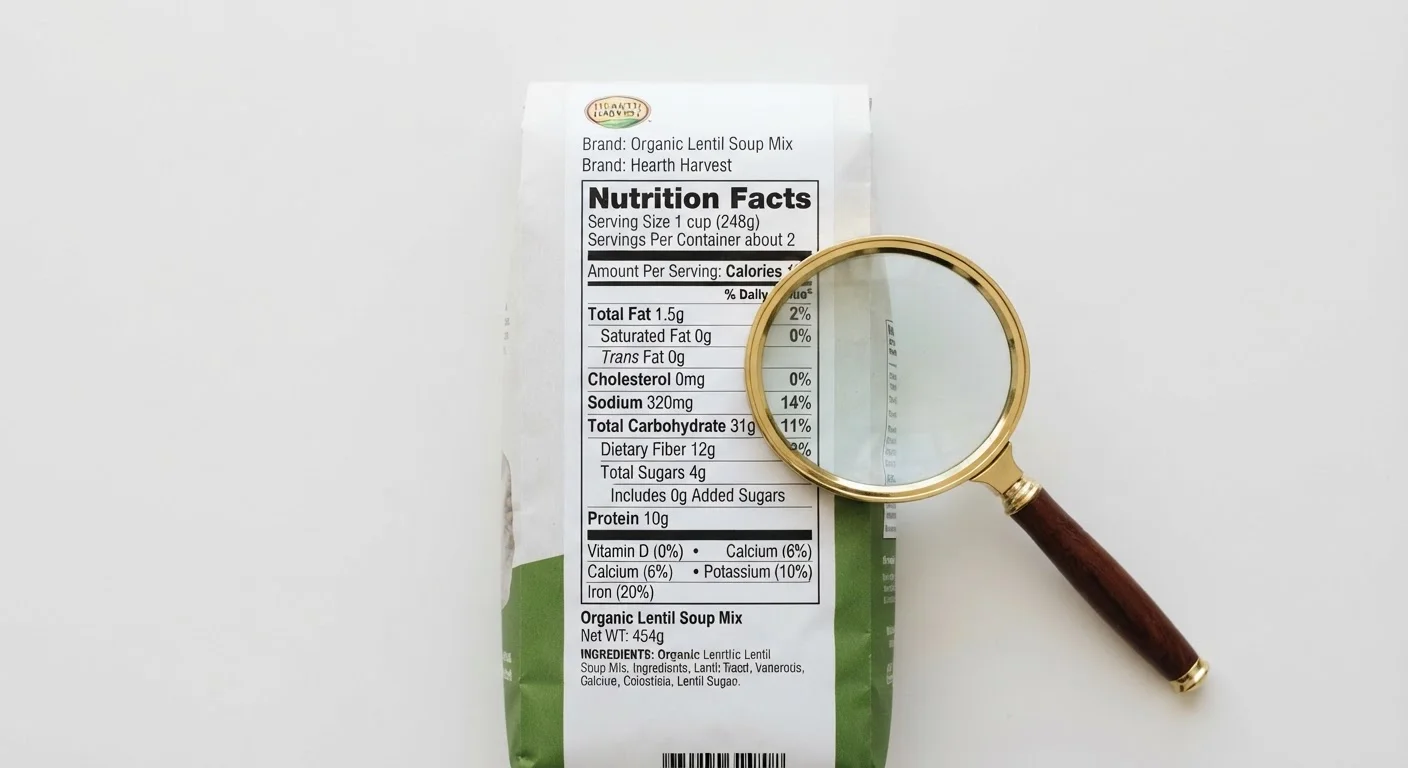
The very first line of any Nutrition Facts panel is Serving Size, followed immediately by Servings Per Container. Every calorie count and nutrient figure on the label applies to one serving - not the whole package.
Check how the serving size is expressed: it appears both as a common household measure (e.g., "1 cup" or "3 crackers") and as a gram weight. The gram weight is the more precise figure for comparison purposes.
Read the Calorie Count in Context
Directly below the serving size, you will see Calories displayed in large, bold type. This figure represents the total energy provided by one serving. It accounts for all three macronutrients: carbohydrates, protein, and fat.
Calories are useful context, but they only tell part of the story. A food can be calorie-dense and nutrient-rich, or calorie-light and nutritionally sparse. For a deeper look at this distinction, see our article on calories vs. nutrient density.
Identify Nutrients to Limit
The upper portion of the nutrient list highlights components that most Americans consume in excess. Scan for:
- Saturated Fat: Associated with cardiovascular risk at high intake levels. Check both the gram amount and the % Daily Value.
- Sodium: Found in large amounts in many packaged and processed foods. High sodium intake is linked to elevated blood pressure in some individuals.
- Added Sugars: Listed separately from total sugars since 2020. This figure shows sugars added during manufacturing, distinct from naturally occurring sugars in fruit or dairy.
Identify Nutrients to Prioritize
The lower section of the nutrient list features components that many Americans do not get enough of. Look for:
- Dietary Fiber: Supports digestive health and is associated with reduced risk of several chronic conditions.
- Vitamin D and Calcium: Critical for bone health; under-consumed in many US diets.
- Iron and Potassium: Also commonly under-consumed, particularly in certain population groups.
Choosing foods with higher % Daily Values for these nutrients is one straightforward way to improve overall dietary quality.
Decode the % Daily Value Column
The right-hand column on every label shows % Daily Value (%DV) for most listed nutrients. This percentage tells you how much of the recommended daily amount for that nutrient one serving provides, based on a 2,000-calorie reference diet established by the FDA.
%DV makes it easy to compare similar products side by side - for example, two breakfast cereals - without doing any math. A food with 30% DV for sodium per serving is meaningfully higher in sodium than one with 8% DV.
[tip_callout]Scan the Ingredient List
The ingredient list appears below the Nutrition Facts panel and is required by law on all packaged foods. Ingredients are listed in descending order by weight - the first ingredient makes up the largest proportion of the food by mass.
A short ingredient list does not automatically mean a food is healthier, but it can make the label easier to interpret. Look for added sugars appearing under many names (corn syrup, dextrose, maltose, cane juice, and others), as well as partially hydrogenated oils as a marker of trans fats. For a broader look at what distinguishes heavily processed foods from less processed options, see our guide on whole vs. ultra-processed foods.
% Daily Values Are a General Reference
The % Daily Value figures on every label are calculated against a standard 2,000-calorie daily diet. Your actual needs may differ significantly based on age, sex, activity level, or health status. These percentages are useful for comparison shopping, but they are not a personal prescription.
Putting It All Together
Reading a nutrition label is not about finding a "perfect" food or avoiding anything with fat or sodium. It is about building a clearer picture of what you are eating so you can make choices that align with your overall dietary pattern. A single label reading takes less than a minute once the habit is formed.
Context matters more than individual numbers. A food that is high in sodium might still fit well into a day where most other meals are low in sodium. Nutrition plays out over time and across your whole diet - not in a single food item or meal. For a practical view of how this balance works day to day, see what healthy eating looks like across a full week.
If you want to go further in evaluating the nutrition information you encounter beyond labels - including online articles and health claims - The Nutrition Information Audit offers a practical checklist for spotting credible sources versus oversimplified advice.
This article is for general informational purposes only and does not constitute medical or dietary advice. For guidance specific to your health needs, consult a registered dietitian or qualified healthcare professional.
The content on this site is for informational purposes only and is not a substitute for professional advice. Always consult a qualified professional for guidance specific to your situation.