

What Soil pH Actually Measures
Think of soil pH as a dial that controls access to nutrients. Even if your soil is packed with nitrogen, phosphorus, and trace minerals, a pH reading that's too low or too high effectively locks those nutrients away from plant roots. This is why gardeners sometimes apply fertiliser and still see stunted, yellowing plants - the problem isn't a lack of nutrients, it's a lack of access.
The scale runs from 0 to 14. Pure water sits at 7 (neutral). Vinegar is acidic, around 2-3; baking soda dissolved in water is alkaline, around 8-9. Your garden soil sits somewhere on that continuum, shaped by rainfall patterns, the parent rock beneath it, organic matter, and years of plant growth and decomposition.
In the US, soils in the humid Southeast and Pacific Northwest tend to run acidic, while soils in the arid Southwest often lean alkaline. That regional baseline matters before you touch a single amendment.
pH Varies Within a Single Garden
It's not unusual to find a pH difference of half a point or more between one corner of your garden and another. Factors like proximity to a concrete foundation (which leaches lime), the concentration of decomposing leaves, or previous amendment applications can all create localized variation. Testing from multiple spots and combining the samples gives a more reliable picture than a single scoop.
How pH Affects Nutrient Availability
Nutrients don't exist in soil as free-floating particles waiting to be absorbed. They bond to soil particles and dissolve into soil water depending on chemistry - and pH governs that chemistry. At a pH below 5.5, aluminum and manganese become soluble enough to reach toxic concentrations for many plants. Above 7.5, phosphorus binds tightly to calcium and becomes essentially unavailable. Iron, zinc, and boron all follow their own availability curves tied to pH.
This means that adding more fertiliser to pH-compromised soil often does very little. You're feeding nutrients into a system that can't deliver them. Correcting pH first - then fertilising - is the logical sequence. Our guide on common fertiliser myths explores this further.
6.0-7.0
Optimal pH range for most vegetables
University extension guidelines across the US consistently cite this range as supporting the broadest nutrient availability for common garden crops.
~25%
US agricultural soils with pH imbalance
Soil surveys conducted by the USDA indicate a significant portion of cultivated land has pH levels outside the optimal range for the crops being grown.
3-6 months
Typical time for lime to alter soil pH
Cooperative extension services commonly note this timeframe for ground limestone to measurably shift soil pH when properly incorporated and watered.
Testing Your Soil pH
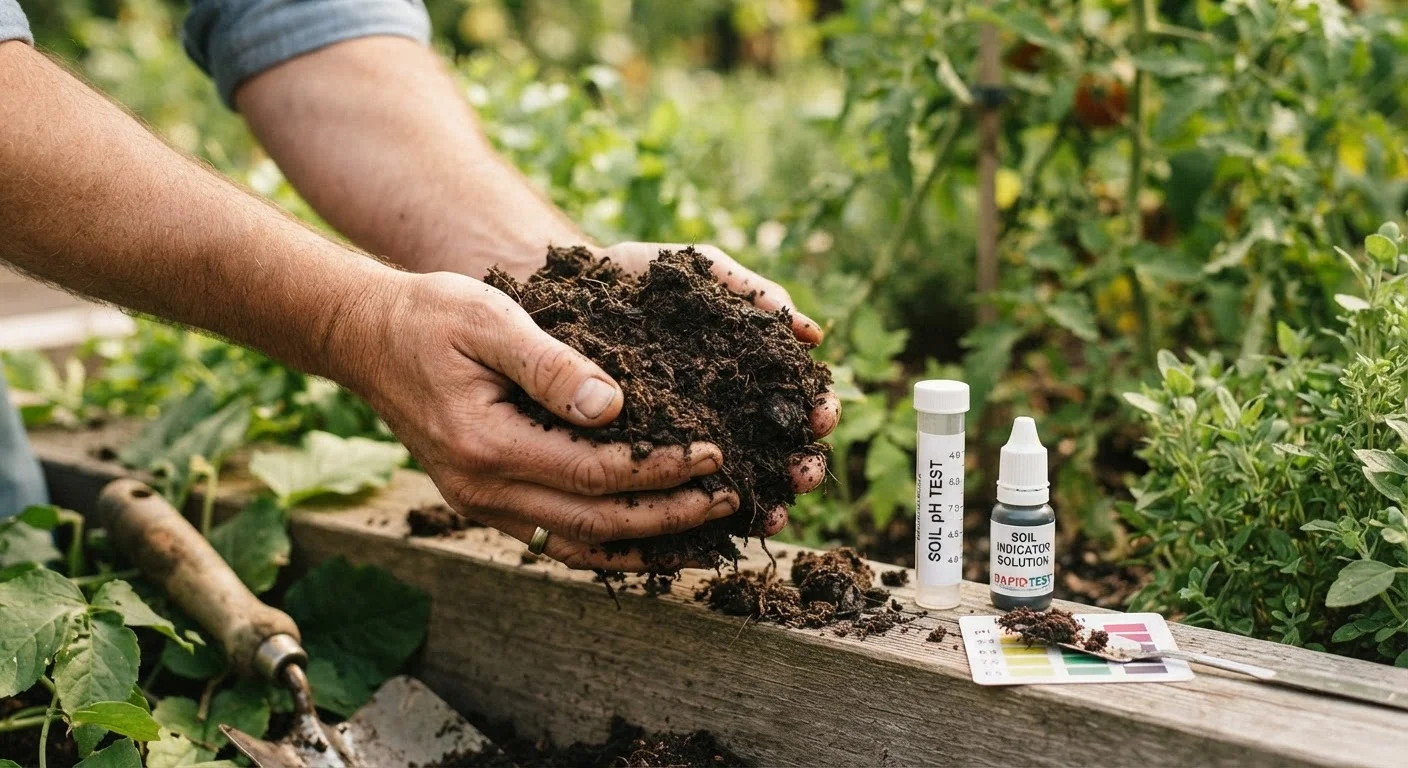
Home pH test kits are inexpensive and widely available at garden centers. They typically involve mixing a small soil sample with water and a color-indicator solution, then comparing the result to a chart. Results are approximate but sufficient for most gardens.
For more precision - especially if you're establishing a new vegetable plot or lawn - consider submitting a sample to your local cooperative extension service. Many US state universities offer this through their extension programs for a modest fee. You'll receive a detailed report including pH, nutrient levels, and specific amendment recommendations for your region and plant goals. If you're building a vegetable garden from scratch, our complete vegetable garden guide walks through soil preparation as part of that process.
Collect samples from several spots in your garden - pH can vary even within a small bed - and mix them together before testing for a representative reading.
Collect Soil Samples Correctly
Use a clean trowel and avoid sampling right after fertilising or heavy rain, as these events temporarily skew pH readings. Sample from 2-4 inches deep for vegetable beds and 1-3 inches deep for lawns. Dry the sample at room temperature before testing if the soil feels wet.
How to Adjust Soil pH
Once you know your baseline, corrections are straightforward - though not instant. To raise pH in acidic soil, garden lime (ground limestone) is the standard choice. Calcitic lime adds calcium; dolomitic lime adds both calcium and magnesium. The amount needed depends on your current pH, your target pH, and your soil texture - clay soils require more amendment than sandy soils to shift the same number of pH points.
To lower pH in alkaline soil, elemental sulfur is commonly used. Soil bacteria convert it into sulfuric acid over time, gradually acidifying the surrounding soil. This process is slower than liming and works best when incorporated well before planting season. Acidifying organic materials like pine bark, peat moss, or coffee grounds can also contribute in a modest way over time.
Work any amendment into the top 6-8 inches of soil rather than leaving it on the surface, and water it in thoroughly. Retest after 2-3 months. Patience matters - overcorrecting is a real risk and can be harder to fix than the original imbalance.
For lawn-specific pH concerns, the same principles apply. A healthy lawn starts with healthy soil; our overview of starting and sustaining a healthy lawn includes guidance on soil prep as part of long-term turf management.
Frequently Asked Questions
Most vegetables perform well at a pH between 6.0 and 6.8. This range keeps nitrogen, phosphorus, and potassium readily available. Some crops like blueberries prefer more acidic conditions around 4.5-5.5, so check the specific needs of each plant you grow.
Testing once a year - ideally in spring before planting - gives you enough data to catch shifts before they harm crops. If you've recently applied amendments, retest after two to three months to see whether levels have moved toward your target range.
Most pH corrections happen gradually over weeks to months, not days. Applying lime or sulfur at the recommended rate and working it into the soil is the standard approach; rushing with large doses can overcorrect and create new problems.
Yes. Many synthetic nitrogen fertilisers are acidifying, and repeated use can gradually lower pH over several growing seasons. Organic matter additions and periodic testing help you stay ahead of this drift.
When pH is too high, iron and manganese become insoluble, and plants display interveinal chlorosis - yellowing between the leaf veins while veins stay green. This symptom can look identical to a nutrient deficiency, which is why testing pH before applying fertiliser matters.
The content on this site is for informational purposes only and is not a substitute for professional advice. Always consult a qualified professional for guidance specific to your situation.