

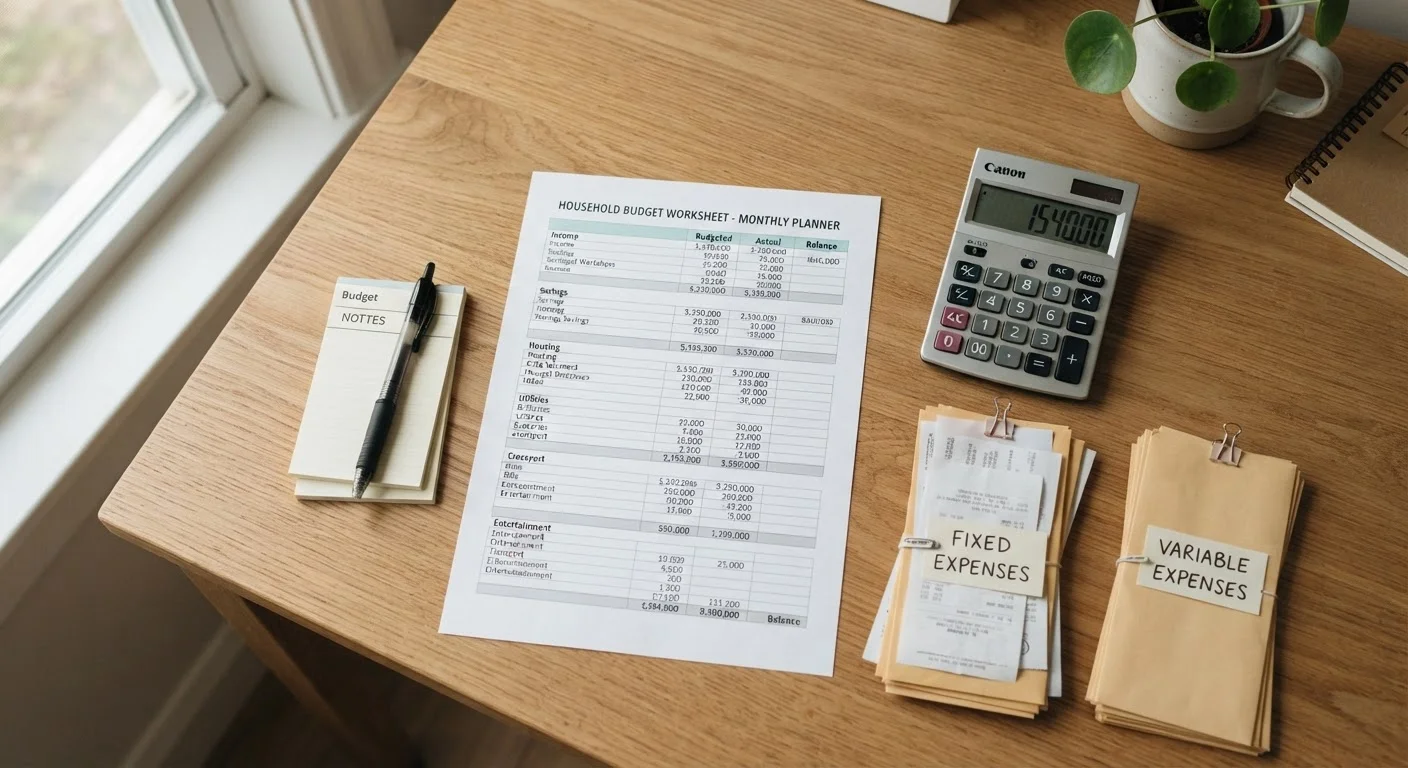
Why the Fixed/Variable Split Is the Foundation of Any Budget
Most budgets fail not because people spend too much overall, but because they don't know which costs are locked in and which ones they can actually control. That distinction - fixed versus variable - is the structural backbone of any spending plan that works in the real world.
When you know exactly how much you owe in non-negotiable obligations each month, you can calculate your financial floor: the minimum income needed to keep the lights on. Everything above that floor is where real budgeting decisions happen. Without this clarity, it's easy to overspend in flexible categories simply because you don't realize how little room you actually have.
This framework is especially useful during income disruptions. If you lose a client, face reduced hours, or deal with an unexpected expense, knowing your fixed costs immediately tells you what's at risk - and what can be trimmed. See how this connects to building a budget that reflects real life for more on adapting your plan when circumstances shift.
Fixed Expenses: The Non-Negotiables
A fixed expense is any cost that remains the same from one billing cycle to the next, regardless of how much you use a product or service. These are contractual or recurring obligations you've already committed to.
Common fixed expenses include:
- Rent or mortgage payments
- Car loan or lease payments
- Health, auto, and renters or homeowners insurance premiums
- Student loan payments (on a standard repayment plan)
- Streaming or software subscription services
- Childcare or private school tuition
The defining characteristic: the dollar amount doesn't change based on your behavior in a given month. You owe the same whether you drove the car 10 miles or 1,000.
Audit Your Fixed Costs Annually
It's worth reviewing your fixed expenses once or twice a year. Subscriptions accumulate quietly, insurance premiums shift at renewal, and loan terms evolve - meaning your actual fixed-cost baseline may be higher than you think. A quick audit can reveal commitments you've forgotten about and free up meaningful room in your budget.
It's worth auditing your fixed expenses once or twice a year. Over time, subscriptions accumulate, insurance premiums shift at renewal, and loan terms change - meaning your actual fixed-cost floor may be higher than you think.
Variable Expenses: Where Flexibility Lives
Variable expenses are costs that change month to month based on your usage, decisions, or circumstances. They're not random - they follow patterns - but they're rarely identical from one period to the next.
Common variable expenses include:
- Groceries and household supplies
- Gasoline and transportation costs
- Dining out and takeout
- Clothing and personal care
- Medical copays and prescriptions
- Entertainment and recreation
- Gifts and celebrations
Variable expenses are where most people have the greatest opportunity to adjust their spending - but also where budgets most often go off track. Without a spending target for each category, it's easy to drift well above what you intended. For a look at variable costs that commonly get missed entirely, see spending categories most people forget to budget for.
Semi-Variable Expenses: The Middle Ground
Not every bill fits neatly into one category. Semi-variable expenses have a consistent base component plus a usage-driven portion that fluctuates. Utilities are the classic example: your electricity provider may charge a flat monthly service fee plus a per-kilowatt-hour rate that rises in summer when the air conditioning runs constantly.
Budgeting for Semi-Variable Bills
For expenses like utilities that have both fixed and usage-based components, review your statements for the past three to six months and calculate a monthly average. Add 10-15% above that average as a buffer for high-usage months, such as peak heating or cooling season. This prevents your budget from being derailed by predictable seasonal swings.
Other semi-variable examples include cell phone plans with overage fees, water bills, and internet plans with data caps. Budget for these using a rolling average of the past three to six months, then add a small buffer for high-usage periods.
Understanding how debt costs behave is similarly nuanced - just as expenses can be fixed or variable, so can the interest rates attached to what you owe. For a deeper look, see fixed vs. variable rate debt.
How to Use This Framework When Building Your Budget
Start by listing every monthly expense and labeling it fixed, variable, or semi-variable. Add up your fixed expenses first - that sum is your minimum monthly commitment. Then review three to six months of bank and credit card statements to find realistic averages for each variable category.
Set a monthly target for each variable line item based on those averages. If your grocery spending ranged from $380 to $460 over six months, a $430 budget is a reasonable and honest target - not an aspirational low number that sets you up to fail. For a more detailed approach to constructing a plan around this framework, see what the fixed vs. variable difference means for your budget.
~33%
Average share of income spent on housing
According to the U.S. Bureau of Labor Statistics Consumer Expenditure Survey, housing consistently represents the largest fixed expense for American households.
4 in 10
Americans who struggle to cover an unexpected $400 expense
Federal Reserve survey data has repeatedly found that a large share of U.S. adults lack the financial buffer to absorb even modest unexpected variable costs.
$227/month
Average American household spending on subscriptions
Research from C+R Research found that consumers routinely underestimate their subscription costs, underscoring the need to audit fixed recurring charges regularly.
This article is for general informational and educational purposes only and does not constitute personalized financial advice. Consider consulting a licensed financial professional for guidance specific to your situation.
Frequently Asked Questions
Fixed expenses are predictable costs that don't change month to month, such as rent or insurance premiums. Variable expenses fluctuate based on your habits and choices, like groceries, entertainment, or gas. Identifying which is which helps you budget more accurately.
Most recurring subscriptions - streaming services, gym memberships, software plans - are fixed expenses because they charge the same amount each billing cycle. However, usage-based subscriptions that charge per unit can behave more like variable expenses.
Fixed expenses represent non-negotiable obligations that must be covered regardless of your month. Variable expenses are where flexibility exists. Knowing the split lets you respond to income changes without panic and find realistic areas to cut.
Yes - for example, if you refinance a loan, switch insurance plans, or move to a different rental, a previously fixed cost changes. Reviewing your fixed expenses periodically ensures your budget reflects your current obligations.
Review several months of past spending to find an average for each variable category, then budget that average amount each month. Building a small buffer above the average helps absorb months when spending runs higher.
The content on this site is for informational purposes only and is not a substitute for professional advice. Always consult a qualified professional for guidance specific to your situation.