

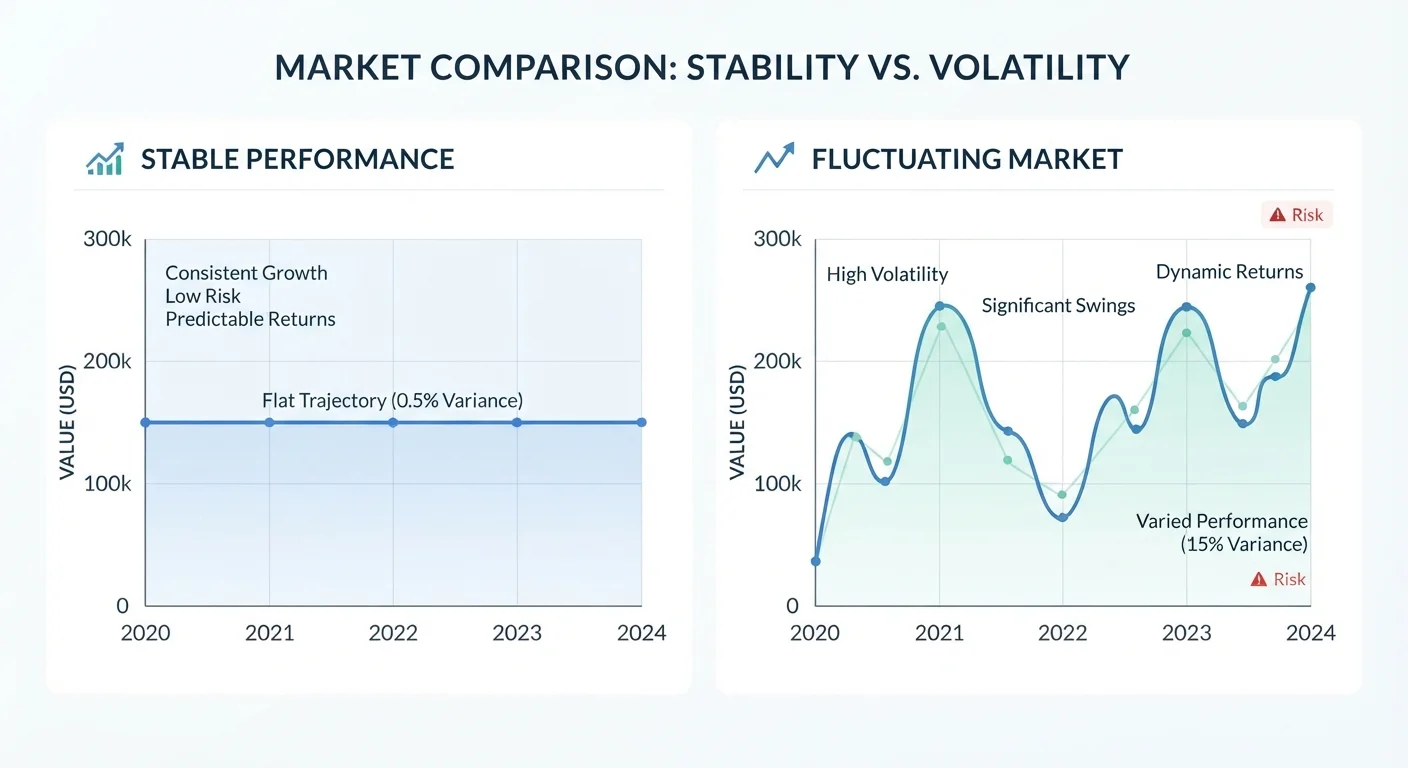
Option A
Fixed-Rate Debt
The predictable, locked-in borrowing option.
Best for: Borrowers who want consistent monthly payments and protection against rising interest rates.
Option B
Variable-Rate Debt
The flexible, market-linked borrowing option.
Best for: Borrowers who expect to pay off debt quickly or anticipate interest rates falling over time.
How Each Rate Type Works
When you borrow money - whether through a mortgage, personal loan, student loan, or credit card - the lender charges interest. The structure of that interest is one of the most consequential choices in any loan agreement.
Fixed-rate debt locks your interest rate at origination. If you take out a personal loan at 7% fixed, that rate stays at 7% for every payment until the balance is cleared. Your monthly payment amount is entirely predictable.
Variable-rate debt ties your rate to a financial benchmark - commonly the federal funds rate or the prime rate - plus a margin set by the lender. As the benchmark moves up or down (typically on a set schedule, such as monthly or quarterly), your interest rate and payment adjust accordingly.
This distinction is related to, but separate from, the difference between fixed and variable expenses in a household budget. If you want to understand how those budgeting categories interact, see our article on fixed vs. variable expenses and budgeting.
| Criterion | Fixed-Rate Debt | Variable-Rate Debt |
|---|---|---|
| Rate stability | Unchanging for loan life | Adjusts with benchmark index |
| Initial rate | Typically higher at origination | Often lower to start |
| Payment predictability | Consistent every period | Can rise or fall over time |
| Risk bearer | Lender bears rate-rise risk | Borrower bears rate-rise risk |
| Best loan length | Long-term loans (10-30 years) | Short-term or flexible payoff |
| Common examples | Fixed mortgages, fixed personal loans | ARMs, variable credit cards, HELOCs |
Interest Rate Risk: What You Are Actually Agreeing To
Every borrowing decision involves a trade-off around interest rate risk - the possibility that rate changes will work against you.
With a fixed rate, the lender absorbs that risk. If market rates soar to 10% and you locked in at 6%, you benefit. If rates drop to 3%, the lender benefits - and you would need to refinance (at potential cost) to capture those savings.
With a variable rate, you absorb that risk. A low introductory rate can climb substantially if the benchmark rises, increasing your monthly payment and total interest paid. Credit cards with variable APRs are a common example: when the Federal Reserve raises its benchmark rate, variable-rate card APRs typically follow within one to two billing cycles.
Prime + margin
How most variable rates are priced
The U.S. prime rate is typically set at 3 percentage points above the federal funds rate target, according to the Federal Reserve.
~45 days
Typical lag before variable credit card APRs adjust
The Consumer Financial Protection Bureau notes that variable-rate credit card APRs generally follow benchmark rate changes within one to two billing cycles.
Understanding how any debt fits into your overall financial picture - whether it is building toward a goal or adding unnecessary cost - is explored in our guide on good debt versus bad debt.
Mortgages: A Practical Illustration
Mortgages are the most significant fixed vs. variable rate decision most consumers will face. A 30-year fixed mortgage guarantees the same principal-and-interest payment every month for three decades. An adjustable-rate mortgage (ARM) typically offers a lower initial fixed period - say, five or seven years - before the rate begins adjusting annually based on an index.
ARMs can be advantageous for buyers who plan to sell or refinance before the adjustment period begins. However, if life circumstances change and the loan remains outstanding, rising adjustments can substantially increase housing costs.
For a deeper look at how fixed and adjustable mortgage structures compare side by side, see our dedicated guide on fixed-rate vs. adjustable-rate mortgages.
Hybrid Structures Are Common
Many loans blend both models. A 5/1 ARM, for example, carries a fixed rate for the first five years, then adjusts annually. Understanding the precise terms - including rate caps, adjustment frequency, and index used - is essential before signing any loan agreement. Always read the loan disclosure documents carefully and ask your lender to walk through worst-case payment scenarios.
This article provides general financial education and is not personalized financial or lending advice. Speak with a licensed financial professional or mortgage adviser before making borrowing decisions.
The content on this site is for informational purposes only and is not a substitute for professional advice. Always consult a qualified professional for guidance specific to your situation.