

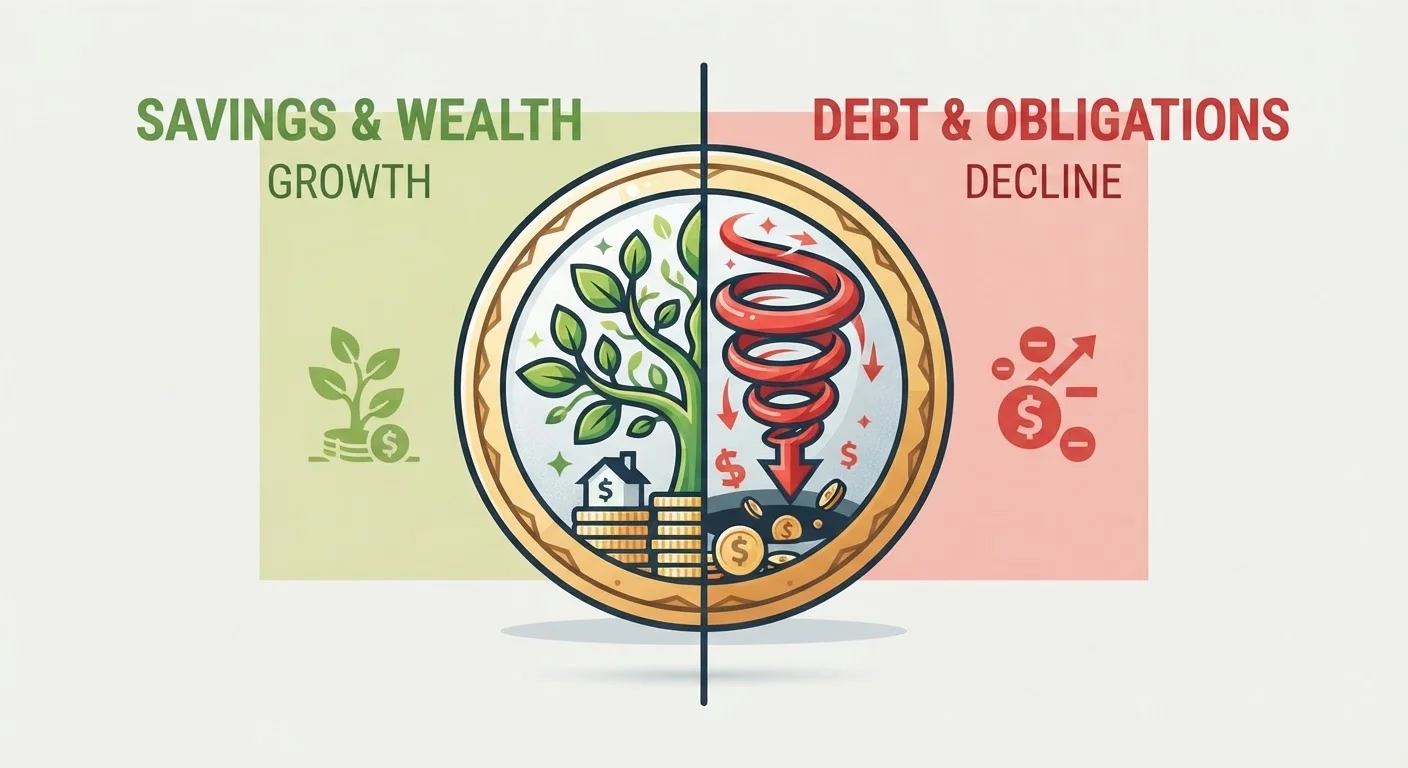
How Compound Interest Actually Works
At its core, compound interest means you earn - or owe - interest on your interest. Unlike simple interest, which only applies to the original principal, compound interest recalculates the balance each period and applies the rate to the new, larger total.
Here's a straightforward illustration: Say you deposit $1,000 in a savings account earning 5% annual interest. After year one, you've earned $50, bringing your balance to $1,050. In year two, you earn 5% on $1,050 - not just on the original $1,000. That extra $2.50 seems minor at first, but the same compounding logic over 20 or 30 years produces a dramatically different outcome than simple interest would.
The formula behind this is: A = P(1 + r/n)^(nt), where A is the final amount, P is the principal, r is the annual interest rate, n is the number of compounding periods per year, and t is time in years. You don't need to memorize this - but understanding that time and frequency are the two levers makes the concept practical.
Daily
How often most credit card interest compounds
The Consumer Financial Protection Bureau (CFPB) notes that most credit card issuers apply interest using a daily periodic rate, which compounds the effective cost of carrying a balance.
~$76,000
Estimated value of $200/month saved for 20 years at 5% APY
This general illustration - based on standard compound interest calculations - shows how consistent contributions at a modest rate accumulate significantly over two decades.
For a deeper look at how interest functions in both directions, see how interest works for and against you.
Compounding in Your Favor: Savings and Investments
When compound interest works for you, it functions like a snowball rolling downhill - gaining size and momentum as it goes. The key ingredients are a competitive interest rate, regular contributions, and above all, time.
Consider two savers: one who puts $200 per month into a savings vehicle starting at age 25, and another who waits until 35 to start the same habit. Assuming the same rate of return, the earlier saver doesn't just come out ahead - they can end up with a substantially larger balance despite contributing for the same number of years, simply because compounding had a longer runway.
Start Small, Start Now
You don't need a large sum to benefit from compounding. Even $25 or $50 per month placed consistently in an interest-bearing account begins compounding immediately. The most important variable is not the amount - it's the time you give it to grow.
This is why financial educators consistently emphasize starting early, even when contribution amounts are modest. The compounding effect rewards patience more than it rewards large late contributions.
For context on how this fits into a broader savings strategy, the Saving & Debt hub covers practical frameworks for building and protecting financial ground over time.
Compounding Against You: Debt and the Cost of Carrying a Balance
The same mechanic that builds wealth can silently erode it when it's applied to debt. Credit cards are the most common example: issuers typically compound interest daily on any unpaid balance. If you carry $3,000 on a card with a 22% APR and only make minimum payments, the balance grows faster than most people realize - and much of each payment goes toward interest rather than reducing what you owe.
Student loans, personal loans, and payday loans all use compounding in varying ways. The key distinction is whether interest capitalizes - meaning unpaid interest is added to the principal, creating a larger base on which future interest is calculated. Once interest capitalizes, the effective debt load can rise even if you're making payments.
To understand strategies for tackling this from both sides simultaneously, see managing debt and saving at the same time.
Making Compound Interest Work in Your Direction
Understanding compounding is most useful when it changes how you make decisions. A few principles apply broadly:
- Compare APY, not just rates. When evaluating savings accounts, the APY tells you the true annual yield after compounding. A 4.8% APR compounded daily yields slightly more than 4.8% compounded annually - APY captures that difference.
- Prioritize high-interest debt. Because compounding amplifies high rates faster, paying down high-APR balances first limits the damage. Every dollar applied to principal reduces the base on which future interest compounds.
- Automate and stay consistent. Regular contributions - even small ones - compound over time. Gaps in saving, or pauses in debt repayment, allow compounding to work in the wrong direction longer than necessary.
A Note on Rates and Products
Interest rates on savings accounts and loans change over time based on broader economic conditions. The examples in this article use illustrative figures to explain the concept - actual rates will vary. Always review the current APY or APR and compounding terms of any specific account or loan before making financial decisions.
This article provides general financial education and is not personalized financial advice. For guidance on your specific situation, consider consulting a licensed financial professional. For broader context on how compounding connects to long-term financial planning, see compound interest and long-term wealth.
Frequently Asked Questions
Simple interest is calculated only on the original principal. Compound interest is calculated on the principal plus any interest already earned or owed. Over time, compound interest produces significantly larger totals - for better or worse - than simple interest on the same balance.
Compounding frequency varies by account or loan type. Common schedules include daily, monthly, and annually. More frequent compounding produces a slightly higher effective rate. Your account's APY (Annual Percentage Yield) reflects the true annualized rate after compounding is applied.
Yes. Credit card balances typically compound daily, meaning unpaid interest is added to your balance and then charged interest itself. Carrying a balance month to month can cause the total owed to grow faster than your minimum payments reduce it.
The general principle is: the earlier, the better. Because compounding accelerates over time, money saved in your 20s has more decades to grow than money saved in your 40s. Starting small but early tends to produce better outcomes than waiting to save larger amounts later.
APY stands for Annual Percentage Yield. It represents the effective annual return on a savings account after compounding is factored in. A savings account with a 5% APR compounded monthly will have a slightly higher APY, reflecting the benefit of intra-year compounding.
The content on this site is for informational purposes only and is not a substitute for professional advice. Always consult a qualified professional for guidance specific to your situation.