

Start here
What Interest Actually Is
Build the foundation
Simple vs. Compound Interest
See both sides
When Interest Works For You
Understand the risk
When Interest Works Against You
Take action
Practical Steps to Shift the Balance
What Interest Actually Is
At its most basic, interest is a fee charged for using someone else's money. When you borrow - through a mortgage, auto loan, or credit card - the lender charges you interest as compensation for the risk and opportunity cost of lending. When you save or invest - in a savings account or certificate of deposit - the institution pays you interest because it is, in effect, borrowing your money to fund its own operations.
Interest is expressed as a rate, typically an annual percentage. A 5% annual rate on a $1,000 deposit means you'd expect to earn $50 over a year under the simplest scenario. That same 5% rate on a $1,000 credit card balance means you owe $50 for carrying that balance a year - before any new charges.
Principal
The original sum of money borrowed or deposited, before any interest is added. Interest is calculated as a percentage of the principal.
Interest Rate
The percentage of the principal charged or paid over a set period, most commonly expressed as an annual figure.
APY (Annual Percentage Yield)
The real rate of return on a savings account or investment in one year, accounting for the effect of compounding. A more accurate measure of earnings than the stated rate alone.
APR (Annual Percentage Rate)
The yearly cost of borrowing money expressed as a percentage, typically used for loans and credit cards. It usually does not account for compounding within the year.
Compounding Frequency
How often interest is calculated and added to a balance - daily, monthly, or annually. More frequent compounding results in slightly faster growth.
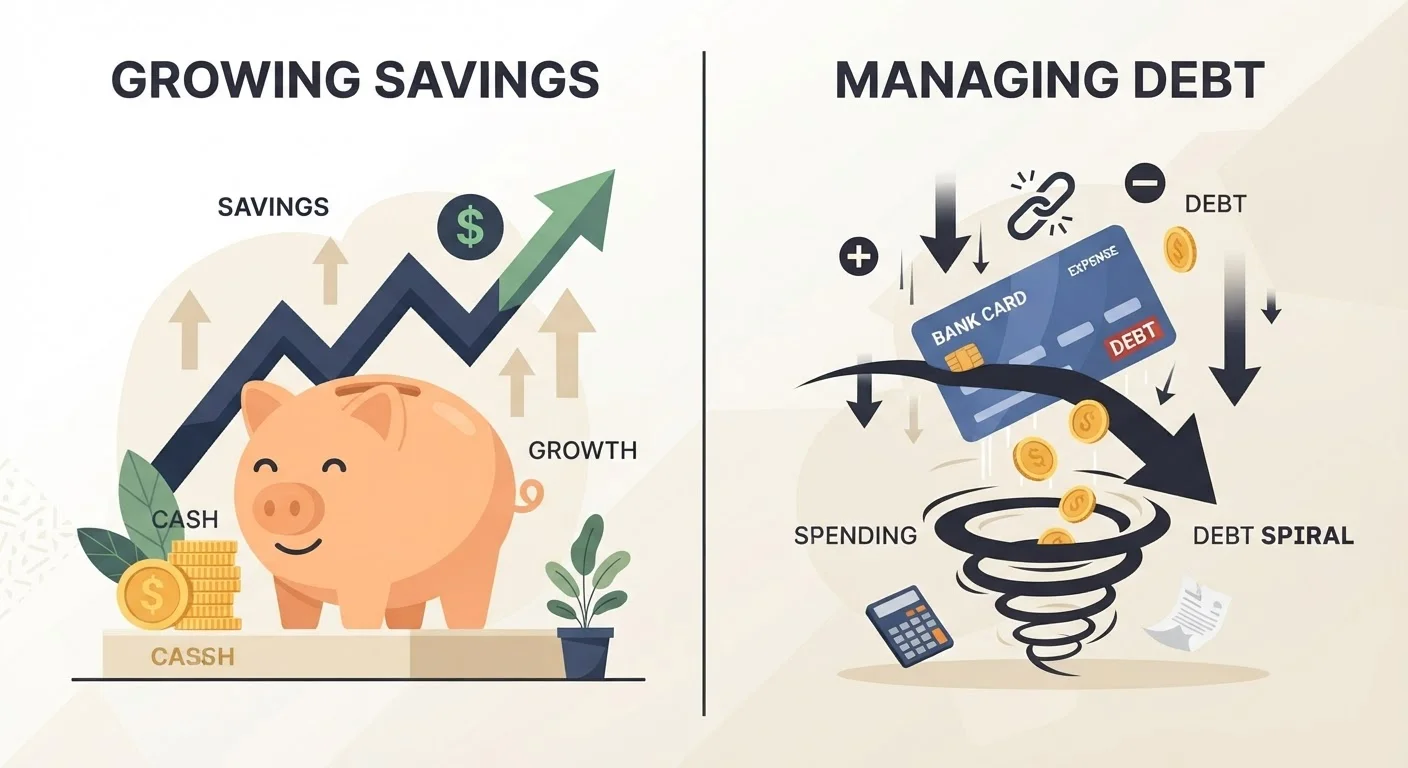
This symmetry is important: the same mechanics that grow your savings also grow your debt. Understanding which side you're on - and how to shift toward the favorable side - is the core skill this article builds.
Simple vs. Compound Interest
Simple interest is calculated only on the original principal. If you deposit $1,000 at 5% simple interest for three years, you earn $50 per year - $150 total. The math never changes because the base never changes.
Compound interest is calculated on the principal plus any interest already accumulated. In year one, you earn $50 on $1,000. In year two, you earn 5% on $1,050 - that's $52.50. By year three, you're earning interest on $1,102.50. The amounts seem small early on, but the effect multiplies significantly over longer timeframes and higher balances.
How often interest compounds also matters. Daily compounding produces slightly more than monthly compounding at the same stated rate. This is why financial products use APY (Annual Percentage Yield) for savings - it reflects compounding - while loans often quote APR (Annual Percentage Rate), which does not. Comparing these directly can mislead; always look at the APY for a true apples-to-apples comparison.
For a deeper look at how compounding scales over time, see our guide to compound interest.
When Interest Works For You
Interest becomes your ally any time you are the one being paid. The three most common scenarios for everyday consumers are:
- High-yield savings accounts and CDs: Federally insured deposit accounts that pay interest on your balance. The principal is protected while interest compounds.
- Retirement accounts invested in interest-bearing assets: Bonds inside a 401(k) or IRA pay periodic interest that, when reinvested, compounds over decades.
- Treasury and government securities: U.S. Treasury bills, notes, and bonds pay fixed interest backed by the federal government.
Time Is Your Most Valuable Asset
When it comes to savings, the length of time your money compounds matters more than the amount you start with. Even setting aside a small, consistent amount each month in a compounding account can result in substantial growth over 20 to 30 years. The earlier you start, the less effort is required to reach the same outcome.
The most powerful variable in compound savings is time. A 25-year-old who saves consistently has decades for compounding to operate. A 45-year-old saving the same total dollars over fewer years ends up with meaningfully less, because the compounding period is shorter. Starting early - even with modest amounts - is more impactful than starting later with larger amounts.
When Interest Works Against You
The same compounding force becomes a significant burden when you carry debt. Common high-interest liabilities include:
- Credit cards: Average APRs on credit cards have historically exceeded 20% for accounts assessed interest, according to Federal Reserve consumer credit data. Carrying a balance month to month means compounding works rapidly against you.
- Personal loans and payday loans: Unsecured personal loans carry moderate-to-high rates; payday loans can carry effective annual rates that are extraordinarily high.
- Adjustable-rate debt: When market rates rise, variable-rate balances cost more - relevant for certain mortgages and credit lines.
Minimum Payments Extend Your Debt Significantly
Paying only the minimum on a credit card balance allows interest to compound on the remaining balance every month. On a high-APR card, a balance can take years or even decades to pay off this way, and the total interest paid can exceed the original purchase price. Always aim to pay more than the minimum whenever possible.
It's also worth noting that interest rates shape major financial decisions beyond personal accounts. For example, rising mortgage rates directly influence what home buyers can afford each month. Our article on how interest rates shape housing affordability explores that dynamic in detail.
Practical Steps to Shift the Balance
Knowing the mechanics is useful only if you apply them. Here are four concrete steps to move interest from working against you to working for you:
- Identify your highest-rate debt first. List every debt with its interest rate. The balance with the highest rate costs you the most per dollar owed, regardless of the dollar amount.
- Make more than the minimum payment. Minimum payments are designed to extend repayment timelines and maximize interest collected. Even small additional payments reduce the principal faster and cut total interest paid.
- Move savings to higher-yield accounts. If your savings are sitting in a low-yield account, the gap between what you earn and what is available elsewhere represents lost compounding. Compare APYs among federally insured options.
- Automate saving contributions. Consistency matters more than timing the market or finding the perfect moment. Automatic transfers make saving a default behavior rather than a deliberate act.
Balancing debt repayment and saving simultaneously is a genuine challenge - our article on managing debt and saving at the same time walks through the trade-offs in depth.
This article is for general informational and educational purposes only and does not constitute personalized financial, tax, or investment advice. Consult a qualified financial professional before making decisions based on your individual circumstances.
Frequently Asked Questions
APR (Annual Percentage Rate) reflects the yearly interest rate without accounting for compounding within the year. APY (Annual Percentage Yield) includes the effect of compounding, making it a more accurate picture of what you'll actually earn or owe. When comparing savings accounts, a higher APY means more earnings; when comparing loans, a higher APR means more cost.
Simple interest is calculated only on the original principal. Compound interest is calculated on the principal plus any interest already earned or accrued, causing the balance to grow faster over time. For savers this is an advantage; for borrowers carrying a balance, it means the debt can grow quickly if left unpaid.
Generally, paying off high-interest debt first offers a better guaranteed financial return than investing, because the interest rate on most consumer debt exceeds typical market returns. For low-interest debt, the trade-off becomes less clear, and a qualified financial adviser can help you weigh your specific situation.
Most savings accounts compound interest daily or monthly, though the frequency varies by institution and account type. More frequent compounding means slightly higher earnings for the same stated rate. Always check the APY, which already accounts for compounding frequency, to make accurate comparisons.
In many cases, yes. Credit card issuers may lower your rate if you have a good payment history and ask directly. Refinancing loans is another option that can reduce your rate. Results are not guaranteed, and terms vary - always read the full terms of any refinanced product before agreeing.
The content on this site is for informational purposes only and is not a substitute for professional advice. Always consult a qualified professional for guidance specific to your situation.