

Option A
Federal Income Tax
The uniform, nationwide layer of income taxation.
Best for: Applies to all U.S. residents and uses a single progressive bracket system administered by the IRS.
Option B
State Income Tax
The variable, state-specific layer that differs by where you live.
Best for: Applies to residents of most states, with rates, rules, and structures that vary dramatically from one state to the next.
How the Two-Layer System Works
When Americans talk about income taxes, they're often referring to two separate obligations: one owed to the federal government and one owed to their state. These are distinct systems - each with its own rates, rules, and filing requirements - but they operate simultaneously, which is why your paycheck may show multiple tax withholding lines.
The federal government taxes income under a progressive bracket system managed by the Internal Revenue Service (IRS). As your taxable income rises, portions of it move into higher brackets - but only the income within each bracket is taxed at that bracket's rate. For a deeper look at how this works, see how marginal rates actually work.
State governments layer their own income taxes on top of the federal system, but with enormous variation. Some states mirror the federal progressive structure, others use a flat rate, and nine states - including Texas, Florida, and Washington - levy no state income tax on wages at all. This means two neighbors living on opposite sides of a state border can face very different overall tax burdens.
| Criterion | Federal Income Tax | State Income Tax |
|---|---|---|
| Who administers it | IRS (federal government) | State revenue department |
| Rate structure | Progressive brackets (7 tiers) | Flat, progressive, or none - varies by state |
| States with no tax | Applies to all U.S. residents | 9 states levy no wage income tax |
| Filing form | Form 1040 | State-specific return |
| Standard deduction | Set by IRS annually | Varies or may not exist |
| Starting point for calculation | Gross income minus adjustments (AGI) | Often based on federal AGI, then modified |
| Interaction between systems | SALT deduction allows some state tax offset | Typically independent of federal liability |
Key Differences in Structure and Calculation
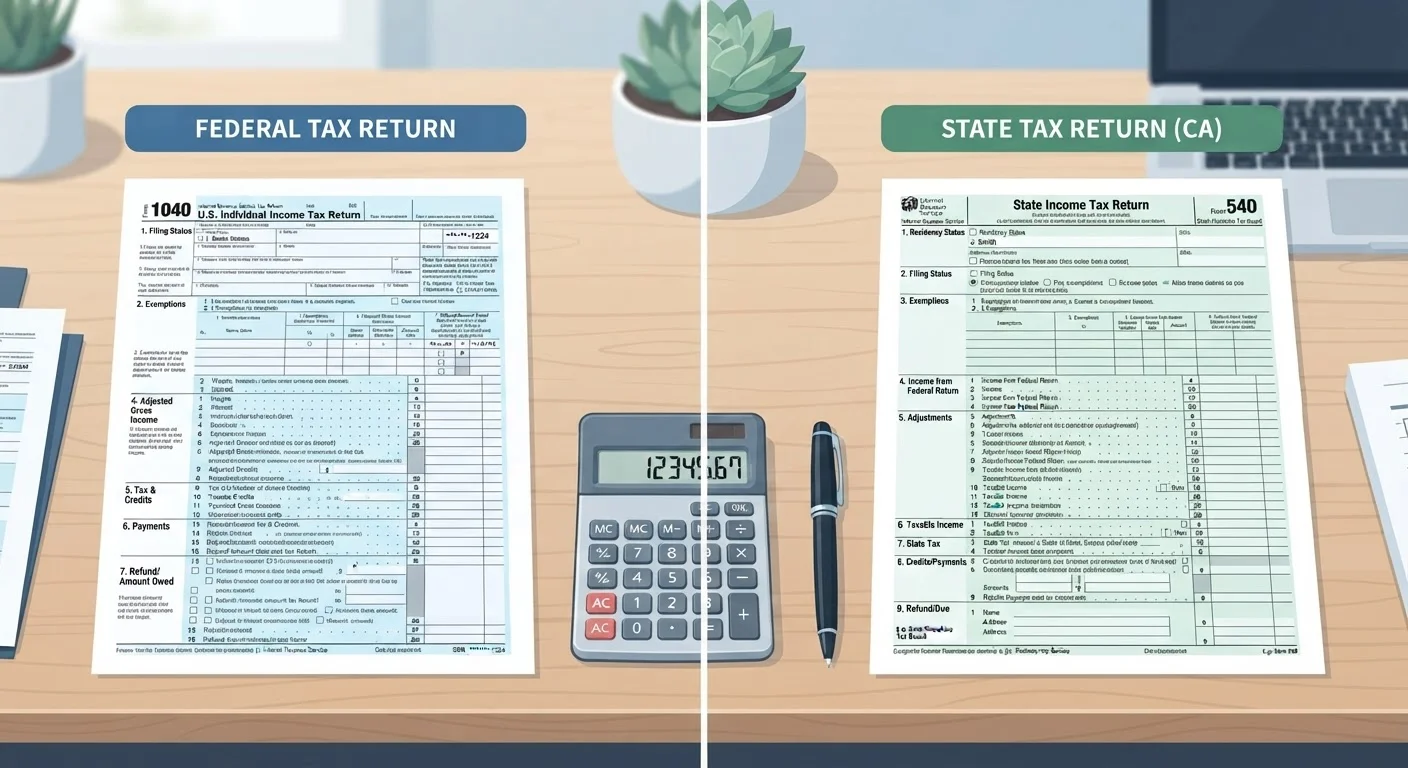
Federal and state taxes are calculated independently, not as a combined formula. When you sit down to file, you complete a federal return (Form 1040) and, if your state requires it, a separate state return. Each return has its own definition of taxable income, its own deductions, and its own credits.
One important nuance: many states use your federal adjusted gross income (AGI) as their starting point, then apply state-specific additions or subtractions. For instance, a state might exempt pension income that the federal government taxes, or it might not allow the same deductions the IRS permits. Understanding the federal return anatomy first makes state returns easier to navigate - our guide on the anatomy of a federal tax return walks through this foundation clearly.
9
States with no wage income tax
According to the Tax Foundation, nine U.S. states - including Florida, Texas, and Nevada - do not tax earned wages at the state level.
$10,000
SALT deduction cap for itemizers
The Tax Cuts and Jobs Act of 2017 capped the federal deduction for state and local taxes (SALT) at $10,000 for single and married-filing-jointly filers.
7
Federal tax brackets in current system
The IRS applies seven marginal tax rates - ranging from 10% to 37% - to progressively higher portions of taxable income.
It's also worth noting that federal law does allow taxpayers who itemize deductions to deduct up to $10,000 of state and local taxes paid (the SALT deduction), creating a limited interaction between the two systems. However, most taxpayers take the standard deduction and this interaction doesn't apply to them directly.
This article provides general educational information about the U.S. tax system and does not constitute personalized tax or legal advice. Consult a qualified tax professional regarding your specific situation.
What This Means for Your Paycheck and Filing
For most salaried employees, both federal and state income taxes are withheld from each paycheck based on information you provide on withholding forms - federal Form W-4 and the equivalent state form. Getting these forms right matters: under-withholding can result in a tax bill at filing time, while over-withholding is essentially an interest-free loan to the government.
Remote Workers and Multi-State Filing
If you work remotely for an employer headquartered in a different state than where you live, you may have tax obligations in both states - though many states have reciprocity agreements that simplify this. Rules vary significantly, so verify your specific situation with your state's revenue department or a tax professional before filing.
At tax time, you reconcile what was withheld against what you actually owe. If you moved between states during the year, worked remotely for an employer in a different state, or earned income from multiple states, your state filing situation can become more complex - those are scenarios where working with a licensed tax professional adds real value.
For a fuller picture of how tax brackets work without the confusion, reviewing the federal structure first gives you the clearest foundation. Once you understand the federal layer, applying those concepts to your state's system - whatever form it takes - becomes considerably more straightforward.
The content on this site is for informational purposes only and is not a substitute for professional advice. Always consult a qualified professional for guidance specific to your situation.