

Why Tax Brackets Confuse So Many People
Ask almost anyone whether getting a raise could cost them money at tax time, and many will say yes. This belief - that crossing into a higher tax bracket means owing more tax on all your income - is one of the most persistent misconceptions in personal finance. It's also completely wrong.
The U.S. federal income tax system is progressive, meaning different portions of your income are taxed at different rates. Higher rates only apply to the dollars that fall within those higher ranges, not to every dollar you earned. Once you understand this structure, "bracket anxiety" tends to disappear entirely.
For a broader look at how federal and state taxes interact, see how the two-layer tax system works.
Myth
If I get a raise that pushes me into a higher bracket, I'll take home less money overall.
Fact
A higher bracket only applies to income above the threshold - not to every dollar you earn. A raise always increases your net pay.
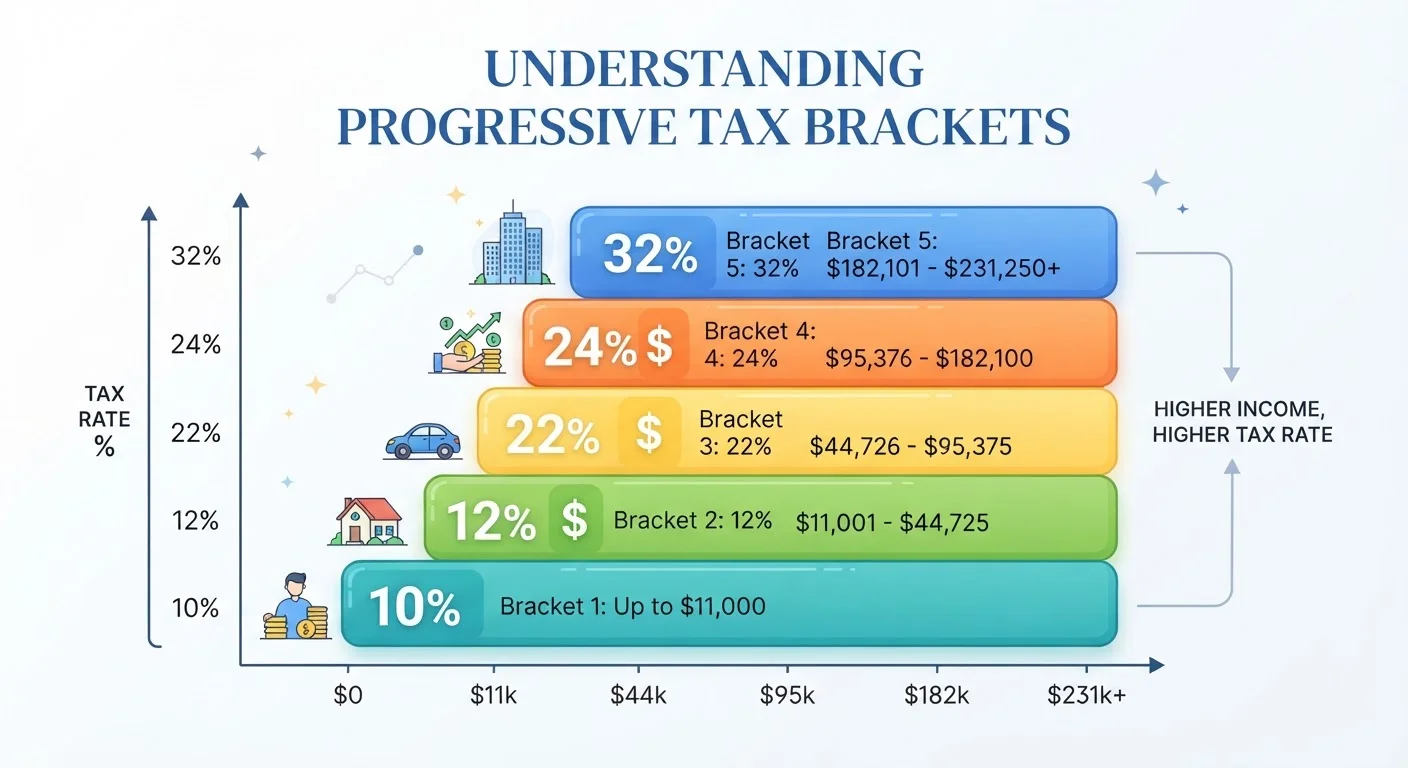
This is the most common tax misconception in America. Suppose the 22% bracket begins at $44,726 for a single filer and you earn $45,000. Only the $274 above that threshold is taxed at 22%. Every dollar below $44,726 is still taxed at the lower rates that applied before your raise. There is no scenario under the progressive bracket system in which earning more leaves you with less after-tax income.
Myth
Your tax bracket is the percentage you owe on all your income.
Fact
Your bracket is your marginal rate - the rate on your highest slice of income, not your whole paycheck.
The U.S. tax code divides income into segments (brackets), each taxed at its own rate. Think of it as filling buckets: the first bucket fills at 10%, the next at 12%, and so on. Your "tax bracket" label simply tells you which bucket your last dollar fell into. Your effective (average) tax rate - what you actually pay as a share of total income - is almost always lower, sometimes substantially so.
Myth
People in high tax brackets pay the advertised rate on every dollar they earn.
Fact
High earners pay the top rate only on income exceeding the bracket threshold - all lower portions are taxed at lower rates.
Even a taxpayer in the highest federal bracket (37% as of recent IRS schedules) still pays 10% on the first segment of income, 12% on the next, and so on. The 37% rate applies only to the portion of income above the top bracket's floor. This layered structure is why high earners often have effective rates considerably below their marginal rate.
Myth
Getting a bonus will bump me into a new bracket and cost me money.
Fact
A bonus may push some dollars into a higher bracket, but only those dollars - the rest of your income is unaffected.
Employers often withhold a flat supplemental rate on bonuses (22% under IRS rules for most employees), which can make it look like a large chunk disappeared. However, withholding is just an estimate. When you file your return, your actual tax is calculated correctly, and any over-withholding is returned as a refund. The bonus itself always adds to your net financial position - it does not claw back taxes owed on prior income.
Myth
The tax bracket system punishes people for working harder.
Fact
Progressive rates are designed so each additional dollar is taxed at its own rate - earning more always means keeping more in absolute terms.
The progressive structure means higher earners contribute a larger share of their marginal income in taxes, but it does not create a situation where work becomes financially counterproductive. After-tax income rises with every additional dollar earned. The design aims to distribute the tax burden proportionally rather than uniformly - a policy choice, but not one that penalizes effort mathematically.
Your Effective Rate vs. Your Marginal Rate
Two terms matter most when reading your tax return: marginal rate and effective rate.
Your marginal rate is the rate that applies to your last dollar of taxable income - the bracket you've reached. Your effective rate is your total tax bill divided by your total taxable income. Because lower brackets cover the first portions of income, the effective rate is always lower than the marginal rate for most taxpayers.
~13.3%
Average effective federal income tax rate for U.S. individual filers
According to IRS Statistics of Income data, the average effective rate across all individual returns is significantly below the top marginal brackets most taxpayers assume they're near.
7 brackets
Number of federal income tax brackets in the U.S.
The U.S. federal tax code uses seven marginal rate brackets, ranging from 10% to 37%, each applied only to the income within that range.
For example, a single filer with $60,000 in taxable income (after the standard deduction) in a hypothetical bracket structure doesn't owe 22% on all $60,000. They owe 10% on the first bracket, 12% on the next segment, and 22% only on the amount above the second bracket's ceiling - producing an effective rate well below 22%.
This distinction matters whenever you're weighing deductions, retirement contributions, or side income. You can also explore how tax brackets work in plain language for a step-by-step walkthrough.
Taxable Income Is Not Gross Income
Bracket calculations apply to your taxable income - what remains after subtracting the standard deduction (or itemized deductions) from your gross income. For tax year 2024, the IRS standard deduction for a single filer is $14,600, meaning the first $14,600 of income is shielded from bracket calculations entirely. Always verify current figures directly on the IRS website (irs.gov), as these amounts adjust annually for inflation.
Practical Implications for Your Finances
Correcting bracket myths isn't just academic - it changes real decisions. Here's what matters practically:
- Raises are always net positive. Moving into a higher bracket means only the new income above the threshold is taxed at the higher rate. Your take-home still increases.
- Deductions reduce taxable income first. The IRS calculates brackets on taxable income, not gross income. Standard deductions (set annually by the IRS) come off the top before any bracket math applies.
- Retirement contributions can lower your bracket exposure. Pre-tax contributions to accounts like a 401(k) reduce your taxable income, potentially keeping more dollars in a lower bracket.
- Withholding is an estimate, not a final bill. Your employer withholds based on projections. Your actual liability - calculated on your return - may result in a refund or a balance due.
Tax planning based on misunderstood brackets often leads to missed savings opportunities. If you're rethinking other money fundamentals, common budgeting myths are worth revisiting too.
Don't Rely on Bracket Estimates Alone
Bracket rates are only one part of your federal tax picture. Credits, deductions, the alternative minimum tax (AMT), self-employment tax, and state income taxes all affect what you actually owe. Running a simplified bracket calculation without accounting for these factors can lead to underestimating or overestimating your real tax bill. A qualified tax professional can give you an accurate picture based on your specific circumstances.
This article is for general informational purposes only and does not constitute tax, legal, or financial advice. Tax laws and bracket thresholds change annually. Consult a qualified tax professional or CPA for guidance tailored to your situation.
The content on this site is for informational purposes only and is not a substitute for professional advice. Always consult a qualified professional for guidance specific to your situation.