

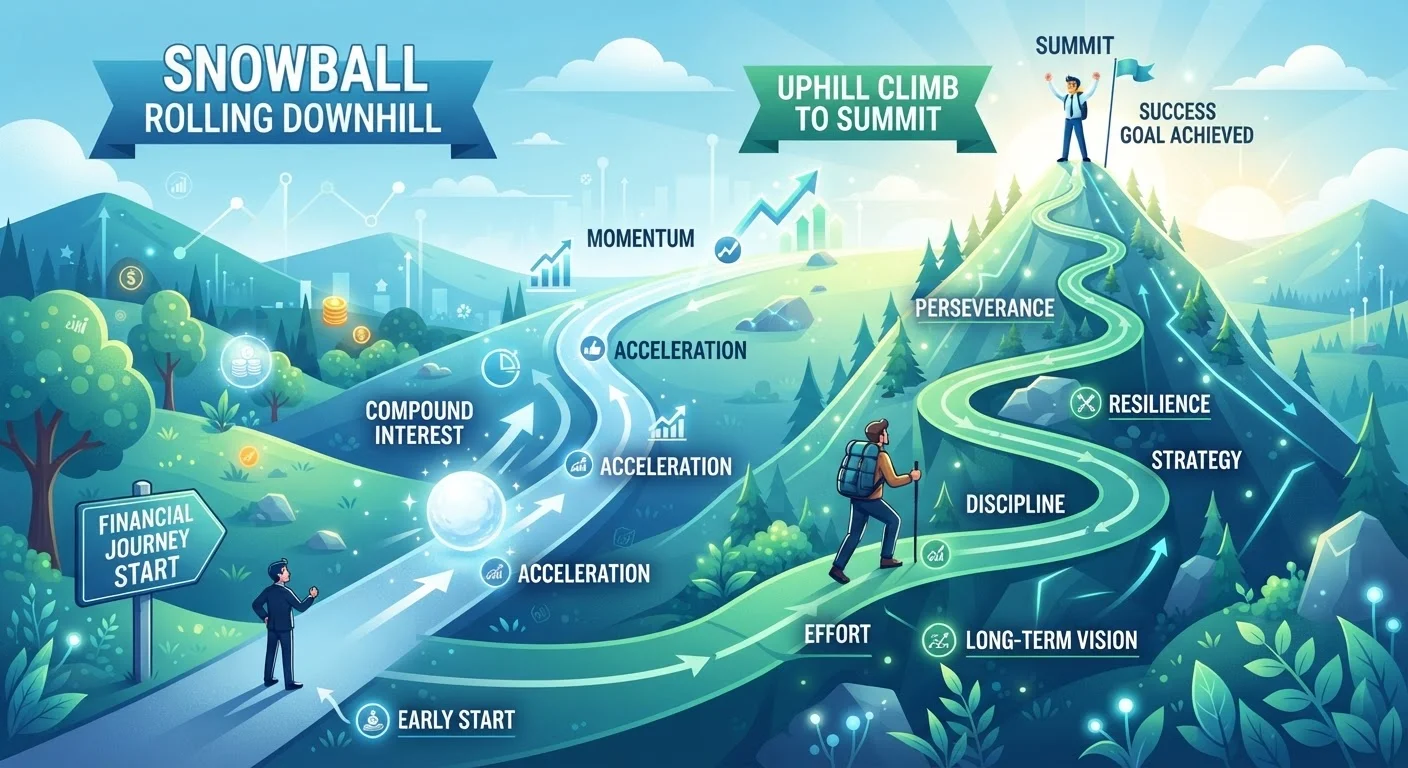
Option A
Debt Avalanche
The mathematically optimal, interest-minimizing approach.
Best for: Disciplined budgeters who want to minimize total interest paid over the life of their debt.
Option B
Debt Snowball
The momentum-driven, psychologically rewarding approach.
Best for: People who need early wins and motivational momentum to stay committed to a repayment plan.
The Core Logic Behind Each Method
Both the debt avalanche and the debt snowball follow the same foundational mechanic: you make minimum payments on all your debts, then direct any extra money toward one specific debt at a time. Once that debt is eliminated, you roll its payment into the next target - building momentum as you go. The difference lies entirely in which debt you target first.
The debt avalanche prioritizes the debt with the highest annual percentage rate (APR). Because interest compounds on outstanding balances, the highest-rate debt costs you the most money the longer it lingers. By attacking it first, you reduce how much interest accumulates across your entire debt load.
The debt snowball prioritizes the debt with the smallest outstanding balance, regardless of interest rate. The rationale is behavioral: eliminating an entire account - even a small one - delivers a concrete psychological reward that reinforces continued effort. Behavioral economists have noted that this sense of progress can be a powerful driver of financial follow-through.
See how each strategy plays out in practice for a closer look at real-world scenarios.
Comparing the Two Methods Side by Side
To understand the trade-offs clearly, it helps to look at both approaches across the dimensions that matter most to everyday borrowers.
| Criterion | Debt Avalanche | Debt Snowball |
|---|---|---|
| First target | Highest interest rate | Smallest balance |
| Total interest paid | Lower (mathematically optimal) | Potentially higher |
| Time to first payoff | Slower if high-rate debt is large | Faster - first win comes sooner |
| Motivational structure | Relies on discipline and long-term thinking | Delivers early wins to sustain momentum |
| Best when | Interest rate gap between debts is large | Number of accounts is high or motivation is low |
| Complexity | Requires tracking APRs across accounts | Simple - sort by balance size |
The avalanche's mathematical advantage is real but can feel abstract - especially in the early months when your high-interest debt may also carry a large balance and progress feels slow. The snowball's psychological advantage is also real, but it comes at a cost: you may pay more in total interest if low-rate debts happen to have small balances while high-rate debts linger.
~$1,000+
Potential interest saved with avalanche vs. snowball
The exact savings depend on your specific balances and rates, but the gap can be substantial on large, high-rate debts held over several years.
3 in 10
U.S. adults carrying credit card debt month-to-month
According to Federal Reserve survey data, a significant share of American households regularly carry revolving credit card balances, making repayment strategy an especially relevant decision.
Which Method Is Right for You?
The honest answer is that the best debt repayment strategy is the one you will consistently follow. A 2016 study published in the Journal of Marketing Research found that participants who focused on eliminating individual accounts (a snowball-like approach) reduced debt faster than those who spread payments across balances - primarily because account closure provided clearer feedback and reinforced commitment.
That said, for borrowers carrying high-rate credit card debt alongside lower-rate installment loans (such as student loans or auto loans), the avalanche can produce meaningfully lower total interest costs. The gap widens the longer repayment takes and the higher the interest rate differential between debts.
Neither Method Requires Extra Money
A common misconception is that these strategies require increasing your total monthly payment. In reality, both work by reallocating the payments you were already making. As each debt is eliminated, its former payment is added to the next target - this is the 'roll-over' effect that accelerates progress over time. You do not need to find new money to make either method work, though adding even a small additional monthly amount can shorten your timeline significantly.
If you find yourself torn, consider a hybrid: start with the snowball to build confidence, then shift to the avalanche once you've eliminated one or two smaller accounts. Many people also explore whether debt consolidation could simplify their repayment picture before choosing a payoff sequence. And if you're weighing debt repayment against building savings simultaneously, managing both goals in parallel is worth understanding before you commit.
This article is for general informational and educational purposes only and does not constitute personalized financial, tax, or legal advice. Consider consulting a qualified financial professional before making decisions about your specific debt situation.
The content on this site is for informational purposes only and is not a substitute for professional advice. Always consult a qualified professional for guidance specific to your situation.