

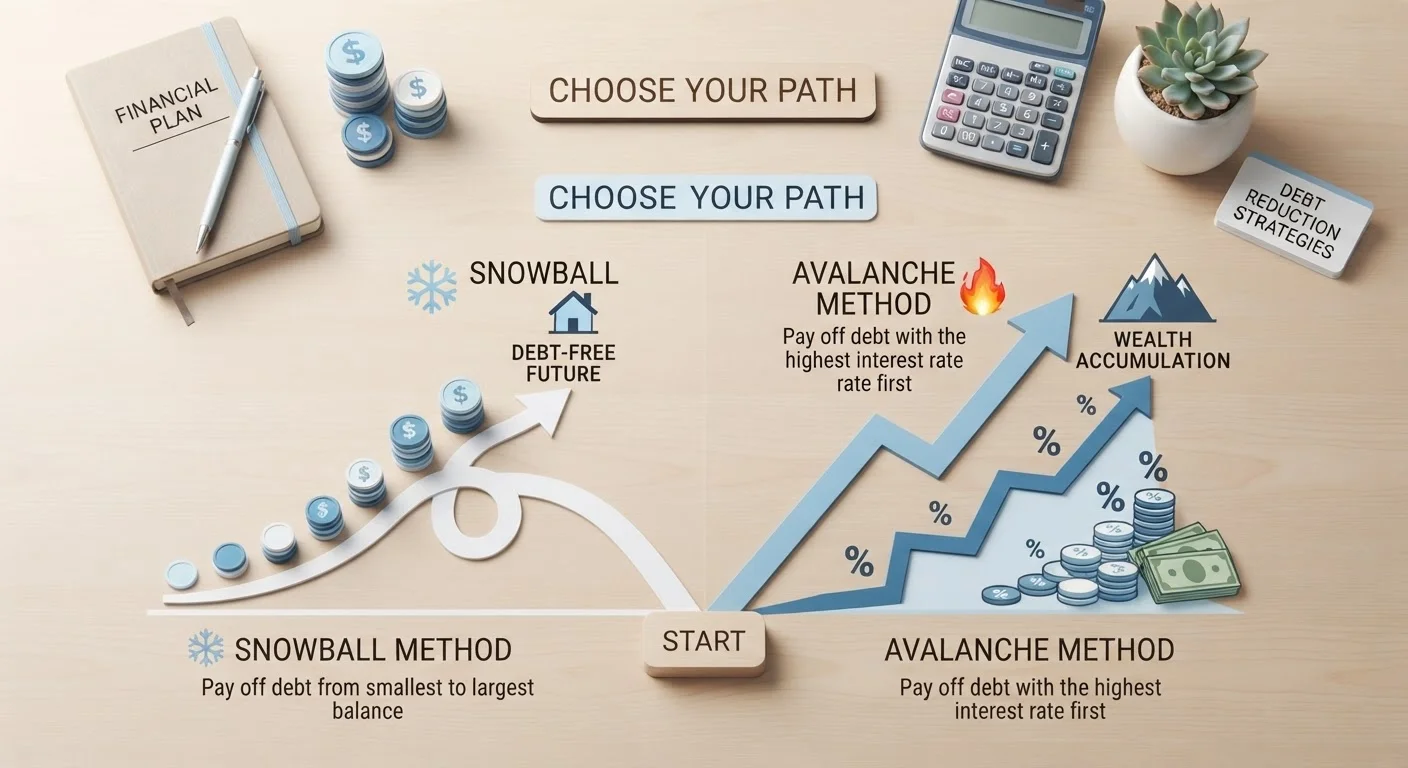
Option A
Debt Avalanche
The mathematically optimal, interest-minimizing approach.
Best for: People who stay motivated by long-term savings and can resist the urge for quick wins.
Option B
Debt Snowball
The psychologically rewarding, momentum-building method.
Best for: People who need early wins to maintain motivation and tend to abandon plans without visible progress.
How Each Strategy Works
Both the debt avalanche and debt snowball are structured repayment frameworks. Neither requires extra income - what both methods share is a core rule: continue making minimum payments on all debts, then direct any additional funds toward one priority debt at a time.
With the debt avalanche, you rank your debts by interest rate (APR), highest to lowest. Your extra payment goes toward the debt with the highest rate first. Once that balance reaches zero, you roll its payment into the next-highest-rate debt. You repeat this process until all balances are cleared. For a deeper comparison of both approaches in context, see how each path leads out of debt.
With the debt snowball, you rank debts by balance, smallest to largest, ignoring interest rates. Extra funds go toward the smallest balance. Once paid off, you redirect that freed-up payment toward the next-smallest balance. The growing payment amount is what gives the method its name - the payment "snowballs" as each account closes.
| Criterion | Debt Avalanche | Debt Snowball |
|---|---|---|
| Priority order | Highest interest rate first | Smallest balance first |
| Total interest paid | Generally lower | Generally higher |
| Time to first payoff | Often longer | Often shorter |
| Psychological reward | Delayed; depends on rates | Early wins build momentum |
| Best motivational fit | Long-term, numbers-driven thinkers | Those who need visible milestones |
| Simplification speed | Slower account closures | Faster reduction in account count |
| Mathematical efficiency | Higher | Lower (but often close) |
The Case for the Avalanche: Saving on Interest
From a pure mathematics standpoint, the avalanche method wins. By targeting high-interest debt first, you reduce the rate at which new interest accumulates across your overall debt load. Over a multi-year repayment timeline, this can translate into a meaningful difference in total dollars paid.
20%+
Typical APR on credit card debt
According to Federal Reserve consumer credit data, average credit card interest rates have exceeded 20% APR in recent years, making high-rate debt particularly costly to carry.
$6,000+
Average American credit card balance
The Consumer Financial Protection Bureau and Federal Reserve data indicate that millions of U.S. households carry persistent revolving credit card balances, making repayment strategy consequential.
~40%
U.S. adults carrying credit card debt month to month
Surveys by the American Bankers Association and Federal Reserve consistently show that a large share of cardholders do not pay their full balance each billing cycle.
Consider a simplified example: if you have a credit card at 24% APR and a personal loan at 9% APR, every dollar left on the credit card generates far more interest cost per month than every dollar on the loan. Paying the card first stops that expensive interest from compounding.
The avalanche is particularly effective when the interest rate gap between your highest and lowest debts is significant - such as when high-rate credit cards exist alongside lower-rate student loans or auto loans.
The Case for the Snowball: Motivation and Follow-Through
Personal finance is as much behavioral as it is mathematical. Research in behavioral economics consistently shows that people are more likely to follow through on goals when they experience early, visible progress. The debt snowball is designed around this insight.
By eliminating the smallest balance first - regardless of its interest rate - you close an account entirely and feel concrete forward momentum. That sense of progress can make the difference between abandoning a repayment plan after six months and sticking with it for three years.
The Behavioral Science Behind the Snowball
Researchers studying goal pursuit have found that completing sub-goals reinforces commitment to the larger objective - a concept sometimes called the 'small wins' effect. Applied to debt repayment, closing even a modest account triggers a sense of accomplishment that can sustain effort over months or years. This is why some financial educators recommend the snowball for borrowers who have previously struggled to maintain a repayment plan, even if the avalanche would technically cost less in interest.
The snowball also simplifies your financial life faster. If you have five separate debts, closing two quickly reduces the number of due dates, minimum payments, and accounts you must manage - which can reduce the cognitive load of debt repayment significantly.
For a broader view of how debt management fits alongside building savings, the principles of managing debt and saving simultaneously are worth understanding before committing to any single repayment path.
Which Method Is Right for You?
There is no universally correct answer - the right strategy is the one you will execute consistently. A mathematically superior plan that you abandon halfway produces worse outcomes than a slightly less efficient plan you complete.
A few questions can help guide your decision:
- How large is the interest rate gap? If your highest-rate debt carries an APR 10 or more percentage points above your others, the avalanche's savings are more pronounced and harder to ignore.
- How many separate debts do you have? Multiple small balances often favor the snowball for the psychological relief of account closures.
- What is your track record with long-term financial commitments? If you have struggled to maintain momentum on plans in the past, the snowball's built-in reward cycle may serve you better.
It is also worth understanding how different types of debt are distinguished, since not all balances carry the same urgency or cost. Some debts may warrant prioritization for reasons beyond interest rate or balance size.
If neither method feels like a complete fit, debt consolidation is a separate approach worth examining - though it comes with its own trade-offs and is not the right move in every situation.
This article is for general informational and educational purposes only and does not constitute personalized financial, tax, or legal advice. For guidance specific to your circumstances, consult a qualified financial professional.
The content on this site is for informational purposes only and is not a substitute for professional advice. Always consult a qualified professional for guidance specific to your situation.