

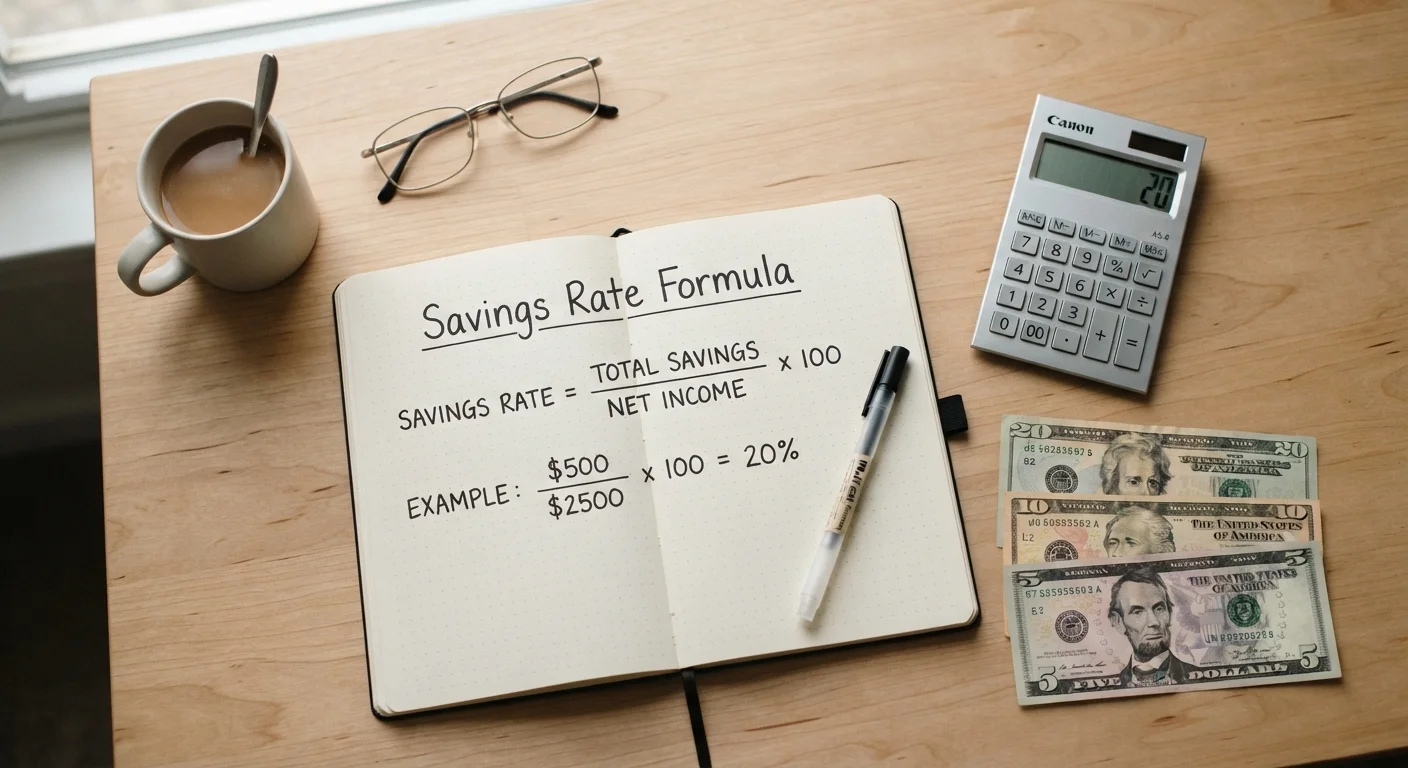
The Basic Formula: How to Calculate Your Personal Savings Rate
Calculating your personal savings rate is straightforward. Use this formula:
Savings Rate (%) = (Amount Saved ÷ Income) × 100
For example, if your monthly take-home pay is $4,000 and you put $400 into a savings or retirement account, your savings rate is 10%. That single number gives you an immediate, honest picture of how much of your income you are retaining versus spending.
When deciding which income figure to use, consider this: using net income (after taxes and deductions) is more practical for day-to-day planning, since it reflects the money you actually receive. Using gross income (before taxes) makes comparisons with national-level data easier. Either is fine - just apply the same method consistently so your rate is comparable over time.
What counts as "savings"? Include contributions to:
- Savings accounts and money market accounts
- Retirement accounts such as a 401(k), 403(b), or IRA
- Investment accounts you are building for future goals
- Employer matching contributions to your retirement plan
Regular monthly bills, debt minimum payments, and everyday expenses do not count - even if you pay them on time and in full.
Include Employer Matches in Your Count
If your employer matches a portion of your 401(k) contribution, that match counts as part of your total savings for the purpose of calculating your rate. A 5% employee contribution with a 3% employer match means 8% of your income is going toward retirement - a more complete picture of your saving progress.
The National Savings Rate: What It Measures and Why It Matters
Beyond individual households, economists track a national personal saving rate - a broad measure of how much income American households collectively set aside. The BEA publishes this figure monthly as part of its Personal Income and Outlays report.
The national rate is calculated by subtracting personal taxes and total personal outlays (spending) from personal income, then dividing that remainder by disposable personal income. Historically, the U.S. personal saving rate has ranged from single digits to brief spikes during periods of economic uncertainty, when households tend to pull back on spending.
~4-5%
Typical recent U.S. personal saving rate
The Bureau of Economic Analysis reports the U.S. personal saving rate, which has frequently hovered in the low single digits in recent years outside of recession-driven spikes.
15%+
Savings rate target often cited by financial educators
Many financial planning frameworks suggest saving at least 15% of gross income - including employer retirement contributions - to support long-term goals including retirement.
Policymakers and financial researchers watch the national savings rate because it signals the financial buffer households have against recessions, job losses, and rising prices. A persistently low national rate can indicate that many households are living close to or beyond their means - a vulnerability that compounds during economic downturns.
For individual consumers, the national figure serves as useful context. If your personal savings rate is meaningfully above the national average, you are building more cushion than most. If it falls below, understanding the gap can motivate targeted changes.
Why Your Savings Rate Is a More Useful Measure Than a Dollar Amount
It might feel more concrete to track a specific dollar amount - "I want to save $500 a month" - but a rate is actually a more durable target. Here's why: as income rises, a fixed dollar goal stays the same while a percentage goal scales automatically. Saving 10% of $4,000 is $400; saving 10% of $6,000 is $600. The percentage keeps pace with your financial growth.
A savings rate also makes it easier to compare your progress across different life stages and income levels. It strips out the noise of raises, salary changes, and income fluctuations to show the underlying habit. Your savings rate reveals a great deal about long-term financial resilience in a way that a raw dollar figure simply cannot.
Tracking your rate monthly - even informally in a spreadsheet - creates accountability and highlights drift before it becomes a problem. If your rate drops from 12% to 6% without a deliberate reason, that is a signal worth investigating.
For readers ready to act on their savings rate, it helps to understand how different types of savings serve different goals. Emergency funds, sinking funds, and savings goals each serve a distinct role in a household budget - and knowing where your saved dollars belong makes the rate more meaningful.
“The personal saving rate is one of the simplest and most telling indicators of household financial health. When it trends low for extended periods, it suggests that many families have little buffer against the unexpected.”
— Bureau of Economic Analysis, U.S. federal agency responsible for national economic statistics
Practical Ways to Improve Your Savings Rate
Improving your savings rate does not necessarily require a large income boost. Small, structural changes often have a lasting effect:
- Automate transfers on payday. Moving money to savings before you can spend it removes the decision from your daily life. Even a small automatic transfer builds the habit.
- Capture windfalls intentionally. Tax refunds, bonuses, and gifts are opportunities to lift your rate without adjusting your regular budget. Directing even half of a windfall to savings registers as a meaningful rate improvement for that period.
- Audit recurring expenses annually. Subscriptions, insurance premiums, and service fees often creep upward. A yearly review can free up dollars that redirect straight into savings.
- Increase your rate incrementally. If saving 15% feels out of reach, start at 3% and add one percentage point every few months. The friction is low, and the compounding effect over years is real.
Where you park saved money also matters for growth. High-yield savings accounts can help your saved dollars earn more interest than a standard savings account, which extends the value of every dollar you set aside. And if you are starting from zero, building a savings habit from scratch is entirely achievable with the right framework.
This article is for general informational and educational purposes only and does not constitute personalized financial or investment advice. Consult a qualified financial professional for guidance specific to your situation.
Frequently Asked Questions
Many financial educators suggest aiming to save at least 15-20% of gross income when accounting for retirement and emergency savings combined. However, any consistent, positive savings rate is a meaningful starting point, especially for those working to establish the habit for the first time.
Extra debt payments above the required minimum can function similarly to saving, since they reduce a liability and improve net worth. That said, most standard savings rate formulas focus on money actively set aside, so the treatment of debt payments varies depending on how you define and track your rate.
The Bureau of Economic Analysis (BEA) calculates the personal saving rate by dividing personal saving - what remains after taxes and spending - by disposable personal income. The result is expressed as a percentage and published monthly.
Both approaches are valid, and financial educators use each. Using net (take-home) income gives a more practical picture of what share of spendable money you are setting aside. Using gross income aligns more closely with national-level calculations and is common in longer-term planning discussions.
Savings typically include money deposited into savings or investment accounts, contributions to retirement accounts (401(k), IRA, etc.), and employer matches. Regular bill payments, loan minimums, and everyday spending do not count.
The content on this site is for informational purposes only and is not a substitute for professional advice. Always consult a qualified professional for guidance specific to your situation.