

Option A
Fixed-Rate Mortgage (FRM)
The predictable, long-term stability choice.
Best for: Buyers who plan to stay in a home long-term and want consistent monthly payments regardless of market conditions.
Option B
Adjustable-Rate Mortgage (ARM)
The lower entry-cost, shorter-horizon option.
Best for: Buyers who expect to sell or refinance within a few years and want to take advantage of a lower initial interest rate.
How Each Mortgage Type Works
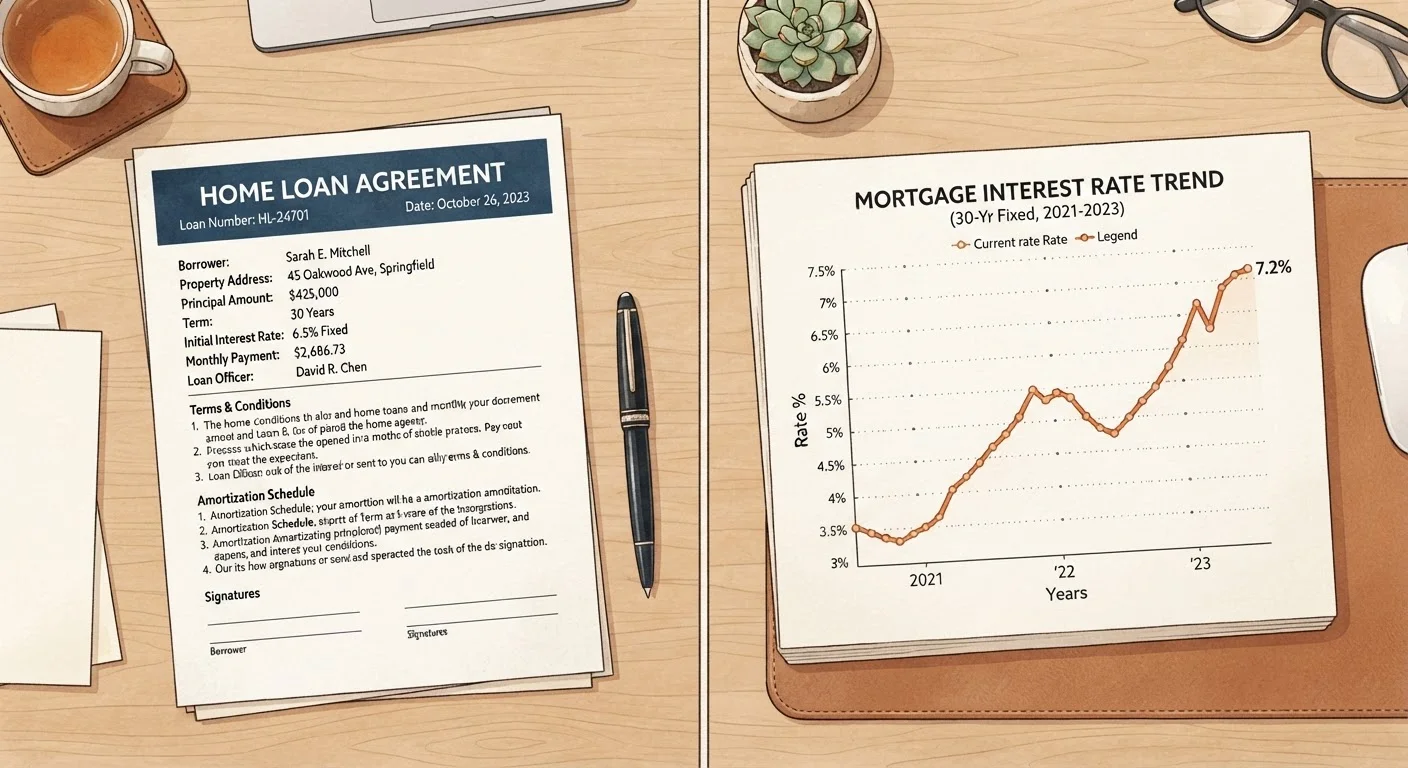
A fixed-rate mortgage (FRM) sets your interest rate on the day you close, and it stays exactly that rate for the life of the loan - whether that's 15 or 30 years. Your principal-and-interest payment never changes, no matter what happens to broader interest rates in the economy.
An adjustable-rate mortgage (ARM) works in two phases. First comes an initial fixed period - commonly 5, 7, or 10 years - during which the rate is set and stable, often lower than a comparable fixed-rate loan. After that, the rate adjusts periodically (typically once a year) based on a financial index plus a fixed margin set by the lender. For example, a "5/1 ARM" has a fixed rate for five years, then adjusts annually after that.
ARM agreements include rate caps - limits on how much the rate can increase per adjustment period and over the life of the loan. These protect borrowers from extreme spikes, but they don't eliminate rate risk entirely. To understand how broader interest rate conditions affect your purchasing power at any stage of the process, see our article on how interest rates shape housing affordability.
| Criterion | Fixed-Rate Mortgage | Adjustable-Rate Mortgage |
|---|---|---|
| Interest rate | Locked in at closing, never changes | Fixed initially, then adjusts periodically |
| Initial monthly payment | Typically higher than an ARM | Typically lower during fixed period |
| Payment predictability | Fully predictable for life of loan | Predictable only during fixed period |
| Rate risk | None - rate is fixed regardless of market | Rate can rise after adjustment period |
| Common loan terms | 15- or 30-year fixed | 5/1, 7/1, or 10/1 ARM structures |
| Best holding period | 10+ years in the home | Shorter than the fixed-rate window |
| Complexity | Simple to understand and compare | Requires understanding caps, indexes, margins |
The Real Trade-Offs: Stability vs. Flexibility
The central tension between these loan types comes down to certainty versus opportunity. Fixed-rate mortgages give you certainty: you know exactly what you'll owe each month for the duration of the loan. That predictability is valuable for long-term financial planning and is particularly important for buyers on fixed or slower-growing incomes.
ARMs offer opportunity - primarily the chance to enter a loan at a lower starting rate, which reduces initial monthly payments and may qualify some buyers for a larger loan amount. But that opportunity comes with exposure: if rates rise after the adjustment period, your payment can increase meaningfully.
30 years
Most common fixed-rate mortgage term in the US
The 30-year fixed-rate mortgage has historically been the most widely used home loan structure among US buyers, according to Freddie Mac's Primary Mortgage Market Survey.
2%-5%
Typical closing cost range for refinancing
The Consumer Financial Protection Bureau notes that refinancing generally costs between 2% and 5% of the loan principal, a factor worth weighing before relying on refinancing as an ARM exit strategy.
5/1
Most common ARM structure by initial fixed period
Among adjustable-rate mortgages, the 5/1 ARM - with a five-year fixed period followed by annual adjustments - has historically been one of the most commonly offered structures by US lenders.
It's worth noting that refinancing is sometimes presented as a safety net for ARM borrowers - the idea being that you can switch to a fixed rate before adjustments begin. However, refinancing isn't guaranteed; it depends on your financial profile, home equity, and market conditions at the time. It also carries its own closing costs, typically ranging from 2% to 5% of the loan amount.
For a broader look at how these loan structures fit into the landscape of mortgage options, our comparison of conventional, FHA, and VA loans provides useful context on eligibility and program differences.
Understanding ARM Rate Caps
Most ARMs include three types of caps: an initial adjustment cap (how much the rate can change at the first adjustment), a periodic cap (the limit per subsequent adjustment), and a lifetime cap (the maximum total increase over the loan's life). A common cap structure is 2/2/5 - meaning the rate can rise no more than 2% at first adjustment, 2% per year after that, and 5% total over the loan term. Always ask your lender to walk through the cap structure before committing to an ARM.
Making the Right Choice for Your Situation
No single mortgage type is right for every buyer. The decision hinges on a few practical questions: How long do you expect to stay in this home? How stable is your income? How much payment variability could you absorb if rates moved against you?
Buyers who are confident they'll sell or refinance within the ARM's initial fixed window - and who have the financial cushion to handle some rate movement - may find an ARM genuinely advantageous. Those who value stability, plan to stay long-term, or prefer simplicity will generally fare better with a fixed-rate loan.
You can also explore how the fixed-versus-adjustable trade-off echoes in other financial decisions. The comparison between month-to-month and fixed-term leases raises similar questions about flexibility versus stability in a renting context.
This article is for general informational and educational purposes only and does not constitute financial, legal, or mortgage advice. Readers should consult a licensed mortgage professional or financial adviser to evaluate options based on their individual circumstances.
The content on this site is for informational purposes only and is not a substitute for professional advice. Always consult a qualified professional for guidance specific to your situation.