

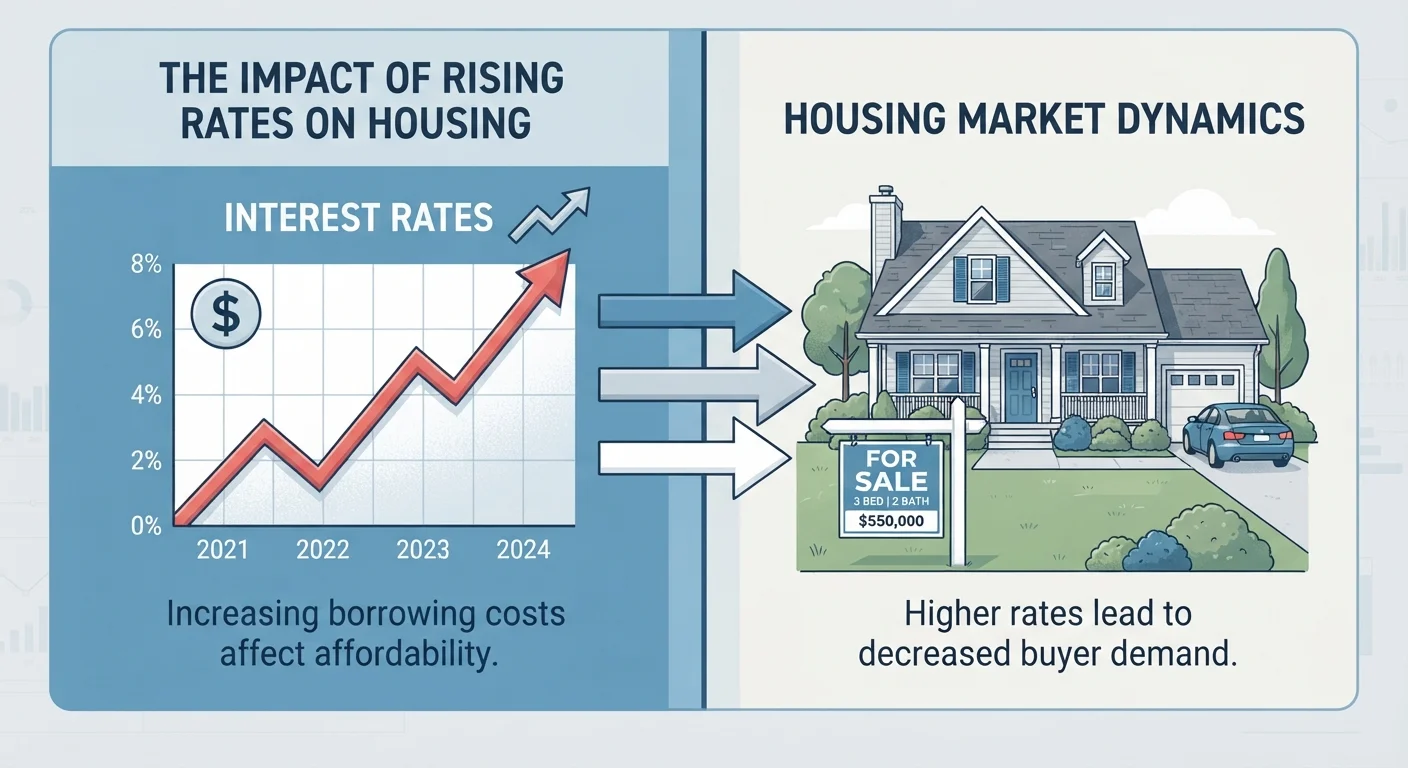
The Mechanics: How Rates Change What Buyers Can Afford
Mortgage rates translate directly into monthly costs. For a buyer taking out a 30-year fixed-rate loan, even a modest rate shift meaningfully changes the payment. At 4%, a $350,000 loan carries a principal-and-interest payment of roughly $1,670 per month. At 7%, that same loan costs about $2,330 - nearly $660 more per month. Over the life of the loan, the difference runs into six figures.
Lenders typically qualify buyers based on their debt-to-income ratio - the share of gross monthly income going toward debt payments. As rates rise, that ratio climbs for the same loan amount, and buyers either need a higher income or must consider a smaller loan. In practice, many buyers shift their target price range downward when rates move up sharply.
This is the clearest and most direct link between rates and affordability. But it's also where the story becomes more nuanced.
~$660
Monthly payment increase on a $350K loan
Comparing a 30-year fixed-rate mortgage at 4% versus 7%, illustrating the direct cost impact of a 3-percentage-point rate rise.
~23%
Share of income needed for median home payment
The National Association of Realtors has tracked affordability ratios showing households in many markets spending well above traditional 20% benchmarks during elevated-rate periods.
When Lower Rates Create Their Own Affordability Problem
Rate decreases feel like good news for buyers, and in isolation they are. But housing markets don't work in isolation. When borrowing costs fall, more households can qualify to buy, demand increases, and competition for available homes intensifies. Sellers recognize this dynamic and price accordingly.
The result is that home prices often rise in low-rate environments, sometimes fast enough to cancel out the payment savings a buyer expected. A buyer who planned to spend $1,800 a month may find that the homes meeting that payment at a lower rate are now priced beyond reach because every other buyer in the market is in the same position.
This is one reason why common assumptions about timing the market deserve scrutiny - equating low rates with automatic affordability gains misses this feedback loop.
“Mortgage rates set the floor for monthly costs, but they don't set the ceiling on prices. Both halves of that equation determine whether a market is truly affordable.”
— Real Estate Basics Editorial Team, Housing market educators focused on consumer literacy
The Lock-In Effect: How Rising Rates Reduce Supply
There's a less-discussed consequence of higher rates that operates on the supply side of the market. Homeowners who refinanced or purchased during a period of historically low rates - say, 2020 through early 2022 - are often reluctant to sell. Selling would mean giving up their existing mortgage and buying their next home at today's higher rate, significantly increasing their monthly obligation.
This behavior, widely referred to in housing economics as the lock-in effect, reduces the number of homes listed for sale. Fewer listings mean buyers face more competition for what's available, which supports prices even as demand cools. The counterintuitive outcome: rising rates can slow buyer activity while simultaneously keeping prices elevated because supply contracts too.
Understanding why inventory matters so deeply to pricing is worth exploring further - inventory levels shape prices, competition, and negotiating power in ways that often override other signals.
Evaluate Affordability on All Three Dimensions
When assessing whether now is a reasonable time to buy, look at mortgage rates, local home prices, and your household income together - not any single factor in isolation. A rate that looks high compared to a few years ago may still be manageable if prices in your target area have moderated. Running the numbers on actual monthly payments relative to your income gives a clearer picture than tracking rates alone.
Reading Rate Signals Without Oversimplifying Them
Rates are one important input into a housing decision, but affordability is the product of at least three variables working together: mortgage rates, home prices, and household income. When all three shift simultaneously - as they often do in real economic cycles - the net effect on affordability is rarely as clean as a single headline suggests.
Broader economic indicators like employment trends and wage growth often shape what actually happens to prices after a rate change. A rate drop in a weakening economy may not produce the buying frenzy observers expect, while a rate increase during strong job growth may cool the market less than projected.
For a fuller picture of how macroeconomic forces connect to housing prices, including where those relationships can break down, see economic signals that often move house prices. And if you're actively weighing a purchase, the home buying basics hub offers foundational guidance for navigating that process confidently.
This article is for general informational and educational purposes only. It does not constitute financial, legal, or investment advice. Readers should consult a qualified financial adviser, mortgage professional, or HUD-approved housing counselor before making housing or borrowing decisions.
Frequently Asked Questions
Not automatically. Lower rates reduce monthly payments, but they also tend to draw more buyers into the market, which pushes prices higher. If prices rise faster than payments drop, overall affordability can actually worsen despite falling rates.
On a $400,000 loan at a 30-year fixed term, a 1-percentage-point rate increase adds roughly $230-$250 per month to the payment. The exact impact depends on loan size, term length, and loan type.
Supply constraints are a major reason. Many existing homeowners locked in low rates and are reluctant to sell, which keeps inventory scarce. When there are fewer homes available, prices remain elevated even as buyer demand cools.
This is a personal financial decision with no universal right answer. Lower rates in the future could bring more competition and higher prices. A licensed financial adviser or HUD-approved housing counselor can help you evaluate your specific situation.
The lock-in effect describes homeowners who avoid selling because doing so would require giving up their existing low-rate mortgage and taking on a new loan at a higher rate. This behavior reduces housing supply and can sustain elevated prices even in a high-rate environment.
The content on this site is for informational purposes only and is not a substitute for professional advice. Always consult a qualified professional for guidance specific to your situation.