

Why Cycles Matter for Everyday Housing Decisions
Whether you're planning to buy, sell, or rent, the state of the housing market shapes your options and outcomes. Markets don't move randomly - they tend to follow a recognizable rhythm. Understanding that rhythm won't give you a crystal ball, but it will help you interpret what you're seeing in your local market and avoid common missteps.
If you're new to tracking real estate trends, our introduction to understanding housing markets is a good place to start before diving into cycle dynamics.
18 years
Estimated average length of a full US housing cycle
Research from the Urban Land Institute suggests full real estate cycles, including all four phases, have historically spanned roughly 15-20 years in the US, though this varies significantly by region.
~6 months
Inventory level often signaling a balanced market
A common industry benchmark holds that roughly six months of housing supply indicates a balanced market - below that tends to favor sellers, above it tends to favor buyers.
3-5 years
Typical minimum recommended ownership horizon
Many housing economists suggest holding a home for at least three to five years to offset transaction costs and reduce exposure to short-term price volatility.
Phase 1: Expansion - Rising Demand, Growing Confidence
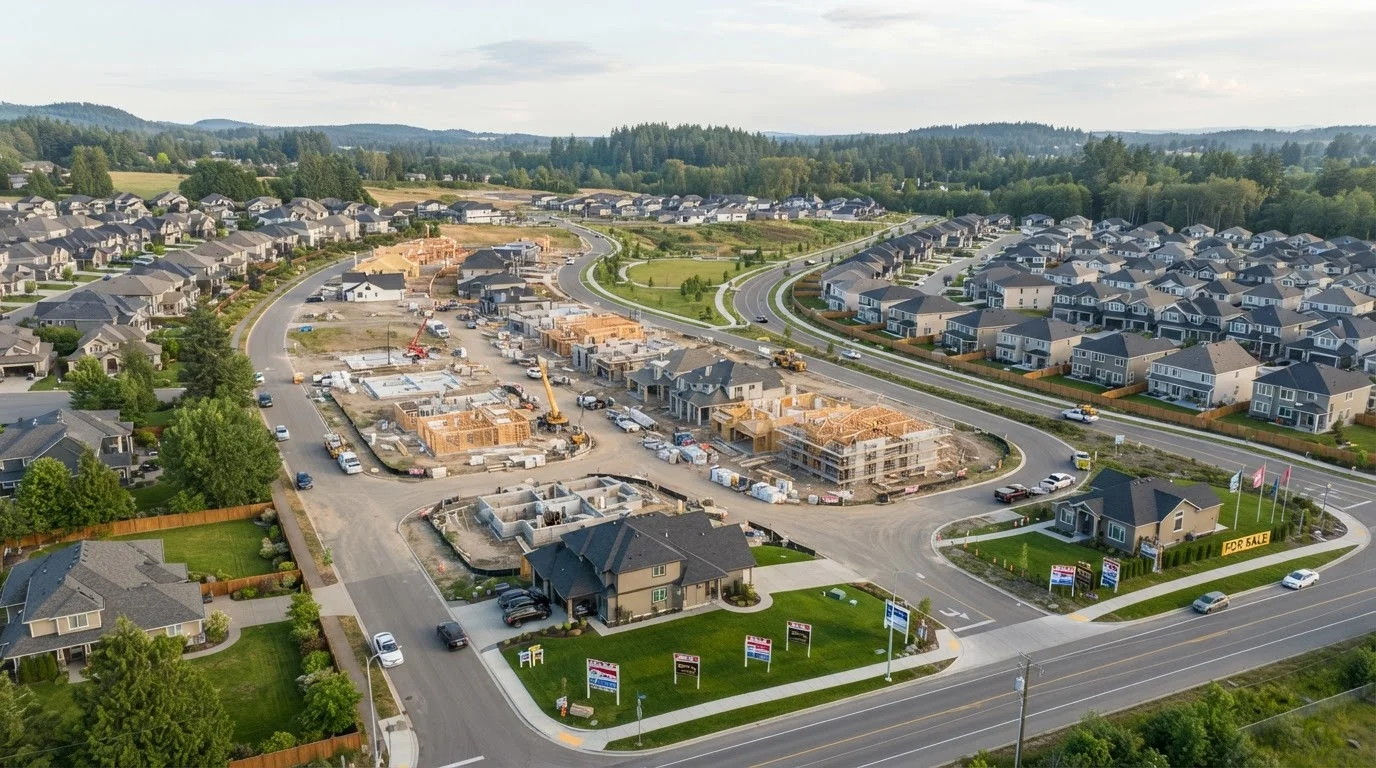
Expansion is the growth phase. Employment rises, household formation increases, and more people are ready and able to buy. Inventory is absorbed quickly, construction picks up, and prices begin climbing. For buyers, competition starts to heat up. For sellers, the market becomes increasingly favorable.
Key signals of expansion include declining days on market, rising sales volume, and steady price appreciation. New construction permits often tick upward as developers respond to demand.
Watch Local Indicators, Not Just Headlines
National housing news often lags behind or doesn't reflect what's happening in specific metro areas or neighborhoods. Tracking local inventory, median days on market, and price-per-square-foot trends gives you a more accurate read on your market's current phase. See our housing market indicators guide for a practical breakdown of what to watch.
Phase 2: Peak - High Prices, Maximum Activity
At the peak, prices are at or near their highest point relative to fundamentals like income and rent. Demand may begin to soften even as prices remain elevated. Bidding wars are common, and affordability starts to strain. Sellers enjoy strong leverage, but buyers face the highest purchase prices of the cycle.
Peaks are often only clearly visible in hindsight. At the time, optimism tends to dominate - which is why it's worth examining whether assumptions about the market are realistic. Our article on real estate market assumptions that mislead consumers explores how overconfidence at peak conditions can lead to costly decisions.
“Real estate cycles are driven by human behavior as much as economics - and human behavior tends to overshoot in both directions. Understanding where you are in the cycle is one of the most valuable tools a buyer or seller can have.”
— A. Randall Contreras, Urban economics researcher and real estate cycle analyst
Phase 3: Contraction - Cooling Prices, Shifting Power
During contraction, demand softens, inventory rises, and price growth slows or reverses. Homes sit on the market longer, and sellers may need to negotiate more. For buyers who are financially prepared, contraction can offer more choices and less pressure - though the risk of further price declines is real.
Contraction doesn't mean collapse in every market. Some regions experience mild corrections while others see significant price drops. Local employment conditions, housing supply, and interest rates all influence how severe a contraction becomes. Renters may see some relief in asking prices during this phase as well.
Phase 4: Recovery - Stabilization Before the Next Expansion
Recovery is the transition out of contraction. Prices stabilize and begin to inch upward. Inventory levels normalize, and buyer confidence slowly returns. Building activity remains subdued early in recovery, which helps absorb existing supply before new construction resumes.
Recovery offers a window for buyers who can tolerate some uncertainty - prices haven't yet climbed steeply, and competition is still modest. For a deeper look at what drives transitions between these phases, see our detailed guide to understanding real estate market cycles.
No matter where the cycle stands, your personal financial readiness - stable income, adequate down payment, long enough time horizon - should anchor any housing decision. For foundational guidance on the buying process, visit our Home Buying Basics hub, and renters can explore relevant considerations in our Renting 101 hub.
This article is for general informational and educational purposes only and does not constitute financial, investment, or legal advice. Consult a qualified professional before making housing decisions based on your individual circumstances.
Frequently Asked Questions
Housing cycles vary widely and don't follow a fixed schedule. Historically, full cycles in the US have ranged from roughly 7 to 18 years, but local markets can move at their own pace. Economic shocks, interest rate changes, and regional supply constraints can accelerate or slow transitions between phases.
Buying during a contraction can offer lower prices and less competition, but it also carries risk if values continue declining. Your personal financial stability - steady income, adequate savings, long time horizon - matters more than cycle timing alone. A qualified financial adviser can help evaluate your specific situation.
Track indicators like inventory levels, days on market, price trends, and months of supply. Rising inventory and longer selling times often signal a shift toward contraction, while shrinking inventory and fast sales suggest expansion or peak conditions. Our <a href="/real-estate-basics/housing-markets/housing-market-indicators-every-consumer-should-know">guide to housing market indicators</a> explains these metrics in detail.
Historically, most US housing markets have recovered and appreciated over long periods, but recovery timelines differ greatly by location and severity of the downturn. Past performance does not guarantee future results, and some regional markets have taken a decade or more to fully recover.
During expansion and peak phases, rising home prices and tight inventory can push more people into renting, which drives up rents. During contraction and recovery, rental demand may ease or shift. Renters benefit from understanding cycle conditions when negotiating leases or deciding whether renting remains the right fit.
The content on this site is for informational purposes only and is not a substitute for professional advice. Always consult a qualified professional for guidance specific to your situation.