

Our Verdict
In a volatile housing market, buying makes the most sense for those with stable income, a long time horizon, and genuine readiness for homeownership costs. Renting is a financially sound and often underappreciated choice for those who need flexibility, are uncertain about their local market, or lack the savings cushion ownership demands. Neither path is inherently superior - the right answer depends on your personal finances, plans, and the specific conditions of your local market.
Best evaluated by anyone weighing a housing decision in an uncertain market who wants a clear, honest framework rather than a one-size-fits-all answer.
Why Market Volatility Changes the Equation
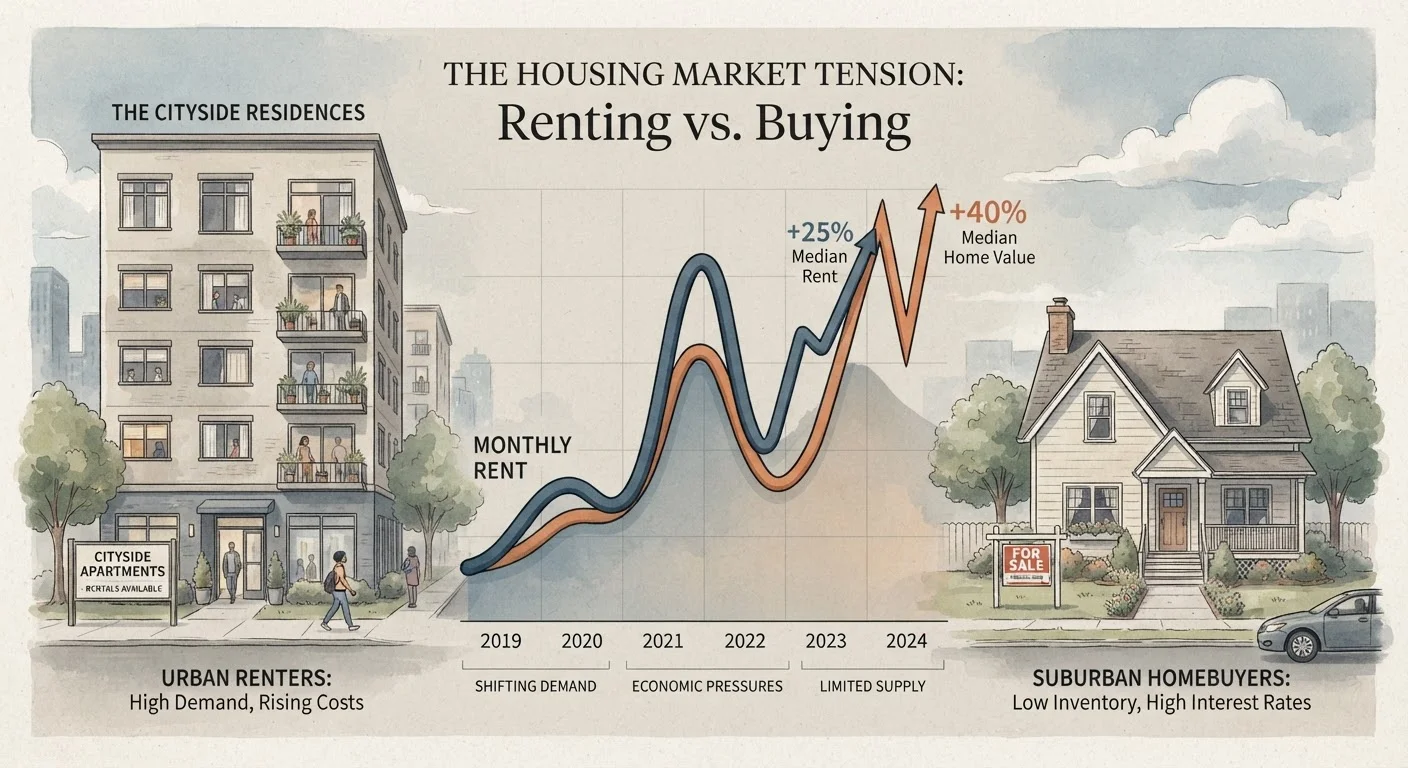
In a stable housing market, the rent-vs.-buy decision is complex enough. Add price swings, shifting mortgage rates, and economic uncertainty, and the calculus gets genuinely harder. Volatile markets introduce risk on both sides of the ledger - buyers may overpay at a peak, while renters may see rents surge if supply tightens.
One useful starting point is the price-to-rent ratio - a measure that compares median home prices in an area to annual median rents. A high ratio (generally above 20) often signals that buying is expensive relative to renting locally, while a lower ratio can favor ownership. But this is a directional tool, not a verdict. Local supply dynamics, your job stability, and how long you plan to stay all matter just as much. For a deeper look at how these market signals work, see how price-to-rent ratios and local supply affect the comparison.
5+ years
Typical break-even horizon for buyers
Real estate economists generally estimate buyers need to hold a property for at least five years to recoup transaction costs, though this varies by market and price.
1-2%
Annual home maintenance cost as share of value
Housing industry guidance commonly cites annual maintenance averaging 1-2% of a home's value, a cost renters typically do not bear directly.
Advantages and Disadvantages of Buying in a Volatile Market
Buying a home during uncertain conditions carries real appeal - and real risk. On the upside, locking in a fixed-rate mortgage protects you from future rent increases and provides stability. Over a long enough period, ownership also builds equity that renting does not. But in a volatile market, short-term buyers face meaningful exposure: if prices fall after purchase, you may owe more than the home is worth, a situation called being "underwater."
Transaction costs - typically 2-5% of the purchase price for buyers, and another 6-10% when selling - mean you generally need to stay put for at least five years to break even. Buying also ties up significant capital in a down payment, reducing the financial flexibility available for other needs or emergencies.
Locks in housing costs with a fixed-rate mortgage
A fixed-rate mortgage shields buyers from future rent increases, providing predictable monthly payments for the life of the loan - a meaningful advantage if rents in the area continue to rise.
Builds equity over time
Each mortgage payment reduces the loan principal, gradually building ownership stake in the property. Over a long holding period, this equity can represent significant accumulated wealth.
Provides stability and control over your living space
Owners are not subject to lease non-renewals, landlord decisions, or rent hikes. This stability can be especially valuable for families who want to put down roots.
Potential tax benefits in some situations
Mortgage interest and property taxes may be deductible depending on individual tax circumstances, though the benefit varies and should be confirmed with a qualified tax professional.
High transaction costs create a break-even hurdle
Closing costs, agent commissions, and moving expenses can total 8-15% of the home's value across buying and selling. Buyers who move within a few years often lose money even if prices are flat.
Price declines can leave buyers underwater
In a volatile market, home values can fall after purchase. Owing more than the property is worth limits your ability to sell or refinance without taking a loss.
Ongoing ownership costs are often underestimated
Property taxes, insurance, HOA fees (where applicable), and maintenance - historically averaging 1-2% of home value annually - add up significantly beyond the mortgage payment.
Ties up capital that could remain liquid
A down payment of 10-20% on a median-priced home is a large sum removed from accessible savings, reducing financial flexibility at a time when conditions may shift unexpectedly.
For a broader framework on timing and readiness, the balanced breakdown of financial and lifestyle factors covers the full picture.
When Renting Is the Smarter Move
Renting is often dismissed as "throwing money away," but that framing ignores what renters actually gain: flexibility, liquidity, and insulation from property value declines. In a volatile market, these are not small advantages.
Renters can relocate relatively quickly if job circumstances change, if a better opportunity appears elsewhere, or if local rents shift significantly. They avoid property taxes, homeowner's insurance at ownership scale, and maintenance costs - which historically average around 1-2% of a home's value annually. That capital can instead remain accessible or be directed toward other financial goals.
Renting Does Not Mean Forfeiting Wealth-Building
A common misconception is that renting is financially passive. Renters who consistently invest the cost difference between renting and owning - including avoided down payments, maintenance, and taxes - may build wealth through other vehicles. That said, investment returns are never guaranteed and depend heavily on individual discipline and market conditions. Speaking with a fee-only financial adviser can help clarify which path aligns better with your overall financial goals.
Renting is not a permanent forfeit of wealth-building. Many renters invest the difference between what ownership would cost and what they actually pay, potentially generating returns - though investment returns are never guaranteed and carry their own risks. The balanced breakdown of real financial and life circumstances explores this trade-off in detail.
A Framework for Making the Decision
Rather than trying to time the market, focus on factors within your control. Ask yourself honestly:
- Time horizon: Do you expect to stay in the same area for at least five years? If not, renting is almost always lower-risk.
- Financial cushion: Beyond a down payment, do you have reserves to cover repairs, a job disruption, or a temporary drop in income? Homeownership without an emergency fund is fragile.
- Debt load: Lenders use your DTI to gauge affordability. A high DTI limits mortgage options and adds financial pressure.
- Local market conditions: Is your area's price-to-rent ratio elevated? Are prices still rising or beginning to soften? Are rents competitive?
Neither renting nor buying is universally better. The right path depends on your specific circumstances, not on broad market headlines. For foundational guidance on navigating a purchase, the Home Buying Basics hub offers step-by-step guidance, and Renting 101 covers what every renter needs to know.
This article is for general informational and educational purposes only and does not constitute financial, legal, or investment advice. Consult a qualified financial adviser or real estate professional before making housing decisions based on your individual circumstances.
The content on this site is for informational purposes only and is not a substitute for professional advice. Always consult a qualified professional for guidance specific to your situation.