

Option A
Fibre Internet
The newer, purpose-built broadband technology.
Best for: Households that need consistently high speeds, low latency, and symmetrical upload and download performance.
Option B
Cable Internet
The widely available, infrastructure-sharing option.
Best for: Households in areas where fibre hasn't yet been deployed but who still need solid broadband speeds.
How Each Technology Actually Works
The most fundamental difference between fibre and cable internet lies in what physically carries your data.
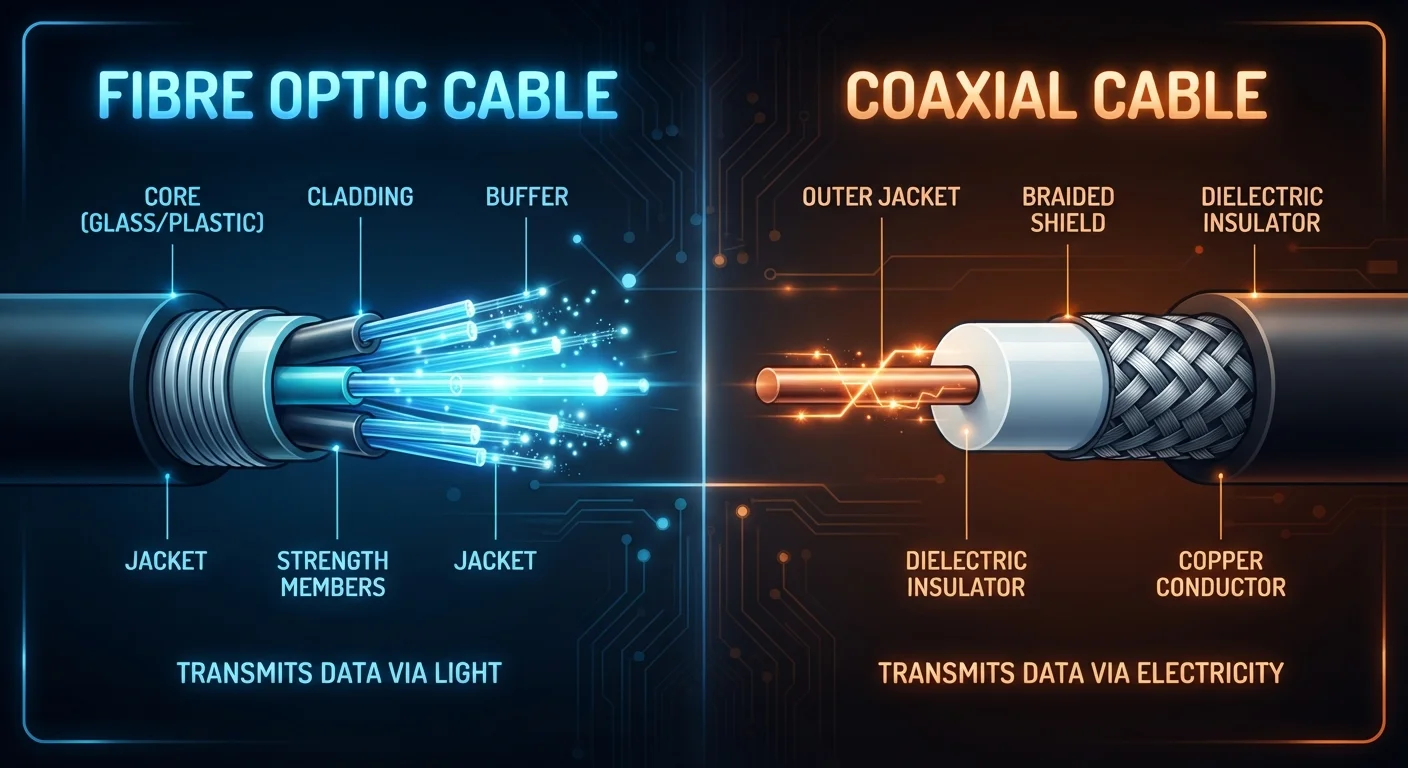
Fibre internet transmits data as pulses of light through thin strands of glass or plastic - known as optical fibres. Because light travels at extraordinary speed and is not subject to electrical interference, fibre connections are exceptionally fast and stable. The signal degrades very little over long distances compared to electrical signals.
Cable internet uses coaxial cables - the same copper-based infrastructure originally laid for cable television. Data travels as electrical signals through these lines. While modern cable technology (using a standard called DOCSIS) has made cable internet competitive in download speeds, the underlying medium has physical limitations that fibre does not share.
Understanding this distinction helps explain nearly every performance difference covered below. For a broader overview of connection types, see our guide to home internet types.
| Criterion | Fibre Internet | Cable Internet |
|---|---|---|
| Transmission medium | Glass or plastic optical fibre (light) | Coaxial copper cable (electrical signal) |
| Typical upload speed | Matches download (symmetrical) | Much slower than download |
| Latency | Lower and more consistent | Higher, can vary under load |
| Peak-hour congestion | Generally unaffected | Can slow significantly |
| Infrastructure age | Purpose-built for data | Adapted from TV cable systems |
| US availability | Expanding, still limited in rural areas | Widely available nationally |
Speed, Latency, and Consistency
Speed is often the headline metric, but it tells only part of the story.
Download vs. upload symmetry: Fibre connections are typically symmetrical - meaning your upload speed matches your download speed. Cable plans, by contrast, are asymmetrical by design: download speeds may be fast, but upload speeds are often a fraction of that. For households that primarily consume content (streaming, browsing), this asymmetry may go unnoticed. For those who send large files, back up to the cloud, or video conference regularly, it can be a significant limitation.
Latency: Latency refers to the time it takes for a data packet to travel from your device to its destination and back - measured in milliseconds (ms). Fibre's light-based transmission produces lower and more consistent latency than cable. This matters most for real-time applications like video calls, online gaming, or voice-over-IP services.
Network congestion: Cable infrastructure is shared among users in a neighbourhood. During peak usage hours - evenings and weekends - speeds can drop noticeably as more households compete for the same bandwidth. Fibre networks are generally less susceptible to this effect. This is one of the most widely misunderstood aspects of home internet; our article on common internet speed myths explores several others.
~43%
US homes with fibre broadband access
According to the FCC's Broadband Data Collection, fibre-to-the-premises availability reached roughly 43% of US housing units as of late 2023 reporting.
~10-20 ms
Typical fibre latency range
Industry benchmarks generally place fibre latency in the 10-20 millisecond range under normal conditions, compared to 20-40 ms commonly reported for cable.
Infrastructure, Availability, and What to Expect
One reason many US households still use cable internet is straightforward: fibre isn't yet available everywhere. Cable's coaxial infrastructure was laid across most of the country decades ago for television service, giving it a significant geographic footprint. Fibre requires new construction - running optical cables through communities, which is costly and time-intensive.
Fibre availability has been expanding steadily, particularly in urban and suburban areas, but large portions of rural America still lack access to it. Before deciding between the two, checking what is actually available at your specific address is an essential first step.
"Fibre" Doesn't Always Mean Full Fibre
When a provider advertises a "fibre" plan, it's worth asking whether optical cable runs all the way to your home or only to a nearby street cabinet. Hybrid FTTC connections use fibre for part of the journey but rely on coaxial or copper for the final link - meaning you may not get the full speed and consistency benefits of a true FTTH connection. Ask your provider specifically about the last-mile connection type before signing up.
It's also worth understanding the terminology used by providers. Some services marketed as "fibre" are actually hybrid networks - fibre runs to a neighbourhood junction box, but the final connection to your home is made via coaxial cable. This is sometimes called FTTC (fibre-to-the-curb) as opposed to FTTH (fibre-to-the-home) or FTTP (fibre-to-the-premises). A true FTTH connection delivers the full benefits of fibre; a hybrid setup behaves more like cable for that last stretch. For a deeper comparison of how fibre and cable perform on reliability specifically, see our fibre vs cable reliability comparison.
The content on this site is for informational purposes only and is not a substitute for professional advice. Always consult a qualified professional for guidance specific to your situation.