

Option A
Fibre Internet
The high-performance, symmetrical connection built for modern demands.
Best for: Households that stream in 4K, work from home, game online, or have multiple heavy users simultaneously.
Option B
Cable Internet
The widely available, familiar broadband option with broad reach.
Best for: Households in areas without fibre coverage, or those with moderate everyday internet needs.
How Each Technology Actually Works
Understanding the difference between fibre and cable internet starts with how each one physically moves data to your home.
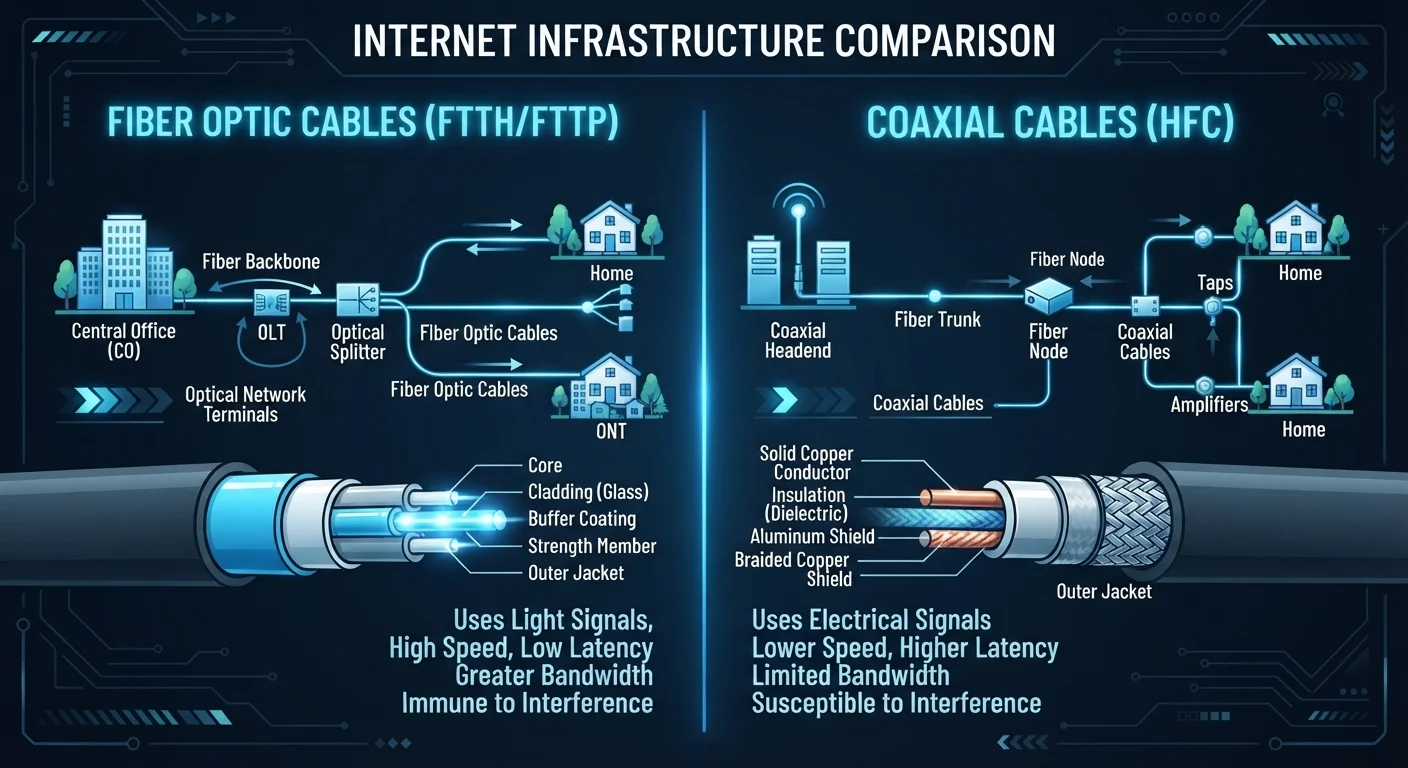
Fibre internet transmits data as pulses of light through thin strands of glass or plastic - a technology called fibre optics. Because light travels without electrical resistance, fibre can carry data over long distances with minimal signal degradation. Most modern fibre deployments bring the connection directly to a home's network terminal, a setup often called FTTH (Fibre to the Home).
Cable internet uses coaxial cables - the same type of wiring originally installed for cable television. These copper-based lines carry data as electrical signals. Because the cable TV infrastructure already existed across much of the US, cable internet became one of the country's most widespread broadband technologies without requiring entirely new wiring.
For a broader look at how these technologies fit alongside DSL and fixed wireless, see Home Internet Types Explained.
| Criterion | Fibre Internet | Cable Internet |
|---|---|---|
| Signal medium | Light through glass/plastic strands | Electrical signal through coaxial copper |
| Typical download speeds | 200 Mbps - 5 Gbps | 100 Mbps - 1 Gbps |
| Upload speeds | Symmetrical (matches download) | Often 10-35 Mbps on fast plans |
| Latency | Typically lower (1-10 ms) | Moderate (10-30 ms typical) |
| Peak-hour consistency | High - less congestion risk | Variable - shared neighbourhood nodes |
| US availability | Growing, stronger in urban areas | Widespread across suburbs and cities |
| Infrastructure age | Newer builds; actively expanding | Mature; upgrades ongoing (DOCSIS 3.1) |
Speed, Latency, and Consistency: Where the Differences Really Show
Raw speed is only part of the picture. How a connection performs consistently - especially during peak usage hours - matters just as much for everyday experience.
Download speeds on cable plans commonly range from 100 Mbps to 1 Gbps, which is adequate for most households. However, cable networks are shared infrastructure: your neighborhood's connections run through a common node, so speeds can slow noticeably during evenings when many users are online simultaneously. This is known as network congestion.
Fibre connections are far less susceptible to this kind of slowdown. Because fibre infrastructure is designed with higher capacity and dedicated signal paths, speeds tend to remain close to the advertised rate even during peak periods.
Upload speeds represent one of fibre's clearest advantages. Cable plans typically offer upload speeds that are a fraction of their download speeds - often 10-35 Mbps on plans marketed as much faster for downloads. Fibre plans commonly deliver symmetrical speeds, meaning upload matches download. This matters considerably for video calls, cloud backups, and remote work.
Latency - the delay between sending a request and receiving a response - is also generally lower on fibre. For online gaming or real-time communication, even small latency differences can affect experience. If you're already troubleshooting sluggish performance, diagnosing a slow connection before calling your provider is a useful first step.
~43%
US homes with access to fibre broadband
According to FCC broadband data, fibre availability has grown substantially but still trails cable coverage across the US.
~10x
Typical fibre vs cable upload speed advantage
Symmetrical fibre plans commonly deliver upload speeds up to ten times higher than comparable cable plans at the same tier.
1-10 ms
Typical fibre internet latency range
Industry benchmarks from sources such as the FCC Broadband Speed Guide consistently show fibre delivering lower latency than cable.
Availability and What to Check Before Deciding
The most important practical question is straightforward: which technologies are actually available at your address? Your options are shaped by geography and local infrastructure investment, not personal preference alone.
Cable internet has long been the more prevalent choice across US suburbs and many urban areas, built on coaxial networks that have been in place for decades. Fibre coverage has expanded significantly in recent years, particularly in cities and newer suburban developments, but rural availability remains limited.
To find out what's available at your address, the FCC's broadband map (available at broadbandmap.fcc.gov) and your state's public utility commission may provide coverage data. Checking directly with local providers for confirmed service at your specific address is also advisable, as published coverage maps can sometimes lag behind actual deployment.
Cable Technology Is Still Improving
Cable providers have been deploying DOCSIS 3.1 and the emerging DOCSIS 4.0 standard, which improve speeds and, in some configurations, move toward more symmetrical upload performance. This means the gap between cable and fibre is narrowing in some markets. When evaluating cable plans, it's worth asking providers which DOCSIS version their local network supports.
Once you know which connection type reaches your home, it's also worth thinking about how your internal setup - including whether you use Wi-Fi or a wired connection - affects your real-world experience. Wi-Fi vs Ethernet explores where a wired connection still has an edge inside the home.
For a deeper foundation on all aspects of home broadband, Everything You Need to Know About Home Broadband covers the full picture from connection types to router setup.
The content on this site is for informational purposes only and is not a substitute for professional advice. Always consult a qualified professional for guidance specific to your situation.