

What the Delta Actually Is
First, the geography: the Mississippi Delta is not where the Mississippi River meets the Gulf of Mexico. That common misunderstanding sends more than a few travelers south of New Orleans looking for something that isn't there. The Delta is an alluvial plain in northwestern Mississippi, roughly bounded by the Mississippi River to the west and the Yazoo River to the east - a flat, fertile corridor stretching from just south of Memphis, Tennessee, down through Greenville and Vicksburg.
The land was shaped by centuries of river flooding that deposited some of the richest topsoil in North America. That agricultural abundance drew plantation agriculture and, with it, the forced labor of enslaved people. The region's entire modern identity - its music, its food, its racial and economic history - flows directly from that origin. Travelers who arrive expecting a simple roots-music road trip will leave with something considerably heavier and more worthwhile.
The Blues: More Than a Museum Exhibit
The Delta's claim as the birthplace of the blues is not marketing language. Musicologists and historians broadly agree that the specific confluence of African musical traditions, field hollers, and work songs that developed in this region in the late 19th and early 20th centuries produced something genuinely new. Towns like Clarksdale, Indianola, and Greenville carry real biographical weight - these are places where artists like Muddy Waters, B.B. King, and Robert Johnson lived and, in some cases, are buried.
Time your visit around a live music weekend or a local blues festival - the Delta's music culture is participatory, and showing up mid-week can mean empty venues.
The Delta's juke joint and roadhouse culture is genuinely alive but not continuous; it clusters around weekends and events, so planning around those windows produces a substantively different experience.
Carry cash. Many of the Delta's most authentic food spots - tamale stands, bbq shacks, small diners - are cash-only operations with no digital presence.
Rural Mississippi commerce often operates outside card payment infrastructure, and the best local food experiences are almost never in the places with a Yelp listing.
Clarksdale functions as the de facto hub for Delta blues tourism. The Delta Blues Museum offers a well-curated introduction without being overwhelming, and the surrounding downtown blocks contain venues where live music still happens on weekends. The experience is participatory rather than purely archival - this matters for how you plan your time. Showing up on a Tuesday expecting a packed juke joint will disappoint; timing your visit around a weekend or a local festival makes a real difference.
Ground-level blues tourism here has a texture you won't replicate elsewhere. Small roadhouses, hand-painted signs, and informal venues are part of the authentic experience - but they also require some tolerance for spontaneity and imperfect information. That's a feature, not a bug.
The Civil Rights and Agricultural History You Can't Separate
The Delta's civil rights history is among the most consequential in American memory. The 1955 murder of Emmett Till in the small town of Money, Mississippi, and the subsequent trial - held in Sumner - became a catalyst for the broader civil rights movement. The Emmett Till Interpretive Center in Sumner and related memorial sites are among the most emotionally significant destinations a US traveler can visit. They demand time and attention, not a quick stop.
This History Requires Thoughtful Engagement
The Delta's civil rights and slavery-era history is not background scenery - it is the primary story. Visitors should approach memorial sites like the Emmett Till Interpretive Center with the time and emotional preparation they deserve. Rushing through these sites does a disservice to their significance and to the communities that have preserved them.
Equally, the sharecropping system that replaced plantation slavery after the Civil War kept Black families economically trapped for generations. The history of the Delta's cotton economy, the Great Migration that pulled hundreds of thousands of Black Mississippians north, and the violent resistance to civil rights organizing are all part of the same story. The blues wasn't just music - it was, in part, how people survived that history.
The broader Gulf South region is often misread by travelers who focus on surface aesthetics. The Delta presents the same challenge at higher intensity.
The Landscape Itself as a Travel Experience
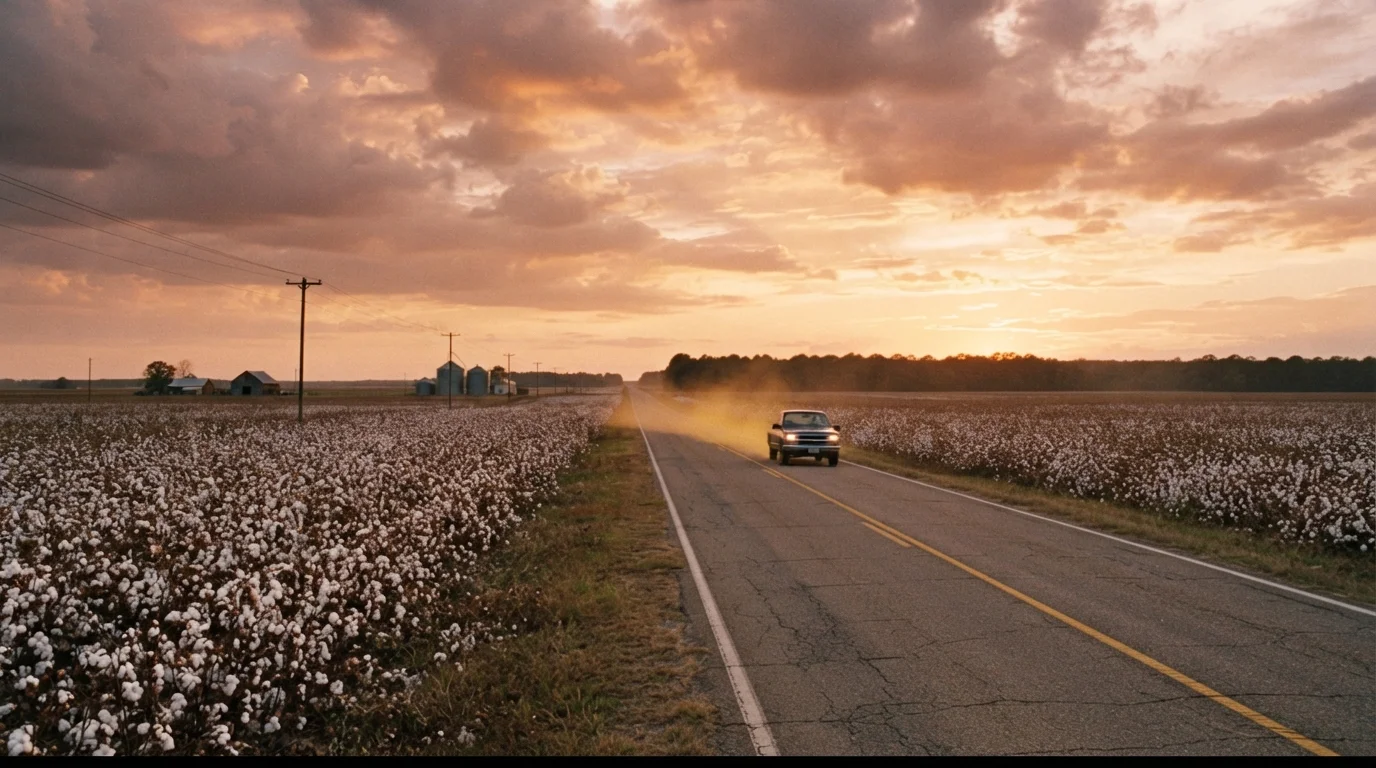
The Delta flatness is disorienting if you're not from the region. There are no hills, almost no topographic variation - just sky, horizon, and the occasional water tower marking a small town. Driving Highway 61, the old blues highway, reveals just how much of American mythology was forged in an almost featureless plain. The light here, especially at dusk, has a particular quality: wide, slow, amber.
~200 miles
Length of the core Delta corridor
The alluvial plain stretches roughly 200 miles from just south of Memphis to Vicksburg, Mississippi.
6 million+
People in the Great Migration
Historians estimate more than six million Black Americans relocated from the South to northern cities between 1910 and 1970, with the Delta among the most significant sending regions.
Wetlands and oxbow lakes punctuate the agricultural fields, and the Mississippi River itself - approached at Greenville or Vicksburg - remains one of the most impressive inland water features on the continent. Vicksburg's Civil War battlefield, sitting above the river, adds another historical layer worth a half day at minimum.
The Delta rewards a slow-travel approach over a rushed multi-stop itinerary. There's no efficient way to process the region's density of history and meaning, and trying to rush it produces a shallow experience.
Practical Notes for Planning Your Trip
Memphis, Tennessee, is the most practical gateway city - it's roughly an hour north of Clarksdale and has a major airport. New Orleans is roughly four hours south and makes a logical end point for a north-to-south drive along Highway 61. The drive itself, with deliberate stops, realistically takes three to five days to do well.
Plan for Limited Infrastructure
Outside Clarksdale and Greenville, lodging, dining, and cell service become sparse quickly. Download offline maps before leaving a hub town, carry cash, and verify museum and venue hours directly before visiting. Building flexibility into your itinerary isn't optional - it's part of how the Delta works.
Accommodations in the Delta are limited outside Clarksdale and Greenville. Some travelers base themselves in Clarksdale and make day trips; others treat the corridor as a point-to-point road journey. Cell service is inconsistent in rural stretches - download offline maps before you go. Summer heat and humidity are intense; spring and fall offer more comfortable conditions. Always verify current hours for museums, historic sites, and venues before visiting, as operating hours in small towns can be irregular.
The Delta is not a polished heritage circuit. Infrastructure is thin, some towns have significant poverty, and the experience can feel unmediated in ways that tourist corridors rarely do. That unmediated quality is precisely what makes it worth going.
The content on this site is for informational purposes only and is not a substitute for professional advice. Always consult a qualified professional for guidance specific to your situation.