

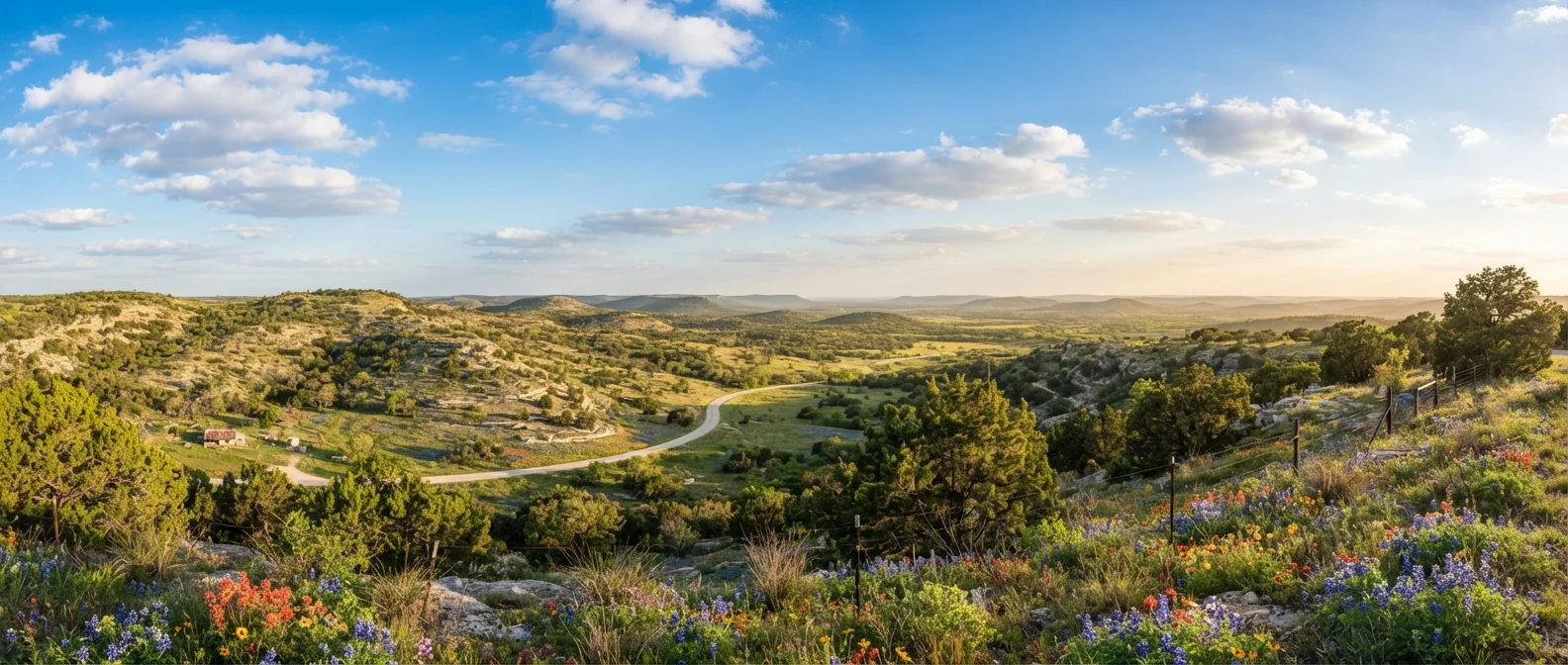
What Kind of Place Is This, Exactly?
The Texas Hill Country doesn't look like the Texas most people picture. There's no flat horizon stretching to infinity here. Instead, the land rolls and dips, interrupted by limestone bluffs, creek crossings, and cedar-covered ridges. Drives along the back highways feel more like the Ozarks than the Panhandle.
The defining geological feature is the Edwards Plateau - a massive uplift of ancient marine limestone that erosion has shaped over millions of years into the terrain visitors see today. Rivers cut through that limestone to create clear, cold swimming holes that feel almost surreal in a state known for heat and dust. The Guadalupe, Pedernales, Frio, and Sabinal rivers are all products of this geology, fed by springs that maintain relatively consistent temperatures year-round.
What draws people isn't any single attraction. It's the cumulative effect: small towns with walkable main streets, peach orchards along roadsides, star-filled skies far from city light pollution, and a sense that the landscape itself has a distinct personality.
~25,000 sq mi
Approximate area of the Edwards Plateau
The Edwards Plateau underlies the core Hill Country region and extends across much of central Texas, according to geological surveys.
68°F
Approximate year-round temperature of spring-fed rivers
Many Hill Country springs maintain relatively stable cool temperatures even during peak Texas summer heat, making them popular recreation destinations.
1840s
Era of German settlement in Fredericksburg
German immigrants established Fredericksburg in 1846, and the town's cultural and architectural character still reflects that founding history.
The Towns and Their Histories
Fredericksburg is the most visited Hill Country town and the one most likely to surprise first-time visitors. Its German heritage isn't a theme-park affectation - it's genuinely historical. German immigrants settled the area in the 1840s, and the cultural influence persists in architecture, family names, and local traditions. The main street, called simply Main Street, is lined with shops, restaurants, and galleries housed in 19th-century limestone buildings.
Kerrville sits along the Guadalupe River and functions more as a working regional hub than a tourist destination, though it has an established arts scene and hosts well-known folk music festivals. Wimberley, southeast of the main Hill Country cluster, has attracted artists and second-home buyers for decades and sits near Jacob's Well - a striking natural spring that requires advance swimming permits.
Boerne (pronounced BUR-nee, a point locals are happy to clarify) offers Hill Country character with easy access from San Antonio, making it a practical base for travelers who want city amenities nearby. For context on how the broader region connects southward, San Antonio's River Walk and its surrounding neighborhoods give a useful picture of the urban gateway to the Hill Country corridor.
What Actually Draws People Here
The honest answer involves several overlapping draws, depending on who you ask.
Wildflowers. Texas's official state flower, the bluebonnet, blooms across Hill Country roadsides in March and April, joined by Indian paintbrush, Mexican hat, and prickly pear cactus blooms. The spectacle varies by rainfall and timing, but in a good year it's genuinely striking. Highway 290 between Johnson City and Fredericksburg is a reliable corridor for wildflower viewing.
River recreation. Tubing the Guadalupe near New Braunfels or swimming the Frio near Concan are summer traditions for Texas families. The water stays cool even in August, which is a meaningful draw when temperatures top 100°F. These spots fill quickly on weekends - early arrival matters.
State parks. Enchanted Rock State Natural Area, a massive pink granite dome north of Fredericksburg, is one of the most visited state parks in Texas. Garner State Park along the Frio River books up months in advance for summer weekends. Both require reservations through the Texas Parks and Wildlife Department's system.
Plan State Park Visits Well in Advance
Enchanted Rock and Garner State Park often reach capacity quickly on spring and summer weekends, with reservations opening weeks or months ahead of time. Check the Texas Parks and Wildlife Department's reservation portal early and have backup plans if your first-choice dates are unavailable. Walk-up entry is possible but not reliable on peak days.
Slower pace and scenery. For visitors from Austin or San Antonio, the Hill Country represents a genuine change of rhythm. The drives themselves - particularly routes like Ranch Road 337 or FM 1340 - are part of the point, winding through terrain that rewards unhurried attention.
Practical Considerations Before You Go
The Hill Country is approachable but not effortless. Cell coverage thins out quickly on rural ranch roads, so downloading offline maps before leaving a town is worth the few minutes it takes. Gas stations grow sparse between towns - fill up when you can.
State park reservations, especially for Enchanted Rock and Garner, often need to be made weeks or months ahead for spring and summer weekends. Walk-up access is limited and not guaranteed. Check the Texas Parks and Wildlife Department website directly for current reservation windows and entry requirements.
Summer heat is real. Afternoon temperatures in July and August regularly exceed 100°F in the region. River activities and early morning hikes are more manageable than midday trail exertion. Hydration and sun protection aren't optional considerations in that environment.
Finally, the Hill Country sits within an area with active wildfire risk during dry periods, particularly in summer and fall. Conditions change quickly, and travelers should check local advisories before backcountry or camping visits. None of this should discourage a trip - just shape how you plan one.
Verify Conditions Before You Travel
Road conditions, park access, river levels, and local advisories can change quickly in the Hill Country, particularly after heavy rains or during drought conditions. Always check official sources - Texas Parks and Wildlife, local county emergency management pages, and the Texas Department of Transportation - before departing. Conditions described in travel guides reflect general patterns, not real-time status.
Frequently Asked Questions
Fredericksburg, Kerrville, Marble Falls, Wimberley, and Boerne are among the most recognized Hill Country towns. The region lacks fixed official borders, so what's included can vary by source. San Antonio and Austin sit at the eastern edge and serve as common gateway cities.
Spring (March through May) brings wildflowers and mild temperatures, making it the most popular season. Fall offers cooler weather and fall foliage. Summers are hot but popular for river activities. Winter is quiet, with lower crowds and cool but rarely harsh conditions.
Yes - tubing rivers, exploring state parks, and visiting small-town main streets are generally family-friendly activities. Garner State Park and Enchanted Rock State Natural Area are especially popular with families. Always check park reservation requirements before visiting, as capacity limits apply.
Fredericksburg, a common first stop, is roughly 70 miles northwest of San Antonio - about an hour and fifteen minutes by car under normal conditions. Many visitors combine a San Antonio trip with a Hill Country detour.
Yes, the Hill Country has developed a notable wine trail over the past few decades, with dozens of vineyards concentrated around Fredericksburg. The region benefits from warm days, cool nights, and well-drained limestone soils. Quality and style vary widely across producers.
The content on this site is for informational purposes only and is not a substitute for professional advice. Always consult a qualified professional for guidance specific to your situation.