

Start here
How D.C.'s Grid Actually Works
Next
Getting Around Without a Car
Then
The Free Museums: What to Know Before You Go
Explore further
Neighborhoods Worth Exploring Beyond the Mall
Before you go
Practical Logistics First-Timers Often Overlook
How D.C.'s Grid Actually Works
Washington D.C. was designed by Pierre Charles L'Enfant in the 1790s on a deliberate grid - and once you understand its logic, getting lost becomes genuinely difficult. The city is divided into four quadrants: Northwest (NW), Northeast (NE), Southwest (SW), and Southeast (SE), all radiating from the Capitol Building at the center.
Streets running east-west carry letter names (A, B, C…), while north-south streets carry numbers. Diagonal avenues - named after states - cut across the grid, creating the plazas and circles that give the city its distinctive visual drama. Every address includes a quadrant designation, which matters: 400 C Street NE and 400 C Street SW are different places entirely.
Most first-time visitors spend the majority of their time in NW, which contains the Mall, Georgetown, Dupont Circle, and the bulk of the Smithsonian campus. Understanding this early saves real confusion when reading maps or transit directions.
Quadrant system
D.C. is divided into four sections (NW, NE, SW, SE) from a central point at the Capitol. Every address includes a quadrant label to distinguish streets that share the same name.
National Mall
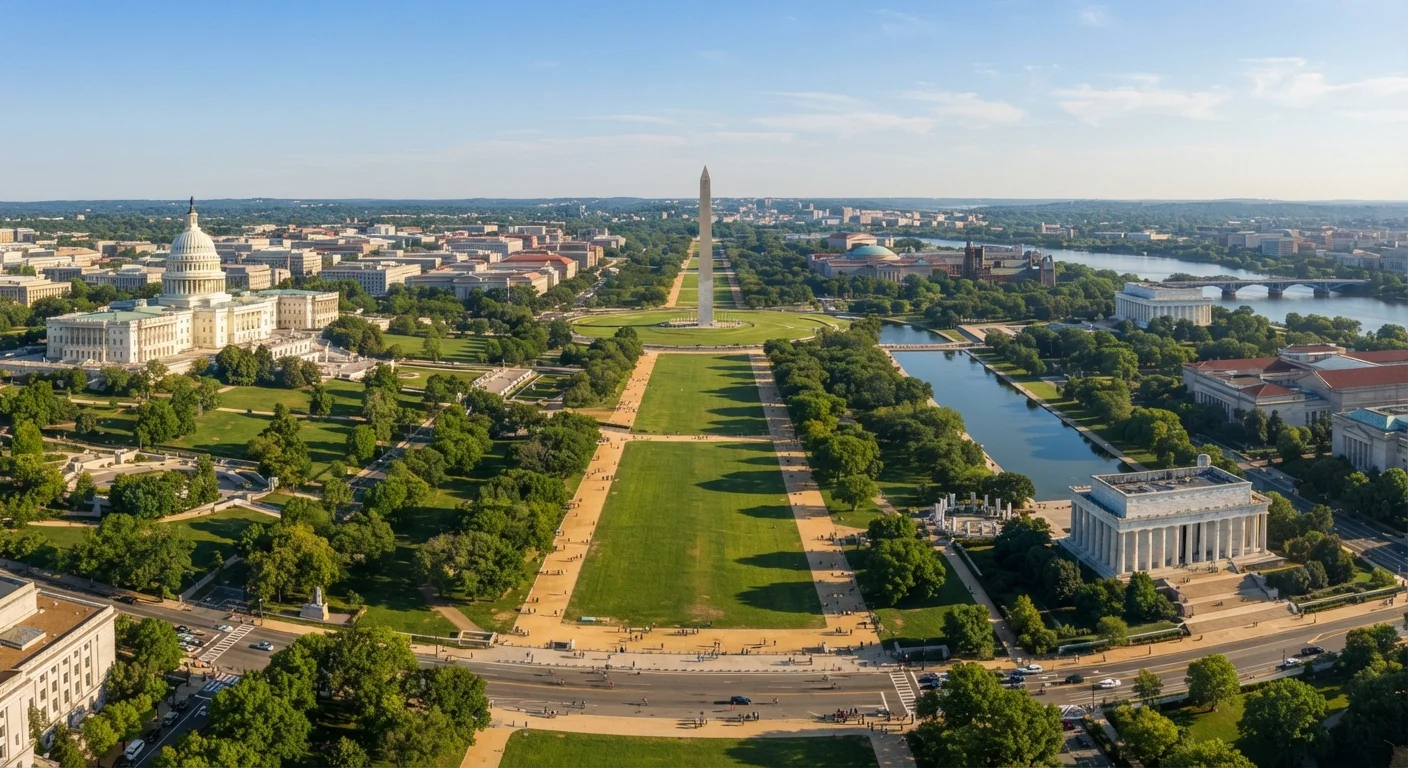
The long, open parkway stretching from the Capitol Building to the Lincoln Memorial, lined with major monuments and Smithsonian museums. It is the geographic and symbolic center of the city.
Smithsonian Institution
A federally funded network of museums, galleries, and a zoo, most located in D.C. and all free to enter. It is the world's largest museum and research complex.
Timed-entry pass
A reservation that assigns you a specific arrival window at a museum or attraction. Required at high-demand D.C. venues and typically booked through the museum's official website.
Metro
D.C.'s rapid transit subway system, operated by WMATA. Color-coded lines connect major neighborhoods, airports, and sightseeing areas across the city and into Virginia and Maryland.
Getting Around Without a Car
D.C.'s Metro system is one of the cleaner and more intuitive subway networks in the United States. Color-coded lines connect the airport corridors (Reagan National via the Yellow and Blue lines) to the major sightseeing zones. Fare cards are distance-based, so short hops on the Mall corridor are inexpensive.
That said, many visitors are surprised to discover that walking the National Mall is faster than riding Metro between its ends. The distance from the Capitol to the Lincoln Memorial is roughly two miles - entirely flat, with monuments and reflecting pools along the way. If weather permits, this is the better experience.
Bikeshare (Capital Bikeshare has stations throughout the city) is a practical option for reaching neighborhoods like Georgetown, which lacks a direct Metro stop. Rideshares operate normally throughout D.C. For comprehensive trip logistics, the trip planning walkthrough covers how to think through ground transportation before you arrive.
Walk the Mall Before You Plan Around It
Many first-time visitors take Metro between Mall landmarks and miss the experience of the space itself. Walking its full length - ideally in the morning before crowds build - gives you a sense of scale and helps you decide which monuments and museums to spend real time at. It's the best orientation tool D.C. offers.
The Free Museums: What to Know Before You Go
The Smithsonian Institution operates 19 museums and galleries, and nearly all of them are free to enter. That's not a limited-time offer - it's a structural policy funded by the federal government. The National Air and Space Museum, the National Museum of Natural History, the National Portrait Gallery, and the National Zoo all fall under this umbrella.
What has changed in recent years is access. The National Museum of African American History and Culture (NMAAHC) requires timed-entry passes that regularly book weeks in advance during peak seasons. The same applies to the National Museum of the American Indian for popular programming periods. Checking each museum's official website and reserving passes before your trip is now standard practice, not optional.
Budget your time honestly: the Air and Space Museum alone can absorb three hours for a thorough visit. Trying to cover four or five Smithsonian museums in a single day produces a blur, not an experience. Picking two per day - and leaving time to linger - is a more satisfying approach.
Museum Pass Policies Change Seasonally
The Smithsonian's timed-entry requirements are not fixed year-round - some museums shift between walk-in and reserved entry depending on season and demand. Before booking anything, check each museum's official page (si.edu) rather than relying on third-party travel sites, which may not reflect current policies. Passes are free but must be reserved in advance when required.
Neighborhoods Worth Exploring Beyond the Mall
The Mall is the gravitational center of D.C., but treating it as the whole city means missing what makes the place genuinely worth a longer visit. Capitol Hill - the residential neighborhood east of the Capitol - has an appealing streetscape of 19th-century row houses, Eastern Market (a working public market on weekends), and a noticeably local pace.
Georgetown predates the city itself and sits along the Potomac riverfront. Its Federal-style architecture, independent bookshops, and canal towpath walking trail make it a good half-day on its own - though expect it to be busy on weekends. Adams Morgan and Columbia Heights, further north in NW, reflect D.C.'s cultural diversity more honestly than the museum corridor and have strong restaurant scenes.
For travelers who enjoy comparing walkable urban destinations, it's worth noting how D.C.'s structure differs from other compact American cities - Savannah's grid of squares, for instance, creates a very different pedestrian rhythm despite similar street-level scale.
Practical Logistics First-Timers Often Overlook
Security screening is part of daily life at D.C.'s major institutions. The Capitol, the White House visitor entrance, and most Smithsonian buildings have airport-style bag checks. Keeping bags compact and avoiding prohibited items (the lists vary by building) saves time. Water bottles are generally allowed if empty before screening.
Weather is a serious planning factor. Summers in D.C. are humid and can be oppressively hot - the Mall offers almost no shade. Spring crowds during cherry blossom season can make the Tidal Basin feel genuinely gridlocked. Shoulder seasons (October through early November, or late February through early March) offer real advantages in comfort and access.
Accommodation choices shape the experience significantly. Staying within Metro distance of the Mall is practical; staying in the neighborhoods themselves - Capitol Hill or Dupont Circle - means you can walk to evening destinations without relying on transit. D.C. can be a relatively expensive city to sleep in; building accommodation costs into your overall travel planning budget early avoids surprises.
This article provides general travel information about Washington D.C. Conditions, entry requirements, museum policies, and transit details can change; always verify current information with official sources before your visit.
Frequently Asked Questions
Three to four days is enough to experience the Mall's major monuments and two or three museums without rushing. A longer stay lets you explore neighborhoods and smaller galleries. First-timers often underestimate walking distances and museum depth, so building in downtime is worthwhile.
Several high-demand museums - including the National Museum of African American History and Culture - require timed-entry passes that should be reserved in advance. Other Smithsonian museums are walk-in. Check each museum's official site before your trip since policies can change seasonally.
The tourist core - the Mall, Capitol Hill, Georgetown, and the main museum corridors - is generally busy and well-monitored. Like any major city, D.C. has neighborhoods where situational awareness matters more, particularly after dark. Staying oriented and using Metro after evening events is a practical habit.
No. Most first-time visitors find Metro and their own feet more than sufficient for the core sights. Driving and parking in D.C. is genuinely challenging and expensive. A car is most useful if you plan to visit suburban Virginia or Maryland attractions outside the transit network.
Spring (late March through May) and fall (September through November) offer the most comfortable temperatures and are considered peak visiting seasons. Cherry blossom season in late March to early April is spectacular but extremely crowded. Summer brings humidity and large crowds; winter is quieter with shorter lines.
Yes - most outdoor monuments on the Mall are accessible around the clock and are staffed by rangers until late evening. Many visitors find the monuments, particularly the Lincoln Memorial and Vietnam Veterans Memorial, more atmospheric after dark and less crowded than midday.
The content on this site is for informational purposes only and is not a substitute for professional advice. Always consult a qualified professional for guidance specific to your situation.