

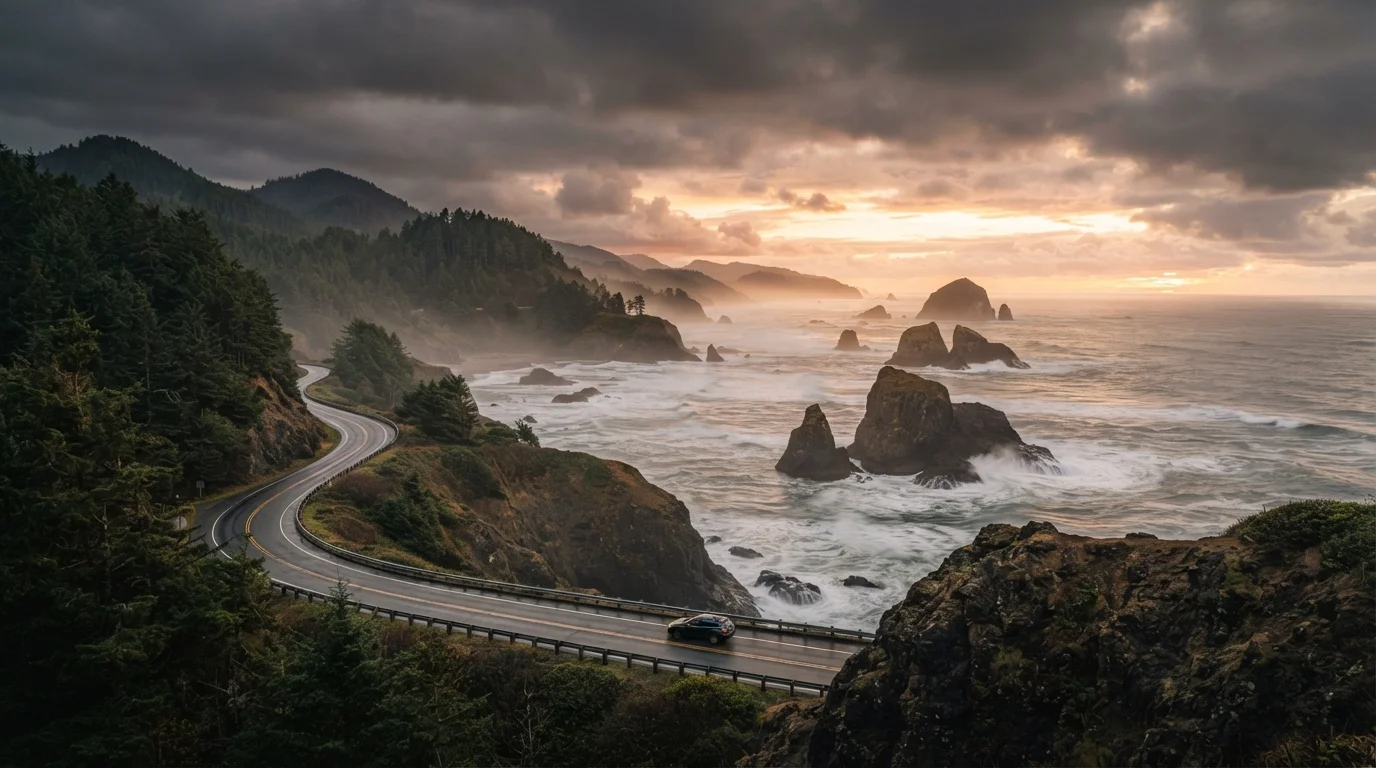
What Slow Travel Actually Means Here
The phrase "slow travel" gets used loosely, but on the Oregon Coast it has a specific, practical meaning. It means resisting the urge to drive the full length of US-101 in two days, photographing every overlook from a car window, and returning home with a checklist completed but little genuine sense of place. It means, instead, choosing a single stretch - say, the central coast around Newport and Waldport, or the north coast between Cannon Beach and Tillamook - and giving it three or four days of genuine attention.
This isn't just philosophical preference. The Oregon Coast is genuinely built for it. Access points are frequent, state parks are numerous, and the working rhythms of port towns like Depoe Bay or Gold Beach create a texture you only absorb through time. Understanding how slow travel differs from multi-destination trips can help you decide whether this approach fits how you actually like to move through a place.
Start With One Region, Not the Whole Route
Resist the temptation to plan a north-to-south driving marathon. Pick a single coastal region and base yourself there for at least three nights. You'll leave with a much clearer sense of what the Oregon Coast actually feels like - rather than a blur of overlooks seen from a windshield.
The Coast's Three Distinct Characters
Oregon's coastline isn't a single uniform experience. The north coast - anchored by Astoria and Cannon Beach - is dramatic and heavily forested, with iconic sea stacks and a rich maritime history rooted in the Columbia River's proximity. The central coast, around Lincoln City, Newport, and the Siuslaw estuary, blends working-class fishing culture with accessible tide pools and the famous Oregon Dunes. The south coast, from Coos Bay down to Brookings, is quieter, less visited, and arguably the most wild - with myrtle wood forests, sea caves, and the Kalmiopsis Wilderness within reach.
Slow travelers benefit from picking one of these regions and staying put rather than trying to sample all three in a single pass. Each rewards a different kind of curiosity, and each has towns worth eating, sleeping, and wandering in over multiple days.
363 miles
Total length of Oregon's publicly accessible coastline
Oregon law guarantees public access to the entire Pacific shoreline, making it one of the few states in the US where no beach is privately closed to visitors.
80+
Oregon state parks and waysides along the coast
Oregon Parks and Recreation Department manages more than 80 coastal parks and recreation areas, offering consistent access points for travelers exploring at their own pace.
~2 hrs
Drive time from Portland to the north Oregon Coast
The relative proximity of Portland to the coast makes it a common pairing for travelers building a Pacific Northwest itinerary.
Why Weather Becomes an Ally, Not an Obstacle
The Oregon Coast has a reputation for overcast skies and unpredictable rain, and that reputation is earned. But travelers who stay long enough discover that the weather is also what makes the place extraordinary. A fog-wrapped morning at Ecola State Park looks nothing like the same headland in afternoon sun. A storm rolling in off the Pacific from a protected viewpoint is one of the more viscerally memorable things the American West Coast offers.
Slow travel gives you the flexibility to work with the coast's weather patterns rather than against them. If a morning is socked in, you explore a tidal zone or browse the docks of a fishing harbor. When the light breaks - and it usually does, at some point - you're already there, in position, rather than two hours down the highway.
Storm Season Has Its Own Appeal
The Oregon Coast's storm-watching season, roughly November through February, draws a dedicated subset of travelers who specifically come for the dramatic weather. Towns like Cannon Beach and Depoe Bay position themselves around this experience. It's worth knowing that off-season visits can be genuinely rewarding rather than a compromise - though always check road and park conditions before heading out, particularly on coastal headland trails.
Pairing the Coast With Portland
Many visitors combine an Oregon Coast stay with time in Portland, and the pairing works well. The drive from Portland to the north coast takes roughly ninety minutes to two hours depending on your destination, making it feasible to use Portland as an arrival hub before heading west. Portland's character as a destination is genuinely different from the coast - urban, food-driven, neighborhood-focused - and the contrast can make each place feel richer. A common structure is two or three days in Portland, followed by four to five days on the coast, with a flexible driving route rather than a locked itinerary.
What makes this combination particularly satisfying is that neither place is primarily about landmarks. Both reward unhurried exploration, local eating, and a willingness to follow curiosity rather than a schedule. That shared sensibility makes them natural travel partners for the kind of trip where the point isn't coverage - it's genuine experience.
Frequently Asked Questions
Driving US-101 end to end without stops takes roughly eight to ten hours. Most travelers who want to actually experience the coast plan at least five to seven days, and many devote that much time to a single region alone.
Late spring through early fall offers the most reliable dry weather, though the coast is rarely fully clear. Summer brings the warmest temperatures and the most visitors. Off-season visits in fall and winter can be dramatically atmospheric, with storm watching drawing dedicated travelers to towns like Cannon Beach and Depoe Bay.
Yes, with some planning. Tide pooling, kite flying on wide flat beaches, and wildlife spotting (sea lions, gray whales, shorebirds) are well-suited to children. Some headland trails involve steep terrain, so checking trail difficulty before setting out is worthwhile.
Day-use beach access is generally free and open, but campground sites at popular parks like Oswald West and Bullards Beach typically require advance reservations, especially in summer. Check Oregon State Parks' official site for current requirements.
Oregon's coast is notably wilder and less developed, partly because all beaches are legally public. There are fewer resort corridors and more working fishing ports, dramatic headlands, and dense coastal forest - a combination that suits travelers looking for scenery over amenities.
The content on this site is for informational purposes only and is not a substitute for professional advice. Always consult a qualified professional for guidance specific to your situation.