

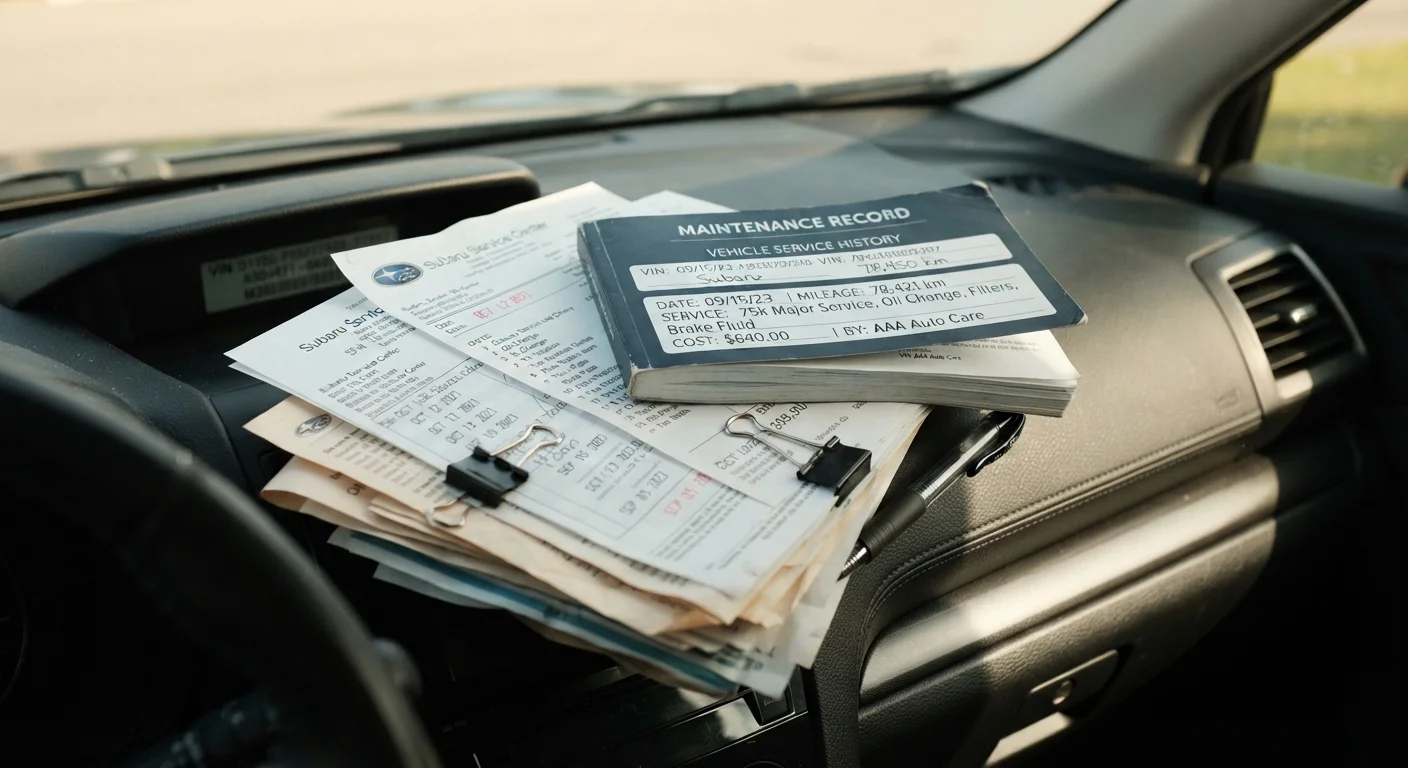
Why a Service History Matters More Than You Might Think
Most drivers keep their registration and insurance cards close at hand but treat service records as optional paperwork. In reality, a well-maintained service history is one of the most practical tools in vehicle ownership. It tells you - and anyone else who works on your car - exactly what's been done, when it was done, and how many miles were on the clock at the time.
When a mechanic can see that your transmission fluid was last changed at 45,000 miles and you're now at 90,000, they have a concrete starting point. Without that record, they're working from guesswork. The same logic applies when selling: a documented history signals that the car was cared for, which is something buyers actively look for. For a deeper look at how service records factor into a used car purchase, see Reading a Used Car's Past.
Up to 30%
Potential reduction in used car resale value without service history
Industry valuations from organizations such as the NADA often reflect significant price differences between vehicles with documented versus undocumented maintenance.
3-5 years
Typical period shops retain customer service records
Most franchised dealerships and many independent shops keep digital service records on file, making partial history reconstruction possible for recent owners.
What to Record and How to Organize It
You don't need a complex system - just a consistent one. For each service event, capture four things: the date, the odometer reading, what was done, and who did it. That applies to everything from oil changes to tire rotations to replacing a cabin air filter.
Log every service event at the time it happens, not weeks later.
Memory fades quickly, and even a few missing entries can create gaps that undermine the record's usefulness. Recording at the point of service ensures accuracy and completeness.
Include mileage alongside the date for every entry.
Many maintenance intervals are mileage-based rather than time-based. Without odometer readings, it's impossible to tell whether a service was done on schedule or overdue.
Keep records for DIY maintenance, not just shop visits.
Owners who handle their own oil changes, filter swaps, or fluid top-offs often skip recording these tasks, creating a misleading impression that the car was neglected.
Store at least one backup copy of your records in a separate location.
Paper records kept only in the glove box are vulnerable to being lost if the car is stolen or severely damaged. A secondary copy - digital or physical - preserves the history.
Note any recurring issues or symptoms alongside each service entry.
A mechanic who can see that the same noise was mentioned at three consecutive visits has far better diagnostic context than one starting from scratch.
Whether you prefer a dedicated paper logbook kept in the glove box, a folder of dealer receipts, or a notes app on your phone, any method works as long as you actually use it. Some drivers keep physical copies of shop invoices and scan them into a cloud folder for backup. Others use dedicated apps that prompt you when the next service is due. The format is less important than the habit. To understand what your vehicle's scheduled services actually involve, Your Car's Maintenance Schedule, Explained breaks down each milestone clearly.
Practical Habits That Make Record-Keeping Stick
The biggest obstacle isn't knowing what to record - it's remembering to do it. A few small habits make the process nearly automatic.
If you've owned your car for a while without keeping records, it's not too late to reconstruct a partial history. Dealers and independent shops typically keep service records on file, often for several years. Calling your previous service providers and asking for a printout of your car's history by VIN (Vehicle Identification Number) can fill in significant gaps. A complete picture of your car's care also connects directly to its long-term reliability - Keeping a Reliable Vehicle: Long-Term Car Care Principles covers how record-keeping fits into the bigger maintenance picture.
What About Manufacturer Warranty Claims?
Some powertrain and extended warranties require proof that scheduled maintenance was performed on time. Without records, a warranty claim could be denied even if the failure was unrelated to a missed service. Keep records that are detailed enough to demonstrate compliance with your manufacturer's recommended intervals. When in doubt, check your warranty documentation for exactly what proof of service is required.
The content on this site is for informational purposes only and is not a substitute for professional advice. Always consult a qualified professional for guidance specific to your situation.