

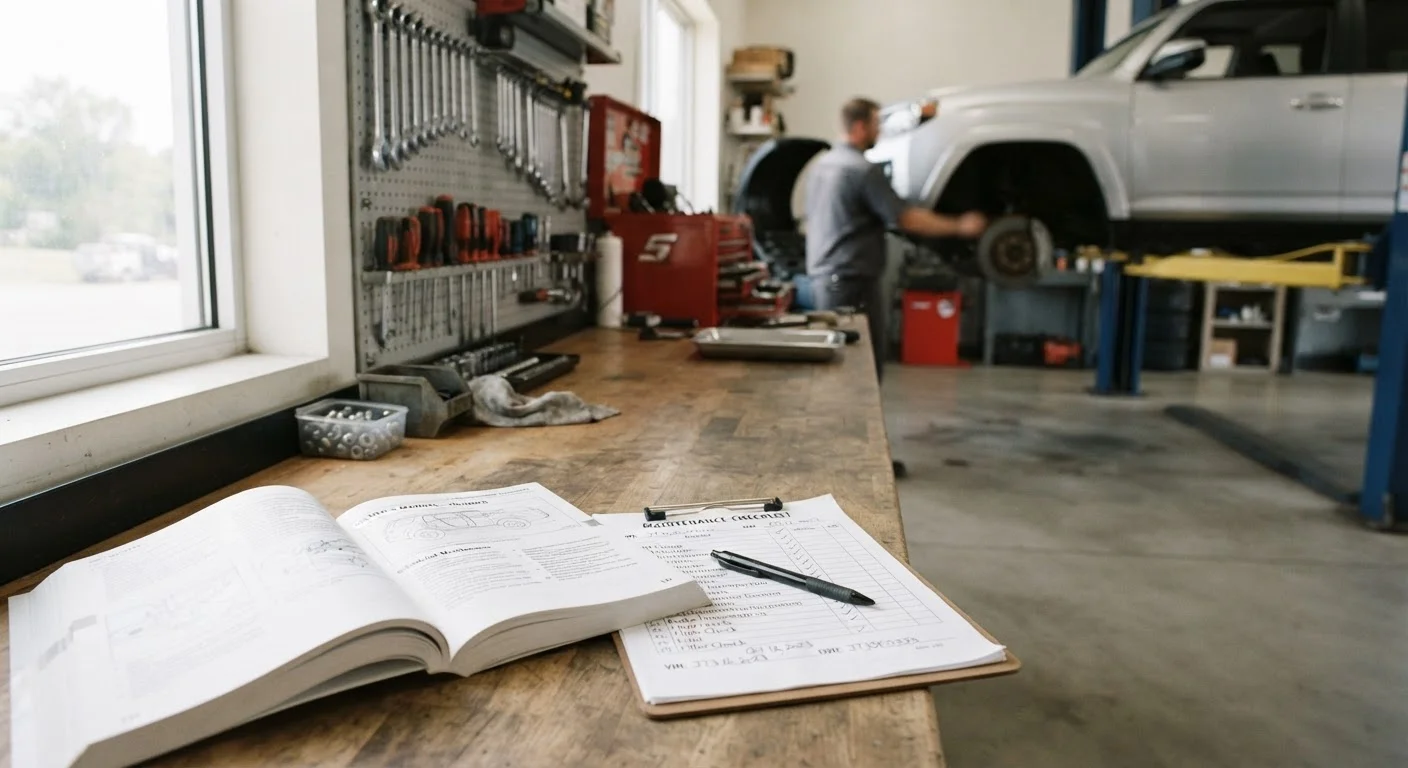
What a Maintenance Schedule Actually Is
Every car leaves the factory with a manufacturer-written plan for keeping it in working order. That plan - your maintenance schedule - lives in your owner's manual and breaks down which services your vehicle needs and when to perform them. It's not a upsell list from a service advisor; it's engineering guidance based on how your specific engine, transmission, and components were designed to operate.
Services are typically triggered by one of two thresholds: mileage (e.g., every 5,000 miles) or elapsed time (e.g., every 12 months). When both apply, the rule is simple: do whichever comes first. A car driven rarely still needs time-based services because fluids degrade and rubber components dry out even without miles on them.
For a plain-language breakdown of the terms you'll encounter in your manual, see our car maintenance glossary.
Start With Your Owner's Manual
Generic maintenance advice online is a starting point, not a substitute. Your owner's manual contains the only schedule tailored to your exact vehicle. If you don't have a physical copy, most automakers make digital versions available through their websites or via a quick search of your year, make, and model.
The Most Common Service Milestones
While every vehicle differs, most gasoline-powered cars share a recognizable set of recurring services:
- Oil and filter change - typically every 5,000-10,000 miles depending on oil type (conventional vs. synthetic) and engine design. This is the single most important routine service.
- Tire rotation - usually every 5,000-7,500 miles to even out tread wear across all four tires.
- Air filter replacement - engine air filters commonly need replacement every 15,000-30,000 miles; cabin air filters (which affect interior air quality) are on a similar cycle.
- Brake inspection - typically checked annually or every 12,000 miles, with pad replacement as wear dictates.
- Spark plug replacement - conventional plugs may need replacement around 30,000 miles; iridium or platinum plugs can last 60,000-100,000 miles.
- Timing belt or chain service - a timing belt (not all vehicles have one) is a high-stakes component often due between 60,000 and 100,000 miles. A failure can destroy an engine; never skip this one.
- Fluid flushes - coolant, brake fluid, and transmission fluid each have recommended replacement intervals. For a full breakdown, see our guide to car fluids.
60,000-100,000 mi
Typical timing belt replacement interval
Manufacturer recommendations vary; consult your owner's manual for the exact interval for your engine.
5,000-10,000 mi
Typical oil change interval (synthetic oil)
Interval depends on oil type, engine design, and driving conditions; conventional oil generally requires more frequent changes.
Severe vs. Normal Driving Conditions
Your owner's manual often lists two maintenance tracks: normal and severe. Many drivers assume they fall under the normal category, but the severe classification is more common than it sounds. It applies if you regularly:
- Make frequent short trips under 5 miles
- Drive in extreme heat or cold
- Tow a trailer or haul heavy loads
- Drive in dusty or hilly terrain
- Sit in heavy stop-and-go traffic regularly
Under severe conditions, most service intervals should be shortened - sometimes by half. Operating a vehicle under these conditions with normal-track intervals accelerates wear on oil, brakes, and drivetrain components.
Electric Vehicles Have Different Schedules
If you drive an EV, the traditional service milestones above don't fully apply. There's no engine oil to change and no spark plugs or timing belt to worry about. However, EVs still require tire rotations, brake system inspections, cabin filter replacements, and battery health checks. The EV maintenance guide covers what the schedule looks like in practice.
Why Sticking to the Schedule Matters
Deferred maintenance compounds. A skipped transmission fluid change doesn't just affect the transmission in isolation - it can introduce heat and friction that stress connected components. Small omissions can become expensive cascades.
There are also practical consequences beyond mechanical wear. Many new-vehicle warranties require documented adherence to the manufacturer's maintenance schedule. If a covered component fails and you can't show it was serviced as required, a warranty claim may be denied. Keeping a proper service record is one of the simplest ways to protect both your warranty and your vehicle's resale value.
For a broader look at habits that extend a car's useful life, see our guide on long-term car care principles.
Frequently Asked Questions
Check your owner's manual - usually in the glove box. It lists every service interval by mileage and time. Some automakers also provide this information through their websites or dealer service departments.
Over time, engine oil breaks down and loses its ability to lubricate moving parts effectively. Skipping oil changes can lead to sludge buildup, increased engine wear, and potentially expensive engine damage. Most manufacturers recommend changing oil every 5,000-10,000 miles depending on oil type and engine.
The 30-60-90 framework (major service at 30,000, 60,000, and 90,000 miles) is a useful general reference, but it doesn't replace your owner's manual. Different vehicles have different interval requirements, and some services fall outside those milestone numbers.
No. EVs skip several traditional services - there's no oil to change and fewer moving parts overall. However, they still require tire rotations, brake inspections, cabin air filter replacements, and periodic battery system checks. See the manufacturer's schedule for your specific EV.
Not necessarily. Many services are triggered by time as well as mileage. Engine oil, coolant, and brake fluid can degrade even if the car sits unused. Always apply the interval - time or mileage - that comes first.
The content on this site is for informational purposes only and is not a substitute for professional advice. Always consult a qualified professional for guidance specific to your situation.