

Our Verdict
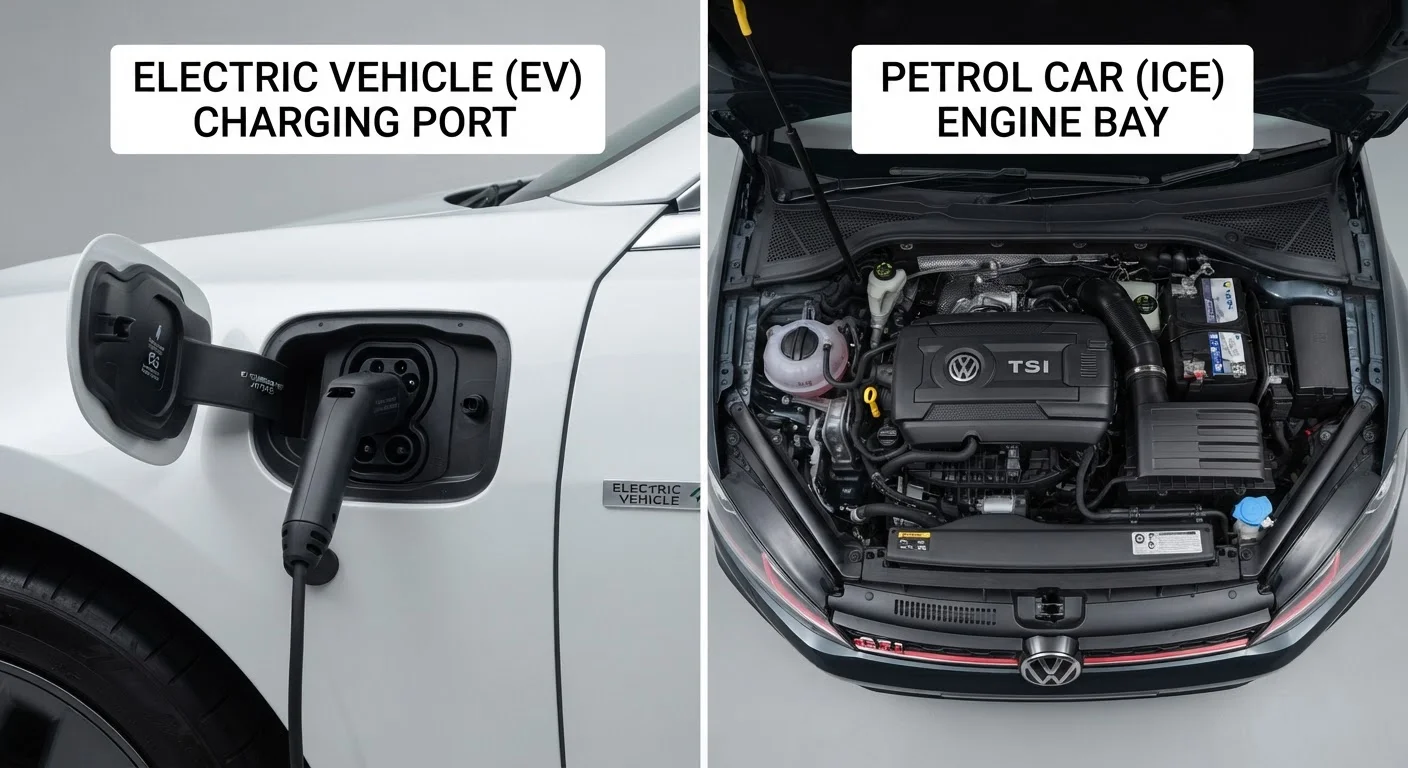
Electric vehicles generally have fewer routine maintenance demands than petrol cars, thanks to simpler drivetrains and regenerative braking. However, EVs introduce battery-specific considerations that petrol car owners never face. Both powertrains share a core set of safety-related checks that every driver should keep up with regardless of fuel type.
| Best for | Recommended |
|---|---|
| Drivers wanting lower routine servicing frequency | Electric Vehicle |
| Owners comfortable with familiar, well-established servicing networks | Petrol Car |
| Those prioritising reduced brake and fluid maintenance | Electric Vehicle |
| Drivers who do significant long-distance or towing use | Petrol Car (consult manufacturer guidance) |
Where the Two Powertrains Fundamentally Differ
A petrol engine relies on controlled combustion to move a car, which means it depends on dozens of moving parts - pistons, valves, belts, and more - all needing lubrication, cooling, and periodic replacement. An electric vehicle (EV) replaces all of that with an electric motor and a battery pack, cutting the moving-part count dramatically.
That difference is the root cause of nearly every maintenance gap between the two. Fewer moving parts means fewer things to wear out, fewer fluids to change, and fewer scheduled service items overall. For the average driver, it translates to fewer trips to a mechanic for routine work - though not zero trips.
See our long-term car care guide for a broader look at how powertrain type fits into overall vehicle ownership habits.
What Petrol Cars Need That EVs Don't
The most well-known difference is the oil change. Petrol engines require regular oil and filter changes - typically every 5,000 to 10,000 miles depending on the vehicle and oil type - to prevent engine wear. EVs have no engine oil to change.
Beyond oil, petrol cars also involve:
- Spark plugs - worn plugs cause misfires and reduce fuel efficiency; they need periodic replacement.
- Timing belts or chains - belts in particular require scheduled replacement, as failure can cause serious engine damage.
- Transmission fluid - automatic and manual gearboxes need fluid changes at intervals.
- Exhaust system components - catalytic converters, oxygen sensors, and mufflers can degrade over time.
- Air filters (engine) - combustion engines need clean intake air; a clogged filter hurts performance and efficiency.
EVs skip every item on that list. That said, don't overlook the subtle habits that wear down any car, regardless of powertrain.
| Maintenance Item | Petrol Car | Electric Vehicle | |
|---|---|---|---|
| Engine oil changes | Required every 5,000-10,000 miles | Not applicable | |
| Spark plugs | Periodic replacement needed | Not applicable | |
| Brake wear | Standard wear rate | Reduced - regenerative braking helps | |
| Battery maintenance | 12V battery only | High-voltage pack + 12V battery | |
| Transmission fluid | Required (auto/manual) | Minimal or not required | |
| Tyre rotation | Regular intervals | Regular intervals (often more critical) | |
| Coolant system | Engine coolant changes needed | Battery thermal coolant - longer interval | |
| Exhaust components | Catalytic converter, sensors, muffler | Not applicable |
EV-Specific Maintenance: The Battery Factor
While EVs shed much of petrol-car complexity, they introduce one significant maintenance area of their own: battery health. The high-voltage battery pack is the most expensive component in any EV, and how you manage it affects both range and long-term reliability.
Most EV manufacturers recommend keeping the battery charge between roughly 20% and 80% for daily use, avoiding frequent DC fast-charging where possible, and being mindful of extreme temperatures. Temperature extremes affect EV batteries more noticeably than petrol engines - both cold and heat can reduce range and, over time, degrade capacity.
Protecting Your EV Battery Long-Term
Avoid regularly charging to 100% unless you need full range for a long trip. Many EVs allow you to set a charge limit in their settings - using it daily can meaningfully slow battery degradation. Check your vehicle's owner manual for the manufacturer's specific guidance, as recommendations vary by model.
EVs also have a separate thermal management system for the battery, which uses coolant. That coolant does need to be checked and eventually replaced - so EVs aren't entirely fluid-free. However, the interval is typically much longer than engine coolant in a petrol car.
Shared Maintenance: What Both Vehicle Types Need
Drivers switching from petrol to electric sometimes assume maintenance nearly disappears. In practice, a solid set of checks applies to both:
- Tyre rotation and pressure - EVs are often heavier than equivalent petrol cars due to battery weight, which can accelerate tyre wear. Regular rotation matters just as much, if not more.
- Brake fluid - Both powertrains use hydraulic brakes and need fluid checks. EVs use brakes less aggressively thanks to regenerative braking (where the motor slows the car and recovers energy), but the hydraulic system still needs attention.
- Cabin air filter - Filters the air inside the passenger compartment. Applies to both EV and petrol cars.
- Windshield wiper blades and washer fluid - Universal requirement.
- Software updates - EVs in particular receive over-the-air updates that can affect performance, battery management, and safety features; staying current matters.
For a structured look at servicing timelines across both vehicle types, our maintenance schedule guide breaks down what each milestone involves.
~40%
Fewer scheduled maintenance items in EVs
Industry analyses suggest EVs can have roughly 40% fewer scheduled maintenance tasks compared to equivalent internal combustion engine vehicles, primarily due to eliminated fluid and engine services.
20-80%
Recommended daily EV charge range
Most EV manufacturers advise keeping the battery within this range for everyday use to help preserve long-term battery capacity.
Choosing the Right Maintenance Approach
Understanding your vehicle's powertrain helps you ask the right questions at service time and avoid paying for things you don't need. EV owners should confirm their service centre has technicians trained to work on high-voltage systems - not all independent shops do. Petrol car owners benefit from sticking closely to manufacturer-recommended fluid change intervals, even when the car seems to be running fine.
For both types, keeping records of every service visit is one of the most practical habits you can build. It helps you track what's been done, supports warranty claims, and adds value if you ever sell the vehicle. Our DIY vs. garage maintenance guide can help you decide which tasks are reasonable to handle yourself and which warrant a professional.
High-Voltage Systems Require Qualified Technicians
EV battery packs and electric drivetrains operate at voltages that can be life-threatening if handled incorrectly. Never attempt to inspect, repair, or modify high-voltage components yourself. Always use a service centre with certified EV technicians for any work involving the battery or motor systems.
The content on this site is for informational purposes only and is not a substitute for professional advice. Always consult a qualified professional for guidance specific to your situation.