

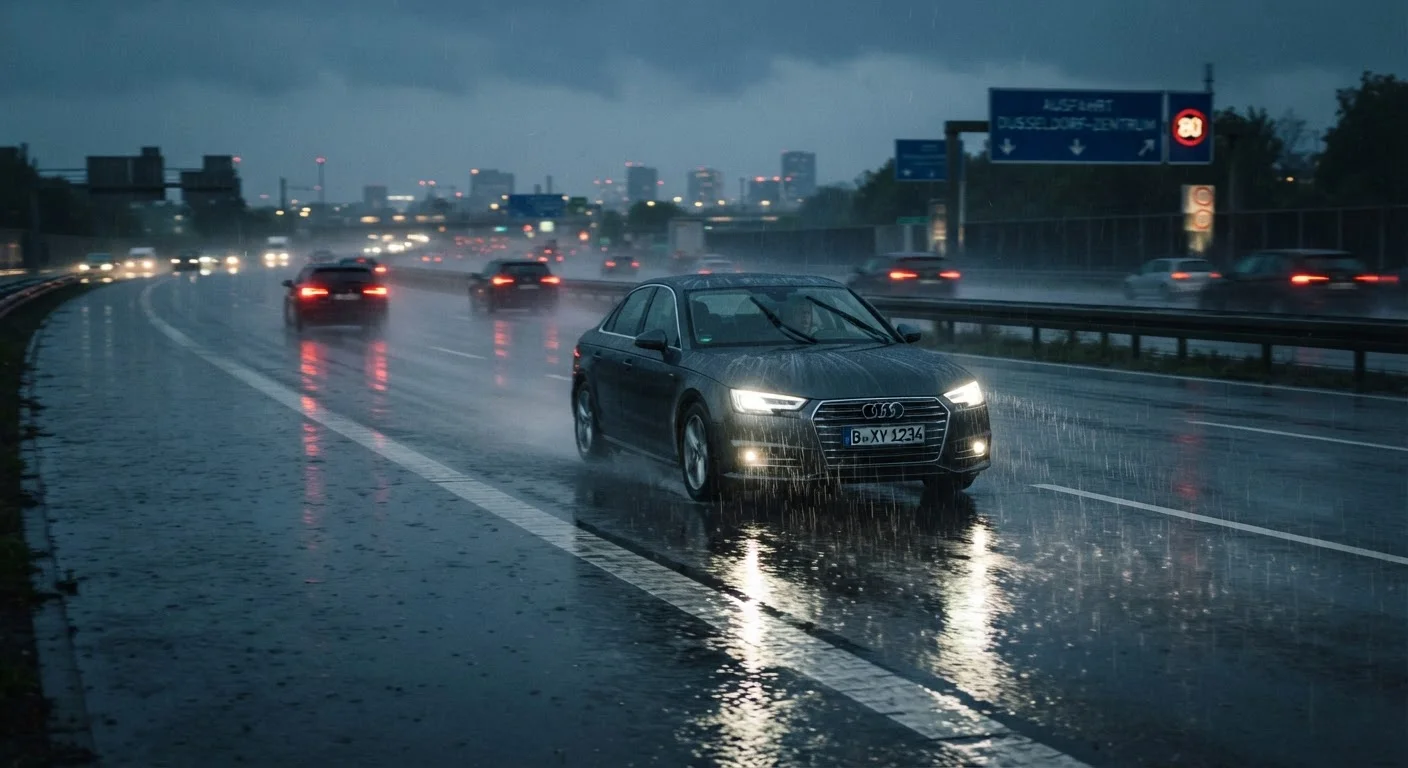
Why Heavy Rain Changes the Rules
Rain doesn't just make the road wet - it changes the physics of driving in several compounding ways. Water reduces the friction between your tires and the tarmac, widens your stopping distance, and dramatically cuts the distance at which you can see and be seen. Heavy rain combines all three effects at once.
Most drivers understand this in principle but underestimate it in practice. A car traveling at 60 mph on a wet road can need nearly twice the distance to stop compared to dry conditions. That gap becomes critical when something unexpected appears ahead. For a deeper look at how wet conditions change driver decision-making, see why wet roads demand a different mindset.
The steps below walk through the adjustments to make before and during heavy rain - covering visibility, traction management, speed, and what to do if control starts to slip.
What you will need
Step-by-Step: Adjusting Your Driving for Heavy Rain
Turn on your headlights
Switch on your headlights as soon as rain reduces visibility - even in daytime. In many U.S. states, law requires headlights when wipers are in use. More importantly, headlights make your car visible to other drivers from a much greater distance, reducing rear-end collision risk. Use low beams; high beams reflect off rain and reduce your own visibility.
Reduce your speed below the posted limit
Speed limits apply to ideal conditions. In heavy rain, reducing your speed by 10-15 mph below the posted limit gives your tires more time to channel water and your reactions more time to work. The faster you travel on a wet surface, the more likely water will build up under the tires faster than the tread can expel it.
Double your following distance
The standard three-second following gap used in dry conditions is not enough on wet roads. Double it to at least six seconds. This gives you significantly more stopping distance if the vehicle ahead brakes unexpectedly. Count using a fixed point on the road - a bridge or sign - and measure the gap from when the car ahead passes it to when you do.
Use smooth, gentle inputs
On a wet road, abrupt steering, braking, or acceleration can overwhelm the tires' available grip. Apply the brakes progressively, steer with deliberate, smooth movements, and accelerate gradually after stops or turns. Think of every input as something to be eased into rather than applied suddenly.
Avoid standing water where possible
Pooled water on the road surface - especially in dips, underpasses, or at the edge of lanes - hides the depth of the road beneath it. Even shallow standing water can cause a car to hydroplane at relatively low speeds. Where water is unavoidable, slow down before entering it, not while driving through it.
Keep your windshield clear inside and out
Heavy rain raises humidity inside the cabin, causing the windshield to fog up quickly. Use your defroster and air conditioning together to clear internal condensation - most modern cars have a dedicated windshield demist button. Keep wiper speed matched to rainfall intensity so your forward view stays as clear as possible throughout.
Tires, Maintenance, and Preparation
Your tires are the single most important variable in wet-weather driving. The grooves in the tread are designed to channel water away from the contact patch so the rubber maintains grip. When tread depth drops below the legal minimum of 2/32 of an inch, that water-clearing ability is severely compromised. Many safety organizations recommend replacing tires before they reach the legal limit.
Beyond tread, tire pressure matters too. Under-inflated tires have a larger contact area that can trap water rather than expel it, increasing hydroplaning risk. Check your vehicle's recommended pressure in the owner's manual or on the door placard - not the maximum figure printed on the tire sidewall.
Check Tires Before Wet Weather Arrives
The penny test gives a rough check: insert a penny into a tread groove with Lincoln's head pointing down. If you can see the top of his head, tread is at or near the legal minimum and tires should be replaced. Doing this check before a forecasted rainy period - rather than during one - gives you time to act.
Wipers and headlights are equally important to maintain. Streaking or skipping wipers don't clear the windshield effectively, and in heavy rain that gap in visibility can be dangerous. Replacing wiper blades is a straightforward car maintenance task that most drivers can do themselves. Functioning headlights - front and rear - ensure other drivers can see your vehicle well before they're close enough to be a hazard.
For a broader look at keeping your vehicle road-ready in all conditions, the vehicle ownership hub covers insurance, inspections, and routine upkeep in one place.
If You Start to Hydroplane
Hydroplaning feels like a sudden lightness or floating sensation in the steering. The car may pull to one side, or the steering may go vague and unresponsive. It happens when a wedge of water builds up under the tires faster than the tread can dispel it - typically at higher speeds on standing water.
Do Not Brake Hard During Hydroplaning
Hard braking while hydroplaning can cause a spin or loss of directional control, especially on rear-wheel-drive vehicles. The instinct to brake is natural but counterproductive - the priority is to reduce speed gradually by lifting off the accelerator and allowing traction to return. Only once you feel the tires grip again should you apply gentle braking if needed.
The immediate response is to ease off the accelerator smoothly - do not brake hard or make a sudden steering correction. Let the car's speed drop until the tires regain contact, then steer gently in the direction you want to go. In most cases, this happens in a second or two. The danger comes from overcorrecting.
Drivers who handle corners and curves well in dry conditions sometimes carry too much speed into bends in wet weather. The grip reduction compounds the geometry problem. Understanding how bends catch drivers out is worth reading alongside this guide.
The content on this site is for informational purposes only and is not a substitute for professional advice. Always consult a qualified professional for guidance specific to your situation.