

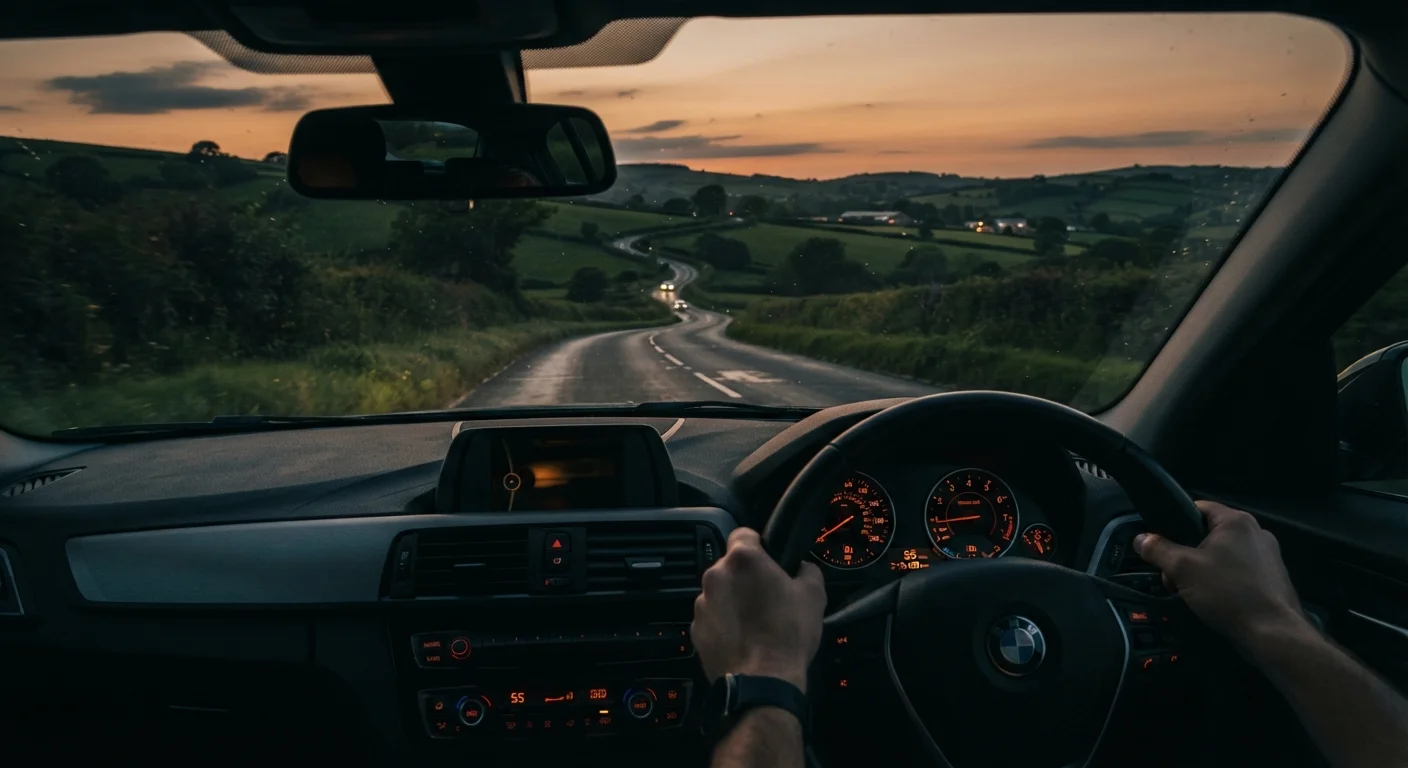
Why Corners Catch Drivers Out
Bends and curves are disproportionately represented in serious road collisions. Straight roads offer time to react and correct; corners compress that time, punish late braking, and expose gaps in a driver's speed judgement and forward vision. Most drivers who get into trouble on a bend aren't doing anything dramatically wrong - they've simply carried a habit from straight-road driving that doesn't transfer safely to cornering.
Understanding why misjudgements happen is the first step toward correcting them. The mistakes below are not reserved for new drivers - they show up across all experience levels. If you've ever felt a corner tighten unexpectedly, or found yourself running wide, at least one of these is likely familiar.
It's also worth noting that road conditions compound every error. Wet roads cut available grip significantly, meaning the same entry speed that felt fine on a dry day can exceed your tyres' limits when it rains.
Entering the bend at too high a speed.
Why it happens: Drivers often judge entry speed by how fast they've taken similar-looking bends before, without accounting for radius, surface condition, or reduced visibility. Familiarity breeds overconfidence.
Braking while the car is mid-corner.
Why it happens: When a bend tightens unexpectedly, the instinctive response is to brake. This is natural but counterproductive - the tyres are already working to handle lateral (sideways) forces, and adding braking force can exceed their grip limit.
Fixing your gaze too close to the front of the car.
Why it happens: At lower speeds and in familiar environments, drivers develop a habit of watching the road immediately ahead. On a curve, this narrows the time available to respond and causes the driver to react to the bend rather than anticipate it.
Taking a poor road position before the bend.
Why it happens: Drivers often hold a fixed lane position regardless of the corner geometry ahead, which can reduce visibility and tighten the effective radius they have to work with.
Underestimating how much grip changes on wet or uneven surfaces.
Why it happens: Drivers calibrate their speed to dry-road performance and don't always consciously adjust that reference point when conditions change. Tyres that feel secure on a dry bend may lose grip quickly on a damp, gravelly, or leaf-covered surface.
Building Better Cornering Habits
Correcting these errors doesn't require advanced driving training, though that can help. Most of it comes down to three disciplines: reading the road earlier, managing speed before the bend rather than during it, and keeping your eyes moving ahead of the car rather than fixed just in front of the bonnet.
~25%
Fatal crashes involving a curve or bend
U.S. Federal Highway Administration data consistently shows curves account for a disproportionate share of fatal crashes relative to their presence on the road network.
4x
Increase in centrifugal force doubling speed
Because cornering forces increase with the square of speed, doubling your speed through a bend requires four times the grip - a relationship most drivers underestimate.
A useful mental framework is slow in, fast out. Arrive at the entry point of the bend at a speed you're comfortable holding through the worst of the curve - not a speed you're hoping to scrub off mid-corner. This keeps the car balanced and gives you options if the bend tightens or something appears in the road ahead.
Forward vision matters enormously. On an unfamiliar road, treat any bend you can't see through as potentially tight. Signs, hedgerow angles, power line direction, and the vanishing point of the road itself all give clues about what's coming. The posted speed limit is a legal ceiling, not a guarantee of safety - on sharp rural bends, appropriate speed is often well below it.
Finally, recognise that good cornering habits erode over time. Overconfidence and routine shortcuts are the enemies of consistent, safe technique. Even experienced drivers benefit from periodically checking their own habits - not just on bends, but across all aspects of their driving.
Unknown Bends Deserve Extra Caution
On an unfamiliar road, you have no way to know whether a bend is a gentle sweep or a tight hairpin until you're already in it. Treat every blind or unfamiliar corner as potentially tighter than it appears. Arriving too slowly and finding it opens up costs nothing; arriving too fast and finding it tightens can be very serious.
The content on this site is for informational purposes only and is not a substitute for professional advice. Always consult a qualified professional for guidance specific to your situation.