

Option A
Posted Speed Limit
The legal maximum set by traffic engineers for ideal conditions.
Best for: Establishing a consistent, enforceable ceiling on public roads under normal circumstances.
Option B
Safe Speed
The driver-assessed speed appropriate for actual, real-time conditions.
Best for: Protecting yourself and others when weather, visibility, traffic, or road geometry demands extra caution.
What the Posted Limit Actually Tells You
Speed limit signs communicate the legal maximum for that stretch of road under normal, favorable conditions. Traffic engineers set these numbers after studying road geometry, sight lines, typical traffic volumes, and pedestrian activity. The limit is designed as a ceiling - not a target or a recommended cruising speed.
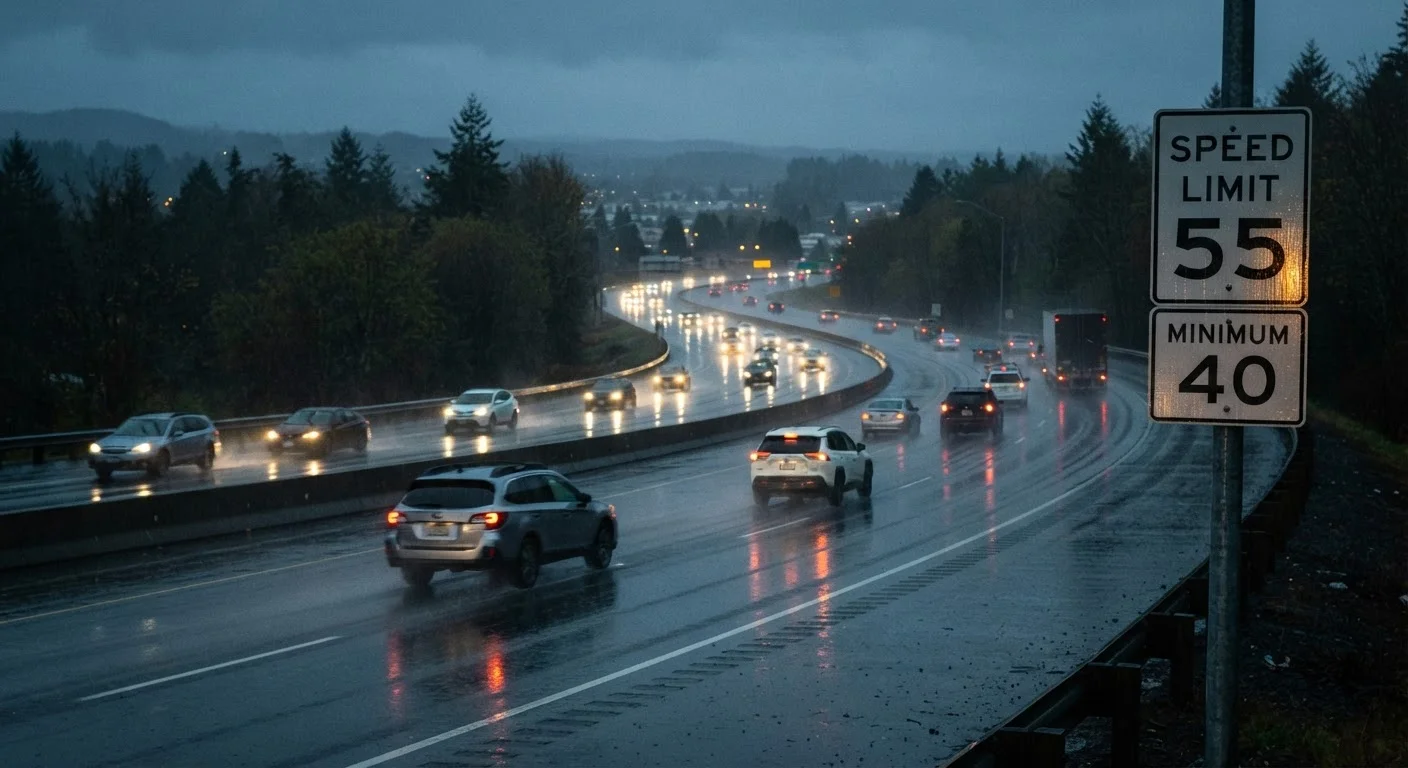
Crucially, limits are calibrated for conditions that don't always exist. A 55 mph highway limit assumes daylight, dry pavement, reasonable visibility, and alert drivers. When any of those variables change, the calculus shifts - but the sign doesn't.
US traffic law reinforces this. Most states include a "basic speed law" (sometimes called the reasonable and prudent standard), which requires drivers to travel at a speed appropriate for actual conditions, even if that means going below the posted limit. In short, the sign tells you the legal ceiling; your judgment must set the floor.
| Criterion | Posted Speed Limit | Safe Speed |
|---|---|---|
| Set by | Traffic engineers via study | Driver judgment in real time |
| Legal status | Enforceable legal maximum | Required by basic speed laws |
| Accounts for weather | No - assumes normal conditions | Yes - must reflect actual conditions |
| Changes with conditions | Only when sign is updated | Continuously, trip by trip |
| Driver action required | None - passively observed | Active situational assessment |
| Applies to curves/hazards | Partially - advisory signs separate | Yes - must reflect geometry and hazards |
When the Limit and Safe Speed Diverge
Several everyday scenarios create a gap between the posted number and a genuinely safe speed:
- Wet or icy roads: Wet pavement can more than double stopping distances. Ice can increase them by up to ten times. The limit doesn't change, but physics does.
- Reduced visibility: Fog, heavy rain, glare, or nighttime driving shrink the distance at which you can react to hazards. If you can't stop within the distance you can see, you're traveling too fast - regardless of the sign.
- Curves and bends: Posted advisory speeds on curves are separate from the road's main limit for a reason. Our guide to misjudging bends and curves explains why corner speeds catch drivers out far more often than straights.
- Heavy traffic or unpredictable drivers: Dense traffic compresses reaction time. Matching the limit in a stop-start situation may mean following too closely and leaving too little buffer.
- Towing or carrying heavy loads: Increased vehicle weight means longer stopping distances, which should translate to a lower working speed.
Stopping distances increase with the square of speed, not linearly - a detail most drivers underestimate. Going from 30 to 60 mph doesn't double your stopping distance; it roughly quadruples it.
4x
Stopping distance increase when speed doubles
Because stopping distance grows with the square of speed, doubling from 30 to 60 mph roughly quadruples the distance needed to stop - a relationship most drivers underestimate.
~2x
Stopping distance increase on wet pavement
Wet roads can more than double the stopping distance compared to dry conditions at the same speed, according to general road safety guidance published by transportation authorities.
Judging Your Own Safe Speed
Building the habit of speed assessment isn't about second-guessing every road sign. It's about developing a quick mental checklist before settling on your cruising speed:
- Road surface: Dry, wet, loose gravel, or packed snow each offer different levels of grip.
- Visibility: Can you see far enough ahead to stop if something appears? If not, slow down.
- Traffic density: More vehicles means more variables. Use appropriate following distance - and see our piece on the two-second rule and when to extend it for how that math changes in adverse conditions.
- Your own state: Fatigue and distraction slow reaction time. If you're not sharp, ease off.
- The road ahead: Intersections, school zones, construction, and curves all warrant reduced speed - often before you reach them.
None of this is about driving timidly. It's about matching your speed to reality rather than to a sign that was posted on a different day, in different conditions, by engineers who couldn't know what your drive would actually look like.
State Laws Vary on Speed Standards
While most US states include some form of a basic speed law requiring drivers to travel at a reasonable speed for conditions, the exact wording and enforcement differ by state. Some states also have minimum speed requirements on certain highways. If you're unsure about the rules in a specific state, consult that state's department of motor vehicles or official driver's handbook for precise language.
The content on this site is for informational purposes only and is not a substitute for professional advice. Always consult a qualified professional for guidance specific to your situation.