

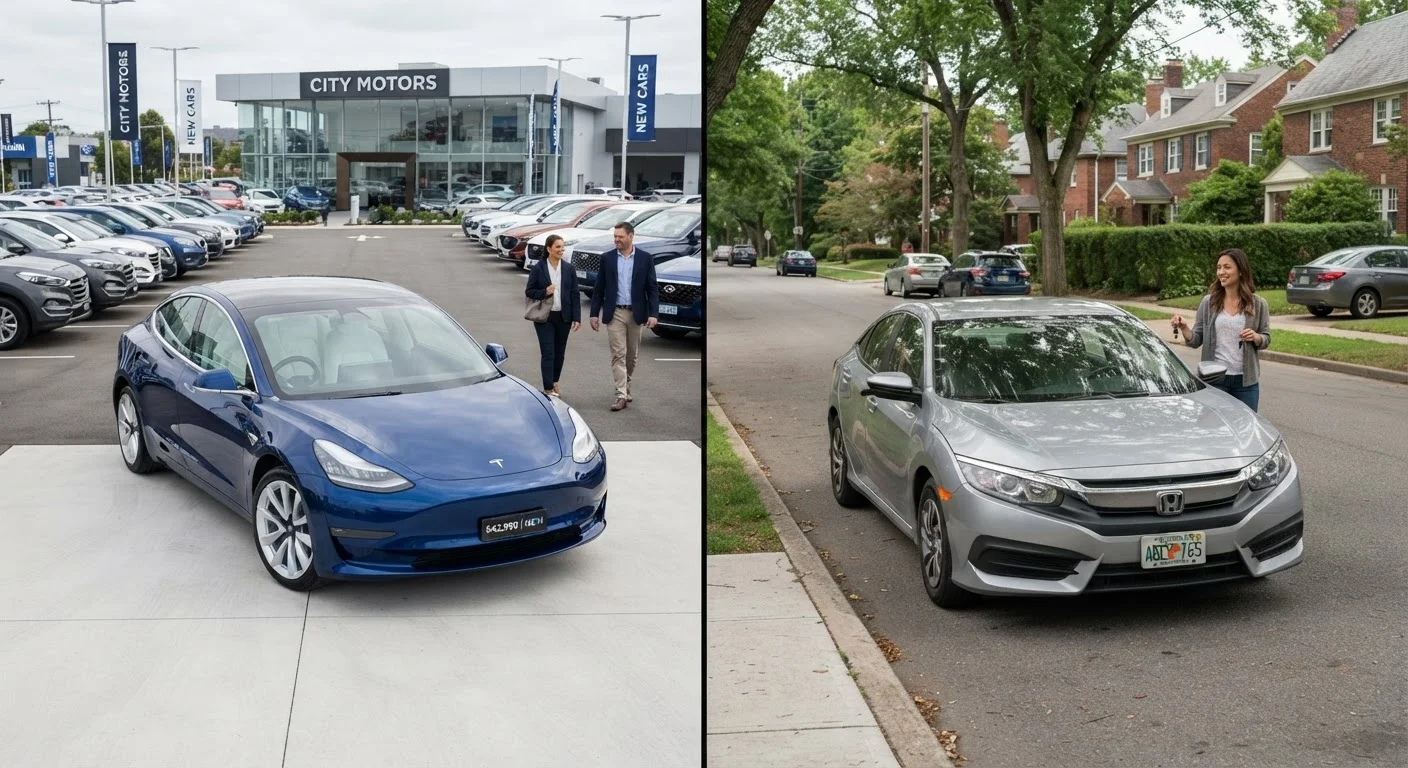
Option A
New Car
The full-warranty, zero-history option.
Best for: Buyers who prioritize warranty coverage, the latest safety features, and predictable near-term maintenance costs.
Option B
Used Car
The lower entry-cost, depreciation-aware alternative.
Best for: Budget-conscious buyers willing to accept some unknowns in exchange for a significantly lower purchase price.
The Depreciation Factor: Where New Cars Lose Ground Fast
Depreciation is the single biggest financial argument against buying new. A new vehicle can lose a significant portion of its value the moment it leaves the lot - commonly estimated in the range of 15-25% in the first year alone, though the exact figure varies by make, model, and market conditions. By year three, many vehicles have shed 40-50% of their original value.
For a used-car buyer, that curve works in their favor. Someone else has already absorbed the steepest loss. Depreciation affects every car owner, but buying a vehicle that is two to four years old lets you sidestep the most punishing portion of that decline.
New-car buyers aren't simply losing money, though - they're also getting a known history (zero), full manufacturer warranty, and typically the latest safety and emissions technology. The question is whether those benefits justify the premium over an equivalent used model.
~20%
Average first-year depreciation for new vehicles
Industry estimates commonly place new-car depreciation between 15-25% in year one, varying by make, model, and market demand.
40-50%
Value lost by year three on many new vehicles
Automotive valuation sources such as Edmunds and Kelley Blue Book have historically cited this range as a general benchmark for average vehicles.
Purchase Price, Financing, and Insurance Costs
The sticker gap between new and used is real, but so are the downstream cost differences. Used-car loans often carry higher interest rates than new-car loans, which can partially offset the lower purchase price, especially over longer loan terms. Lenders view used vehicles as higher-risk collateral, so the spread can be meaningful depending on credit profile and vehicle age.
Insurance costs also skew higher for new cars in most cases - comprehensive and collision coverage on a newer, higher-value vehicle generally costs more. Registration fees in many states are tied to vehicle value or model year, meaning a new car can cost noticeably more to register annually in its early years.
If you're weighing how you'll actually fund the purchase, our financing vs. paying cash comparison breaks down what each approach means for your overall cost. For a fuller picture of what ownership costs beyond the purchase, see the real cost of owning a car.
| Criterion | New Car | Used Car |
|---|---|---|
| Purchase price | Higher | Lower |
| First-year depreciation | Steep (15-25% typical) | Already absorbed by prior owner |
| Financing interest rate | Generally lower | Generally higher |
| Insurance cost | Typically higher | Typically lower |
| Warranty coverage | Full manufacturer warranty | Limited or none (CPO extends it) |
| Vehicle history | Zero - known from day one | Unknown; requires research |
| Latest safety tech | Current model-year features | Varies by model year |
| Registration fees | Higher in early years | Lower for older vehicles |
Warranty Coverage and Reliability Uncertainty
New cars come with manufacturer warranties - typically a bumper-to-bumper coverage period of three years or 36,000 miles, plus a powertrain warranty that often extends to five years or 60,000 miles. These figures vary by manufacturer. The practical value: most repair costs in those early years fall to the manufacturer, not you.
Used cars outside their original warranty leave buyers responsible for repair costs from the start. Reliability data and vehicle history reports (such as those from carfax or similar services) can reduce uncertainty, but they can't eliminate it entirely. Certified pre-owned (CPO) programs, offered by many manufacturers, include a dealer inspection checklist and an extended warranty - generally at a price above non-certified used vehicles but below new.
If you're considering a used car that's beyond its original warranty, it's worth understanding the trade-offs around extended coverage. Our honest look at extended warranties explains what they typically cover and where they often fall short.
What 'Certified Pre-Owned' Actually Means
CPO programs are run directly by vehicle manufacturers, not independently. Each manufacturer sets its own inspection standards, warranty terms, and mileage limits - so a CPO label from one brand may offer meaningfully different coverage than another. Always review the specific CPO terms for the vehicle you're considering, and don't assume CPO and 'dealer certified' are the same thing. 'Dealer certified' is a less regulated term and may not include a manufacturer-backed warranty.
Which Choice Actually Makes Financial Sense?
Neither option is universally better - it depends on how long you plan to keep the vehicle, how much reliability certainty you need, and what you can realistically afford each month. A new car held for ten or more years amortizes its depreciation hit over a long timeline, making the initial loss less dramatic on a per-year basis. A used car purchased at the right point on the depreciation curve can offer strong value, especially if bought with a clean history report and inspected by a trusted mechanic before purchase.
Leasing is a third path worth knowing about: our leasing vs. buying comparison covers the mechanics of that trade-off in detail. And if your household is deciding between running one car or two, the one-car vs. two-car household guide addresses the broader financial picture.
The most important step is calculating total cost of ownership - purchase price, financing interest, insurance, registration, expected maintenance, and resale value - for any specific vehicle you're considering, rather than comparing categories in the abstract.
The content on this site is for informational purposes only and is not a substitute for professional advice. Always consult a qualified professional for guidance specific to your situation.