

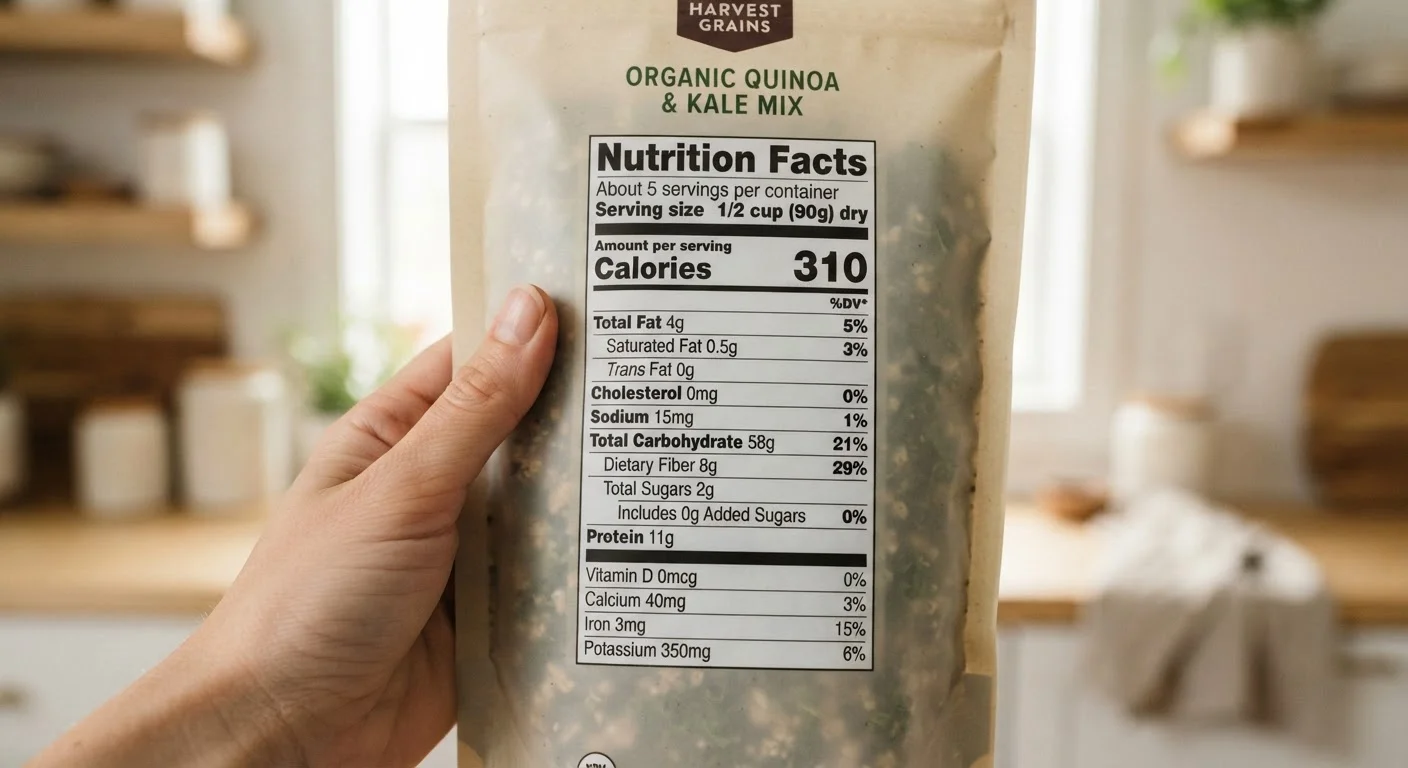
Why the Label Exists - and What It Actually Tells You
The Nutrition Facts panel is a federally standardized format required by the U.S. Food and Drug Administration on most packaged foods. Its purpose is straightforward: give consumers consistent, comparable information about what they are eating. The format was updated in 2020 to reflect current nutrition science, adding a dedicated line for added sugars and updating serving sizes to better reflect how people actually eat.
What the label does not do is tell you whether a food is good or bad for you outright. It provides raw data - grams, calories, percentages - that become meaningful only when you understand what you are looking at. If you want to build fluency with the underlying terminology, the nutritional glossary of key terms is a helpful companion reference.
What you will need
Nutrition labels are also just one layer of food information. Front-of-package claims like "natural," "light," or "multigrain" are marketing language and are not regulated as strictly as the Nutrition Facts panel itself. Learning to read the panel directly puts you past the marketing and into the actual data.
How to Read the Label Step by Step
Nutrition Facts Panel
The standardized label on packaged foods - the primary document you will be reading and interpreting.
Ingredients List
Found below or near the Nutrition Facts panel; lists every ingredient by descending weight.
Nutritional Glossary Reference
A reference for unfamiliar terms like 'saturated fat,' 'sodium,' or 'added sugars' you encounter on labels.
Start with the serving size
Every number on the label - calories, fat, sodium, vitamins - is based on one serving, not the whole package. Find the Serving Size line at the very top of the panel, and note the Servings Per Container line directly below it. If a bag of crackers lists a serving size as 15 crackers and you typically eat 30, every nutrient value doubles for your actual intake.
Read the calorie count in context
Calories appear prominently just below the serving information. This figure tells you how much energy one serving provides. Rather than treating this number in isolation, consider it alongside nutrient density - a food can be high in calories but rich in fiber, protein, and micronutrients, or low in calories but nutritionally sparse. For a broader view, see how calorie count compares to nutrient density.
Scan the nutrients to limit
The label highlights several nutrients that most Americans tend to consume in excess: saturated fat, trans fat, sodium, and added sugars. High intake of these is associated with increased risk of cardiovascular disease and other health concerns, according to established dietary guidelines. Look at the gram amounts and the % Daily Value column alongside them.
Check the nutrients to prioritize
Below the nutrients to limit, the label lists nutrients that many people fall short on: dietary fiber, vitamin D, calcium, iron, and potassium. A higher % Daily Value here is generally a positive signal. Dietary fiber in particular plays an important role in digestive health and satiety - learn more about why fiber is frequently underestimated.
Understand % Daily Value
The % Daily Value (%DV) column tells you what percentage of a nutrient's recommended daily intake one serving provides, based on a general 2,000-calorie reference diet. It is a comparison tool, not a precise personal target. Use the 5%/20% benchmark: 5% DV or less is low; 20% DV or more is high. This makes it easy to compare products side by side without converting grams to percentages yourself.
Read the ingredients list
Ingredients are listed in descending order by weight, so whatever appears first makes up the largest proportion of the product. A food whose first ingredient is whole grain, a vegetable, or a protein source is structured differently from one where sugar or refined flour leads the list. The ingredients list also reveals additives, preservatives, and allergens not obvious from the nutrient numbers alone. For context on what whole-food versus heavily processed products look like at the ingredient level, see the distinction between whole and ultra-processed foods.
Use the 5% and 20% Rule of Thumb
A % Daily Value of 5% or less is generally considered low for a nutrient; 20% or more is considered high. This quick benchmark helps you scan a label in seconds without doing any math. It applies to most nutrients - saturated fat, sodium, fiber, calcium, and more.
Watch for Misleading Serving Sizes
Some packages that appear single-serving actually contain two or more servings. If you eat the whole package, multiply every number on the label by the number of servings listed. This is one of the most common ways that calorie and nutrient counts appear lower than they really are in real-world consumption.
Labels Reflect General Guidance, Not Personal Prescriptions
The % Daily Values on Nutrition Facts panels are based on a general 2,000-calorie daily diet and do not account for individual health conditions, age, activity level, or medical needs. Use this information as a general reference point. If you have a specific health condition or dietary requirement, consult a registered dietitian or your healthcare provider for personalized guidance.
Once you have worked through the panel, take a moment to compare what you found against your overall eating pattern that day. A single food's label rarely tells the whole story - what matters most is the cumulative picture across meals. For a framework on putting meals together using this kind of nutritional awareness, see practical plate-building frameworks.
If you are new to thinking about nutrition more broadly, a foundational guide to nutrition covers the core concepts - macronutrients, micronutrients, and balance - in accessible terms that complement what you have learned here.
This article is for general informational and educational purposes only and is not a substitute for professional medical or dietary advice. Consult a qualified healthcare provider or registered dietitian before making significant changes to your diet, especially if you have an existing health condition.
The content on this site is for informational purposes only and is not a substitute for professional advice. Always consult a qualified professional for guidance specific to your situation.