

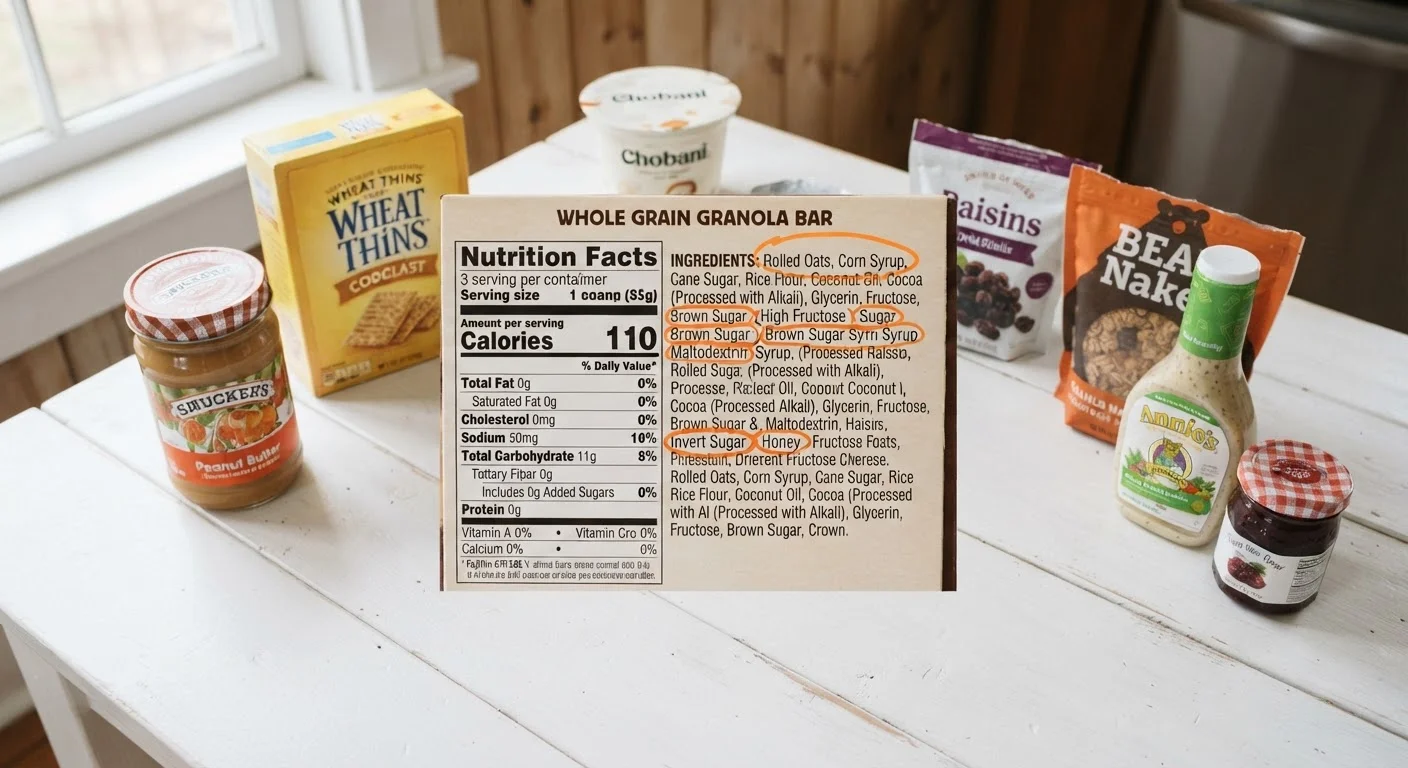
Why Sugar Has So Many Names
Ingredient lists on packaged foods are required by the FDA to name every ingredient - but there's no rule saying all forms of added sugar must be grouped under a single term. Manufacturers use a wide variety of sweeteners, each with a chemically distinct name. The result: a single product can contain added sugar in three or four forms without the word "sugar" appearing more than once, if at all.
This isn't necessarily intentional deception, but it does make it harder to get a clear picture of how much added sugar a product contains. Understanding the vocabulary is the first practical step to reading labels more confidently. For a broader guide to decoding nutrition facts panels, see Reading a Nutrition Label Without Getting Lost.
| Number of sugar aliases | 60+ (Commonly cited across nutrition education resources) |
| Added Sugars label required by | FDA (most manufacturers, as of 2020) (FDA Nutrition Facts label update) |
| Daily Value reference for added sugars | 50 grams (based on 2,000-calorie diet) (FDA % Daily Value basis) |
| DGA recommended limit | Less than 10% of total daily calories (Dietary Guidelines for Americans) |
| Ingredient list order | By weight, highest to lowest (FDA labeling regulations) |
A Reference List of Common Sugar Aliases
The list below covers the most frequently appearing added-sugar names across US packaged food products. It is organized by category to make patterns easier to recognize.
Syrups
- High-fructose corn syrup (HFCS)
- Corn syrup / corn syrup solids
- Brown rice syrup
- Malt syrup / barley malt syrup
- Maple syrup
- Agave syrup (also labeled agave nectar)
- Tapioca syrup
"-ose" Sugars
- Sucrose (table sugar)
- Fructose (fruit sugar)
- Glucose
- Dextrose
- Maltose
- Lactose (naturally occurring in dairy - listed here for completeness)
- Galactose
"Natural" and Minimally Processed Sugars
- Honey
- Molasses / blackstrap molasses
- Coconut sugar / coconut palm sugar
- Date sugar / date paste / date syrup
- Turbinado, Demerara, or raw sugar
- Evaporated cane juice / cane sugar / cane juice
Other Common Terms
- Invert sugar
- Caramel / caramel color
- Fruit juice concentrate
- Treacle
- Beet sugar
If any of these appear near the top of an ingredient list - ingredients are listed by weight, from most to least - the product likely contains a significant amount of added sugar.
Added sugars
Sugars and syrups added to foods or beverages during processing or preparation, as opposed to sugars occurring naturally in foods like fruit or dairy. They appear as a distinct line on the updated FDA Nutrition Facts label.
High-fructose corn syrup (HFCS)
A liquid sweetener made by converting some of the glucose in corn syrup into fructose. It is widely used in processed foods and beverages and is chemically similar in composition to sucrose.
Sucrose
The scientific name for common table sugar, composed of equal parts glucose and fructose. It is derived from sugarcane or sugar beets and is one of the most common added sugars in packaged foods.
Invert sugar
A mixture of glucose and fructose created by breaking down sucrose, often used in baked goods and confections to retain moisture and extend shelf life.
Fruit juice concentrate
Juice from which most of the water has been removed. When added to foods as a sweetener, it contributes added sugars even though it originates from fruit.
% Daily Value (% DV)
A reference percentage on nutrition labels showing how much a nutrient in a serving contributes to a daily diet based on a 2,000-calorie reference. A % DV of 5% or less is considered low; 20% or more is considered high.
What the "Added Sugars" Line on the Label Actually Tells You
Since 2020, the updated FDA Nutrition Facts label requires most manufacturers to list Added Sugars in grams and as a percentage of the Daily Value (% DV) beneath the Total Sugars line. This was a significant update because it separates sugars inherent to food - such as lactose in milk or fructose in whole fruit - from sugars introduced during processing or preparation.
The % DV for added sugars is based on a reference intake of 50 grams per day for a 2,000-calorie diet. The DGA and the American Heart Association both suggest limiting added sugar intake, though their specific guidance differs. The DGA recommends keeping added sugars below 10% of total daily calories. The AHA recommends lower limits, particularly for children. Always consider these as general population-level references, not personal prescriptions - individual needs vary, and a registered dietitian can help you apply guidance to your own situation.
17 tsp
Average daily added sugar intake for US adults
According to National Health and Nutrition Examination Survey (NHANES) data analyzed by the CDC.
10%
Recommended added sugar ceiling (of daily calories)
Per the Dietary Guidelines for Americans, which is issued jointly by the USDA and HHS.
74%
US packaged foods containing added sugar
Estimate based on a study published in the journal Lancet Diabetes & Endocrinology (2016) analyzing US food supply.
Understanding this line alongside the ingredient list gives you a more complete picture. For a deeper look at how nutrition label terminology can trip readers up, see our article on navigating nutrition confusion.
A Practical Approach to Label Reading
Knowing the names is useful; knowing how to apply that knowledge quickly is more useful. A few practical habits can help:
- Check the Added Sugars line first. It gives you the aggregate number in grams without requiring you to identify every sugar alias in the ingredient list.
- Scan the first five ingredients. Because ingredients are listed by weight, a sugar appearing in the top five signals it is a major component - regardless of what it's called.
- Count sugar entries. If you spot two, three, or four sugar aliases spread through the ingredient list, be aware that their combined contribution may be higher than any single entry suggests.
- Compare serving sizes. A serving size listed as a small portion can make the added sugars figure appear low. Always assess it in the context of how much you actually eat.
Labels are one tool among many. Whole, minimally processed foods rarely carry ingredient lists at all - which is itself informative. For related context on how nutrients are described and categorized, explore our nutritional glossary of key terms.
This article is for general informational and educational purposes only and does not constitute medical or dietary advice. Consult a qualified healthcare professional or registered dietitian before making changes to your diet, especially if you have a health condition.
The content on this site is for informational purposes only and is not a substitute for professional advice. Always consult a qualified professional for guidance specific to your situation.