

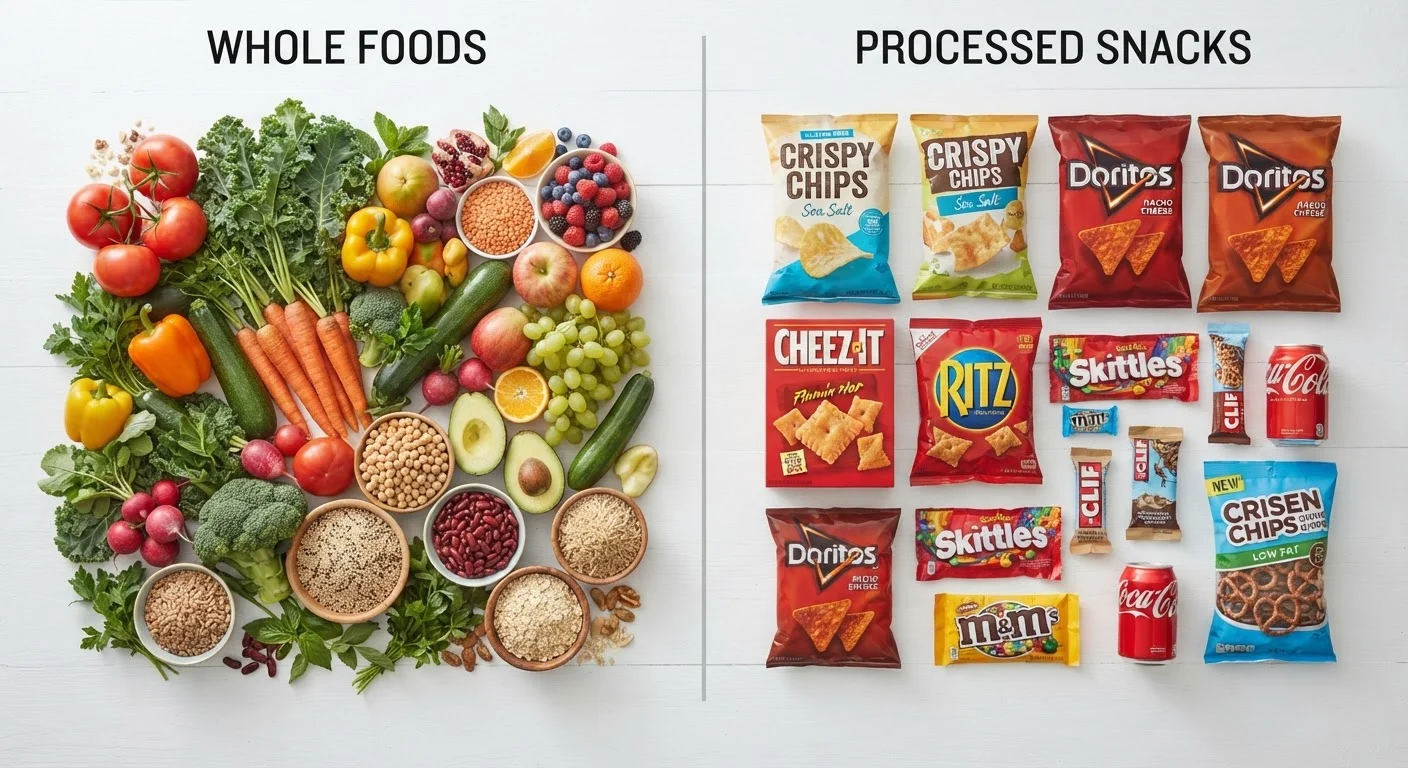
Option A
Whole Foods
Minimally altered, nutrient-dense foods as nature produces them.
Best for: People aiming to maximize nutrient density and support long-term metabolic and digestive health.
Option B
Processed Foods
A broad, varied category shaped by how much human intervention changes a food.
Best for: Understanding the spectrum of processing helps any eater make more informed, flexible dietary choices.
Defining the Terms: What 'Whole' and 'Processed' Actually Mean
The word whole food refers to a food that is eaten in or very close to its naturally occurring form - think an apple, a handful of lentils, a piece of salmon, or a raw walnut. Little to no industrial transformation has taken place between harvest and your plate.
Processed food, by contrast, describes any food that has been altered from its natural state through methods such as cooking, drying, fermentation, canning, or the addition of ingredients. Under this definition, pasteurized milk, canned tomatoes, and rolled oats are technically all processed - but so are chips, packaged cookies, and flavored beverages loaded with additives.
This is why researchers developed the NOVA classification system, which groups foods into four categories based on the extent and purpose of processing - from unprocessed or minimally processed foods (Group 1) to ultra-processed formulations (Group 4). Ultra-processed foods (UPFs) are defined by the presence of ingredients rarely found in a home kitchen: emulsifiers, flavor enhancers, hydrogenated oils, high-fructose corn syrup, and artificial colors, among others.
Understanding this spectrum is essential before drawing any conclusions. As nutrition guidance can be contradictory, lumping all processed foods together as equally harmful oversimplifies the science.
How Processing Affects Nutritional Value
The nutritional impact of processing depends heavily on what methods are used and what is added or removed in the process.
What whole foods offer
Whole foods deliver nutrients in their native matrix - the physical structure of a food that affects how its components are digested and absorbed. Fiber in whole grains, for example, slows glucose absorption and feeds beneficial gut bacteria. Phytonutrients in fresh vegetables may have antioxidant or anti-inflammatory properties, though research into exact mechanisms is ongoing.
What processing can remove or diminish
Refining grains into white flour strips away the bran and germ, reducing fiber, B vitamins, iron, and magnesium. High-heat processing can degrade heat-sensitive vitamins such as vitamin C and certain B vitamins. Juicing removes fiber from fruit, concentrating sugars while eliminating a key beneficial component.
What processing can add - for better or worse
Some processing is deliberately nutritive: iodized salt addresses iodine deficiency; fortified cereals restore B vitamins stripped during milling; pasteurization eliminates dangerous pathogens. On the other hand, ultra-processed products often add large amounts of sodium, refined sugars, and saturated or trans fats to improve taste, texture, and shelf life - ingredients that, in excess, are associated with cardiovascular and metabolic health concerns.
| Criterion | Whole Foods | Processed Foods |
|---|---|---|
| Definition | Eaten in or close to natural form | Altered by industrial or culinary methods |
| Fiber content | Generally preserved and intact | Often reduced; stripped in ultra-processed versions |
| Micronutrient retention | High - minimal processing loss | Variable; some fortified, others depleted |
| Added sugar / sodium | Naturally low or absent | Often added, especially in ultra-processed foods |
| Convenience / shelf life | Shorter shelf life; preparation required | Longer shelf life; ready to eat or quick to prepare |
| Cost and accessibility | Can vary; fresh produce may cost more | Often lower cost and widely available |
| Research association | Linked to favorable long-term health outcomes | Ultra-processed linked to elevated disease risk; minimally processed generally neutral |
For a closer look at how to assess what's actually in a packaged product, learning to read nutrition labels is a practical next step.
What the Evidence Shows - and Where It's Still Evolving
A substantial and growing body of observational research links high consumption of ultra-processed foods to increased risk of obesity, type 2 diabetes, cardiovascular disease, and certain digestive conditions. A 2019 study published in The BMJ found that a 10% increase in ultra-processed food consumption was associated with elevated cardiovascular disease risk - though the study, like most in nutrition epidemiology, could not establish direct causation.
57%
Share of US calories from ultra-processed foods
Research published in BMJ Open estimated that ultra-processed foods account for approximately 57% of total daily caloric intake in the average American diet.
10%
UPF increase linked to cardiovascular risk
A large cohort study published in The BMJ (2019) found a 10% rise in ultra-processed food consumption was associated with significantly higher cardiovascular disease incidence.
~28g
Recommended daily dietary fiber (adults)
The U.S. Dietary Guidelines for Americans recommend approximately 28 grams of dietary fiber per day for a standard 2,000-calorie diet - a target most Americans fall well short of.
Importantly, the research does not uniformly condemn all processed foods. Fermented dairy such as plain yogurt, minimally processed whole-grain bread, and canned fish are consistently associated with neutral or positive health outcomes in dietary studies. What matters most appears to be degree of processing and the overall dietary pattern - not whether a food has been touched by any industrial process at all.
Diet quality, as most researchers and registered dietitians emphasize, is best evaluated across the full week of eating, not meal by meal. Seeing how balance plays out over a week is a more realistic and actionable framework than chasing perfection at each meal.
Not All Processing Is Equal
Freezing vegetables, fermenting milk into yogurt, and canning beans are forms of processing that generally preserve or have minimal effect on nutritional value. The NOVA classification system distinguishes these from ultra-processed formulations, which are engineered primarily for palatability and shelf life. When evaluating a food, consider the ingredient list and the degree of transformation, not just whether processing occurred at all.
This article is for general informational and educational purposes only and is not a substitute for personalized medical or dietary advice. Consult a registered dietitian or qualified healthcare professional for guidance specific to your health needs and circumstances.
The content on this site is for informational purposes only and is not a substitute for professional advice. Always consult a qualified professional for guidance specific to your situation.